Splitting Bills When You're Dating vs Engaged vs Married (It Changes)
How couples split bills changes as the relationship deepens. Here's a stage-by-stage guide from dating to married, with what's normal at each step.

Anna
Supasplit Team
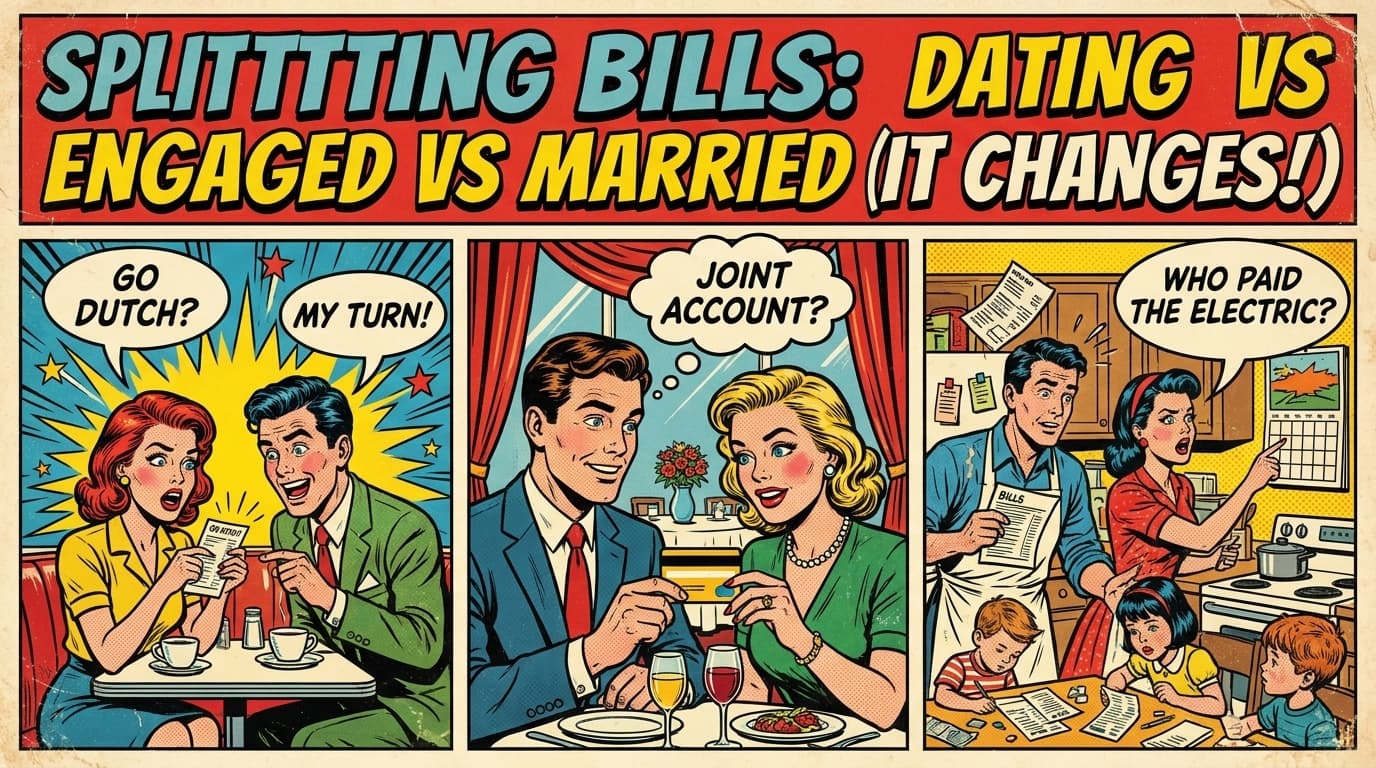
How couples split bills isn't static. What's normal at three months of dating is weird at three years. What's normal at two years of marriage is weird at year ten.
Most couples drift through these transitions without explicitly renegotiating. That's how you end up with the splits-not-matching-stage problem, where one partner is still operating like you're roommates and the other is operating like you're partners.
Here's a stage-by-stage map. Use it to figure out where your money split actually is, and whether it matches where your relationship is.
Stage 1: Casual dating (under 6 months)
Money is usually fully separate. You each pay your own bills, your own rent, your own food. The shared expenses are:
- Dates you go on together
- Occasional shared activities (concerts, trips)
- Shared subscriptions if you're really into each other (rare this early)
Date payment norms:
Older convention was "whoever initiated the date pays." Increasingly common is "split or alternate." Both work. Choose what feels right for you and bring it up explicitly.
If you've been doing the alternating thing for a few months, that's a working system. If one of you has been quietly carrying the date budget for months, that's a frustration about to bubble up. Address it.
More on this in our who pays on dates breakdown.
Trips together early:
Usually split as a friends-trip, because that's effectively what it is. Equal share of accommodation, split groceries, alternate paying for meals. Casual dating money rules apply.
Stage 2: Seriously dating (6 months to 1 year)
Money starts to mingle more, but the structure stays mostly separate.
Things that might shift:
- One of you covers your shared streaming subscriptions (Netflix, Spotify) and the other reimburses, or you split per-service.
- Gifts, restaurants, and outings are more loosely tracked. Less "you paid last time" math.
- If one of you cooks for both regularly, the other contributes to groceries.
Vacation costs:
Still mostly equal share, but adjusted for affordability differences. If one partner makes significantly more, they might cover more of an expensive trip, especially if they suggested it.
The trip-with-different-budgets framework applies even for couples.
Stage 3: Living together, unmarried (any duration)
Moving in together is the biggest money transition couples make short of marriage. Suddenly there's shared rent, shared utilities, shared groceries, shared everything domestic.
The defining question at this stage: how do we split shared expenses?
Three common approaches (all valid):
Approach A: 50/50 on everything.
Clean and simple. Works best when you make similar incomes. Falls apart when one partner makes substantially more and 50% of shared costs is a much bigger share of their salary than yours (or vice versa).
Approach B: Proportional to income.
Each partner contributes to shared expenses proportional to their income. If you make 60% of the combined income, you cover 60% of shared rent and bills.
Works well when incomes are uneven. Requires sharing income information openly. Some couples find this awkward in the dating phase, normal in the engaged/married phase.
Approach C: Yours, mine, and ours.
Each partner keeps separate personal accounts, plus you have a joint account for shared expenses. Each contributes a set amount monthly to the joint, which covers rent, utilities, groceries, etc. Personal accounts cover everything else.
The shared contribution can be 50/50 or proportional to income. Often considered the best of both worlds.
More on this in our joint vs separate accounts deep dive.
Stage 4: Engaged
The engagement period is the natural moment to talk about money seriously, before the legal and financial entanglement of marriage.
Conversations that should happen during engagement:
- Income, debts, credit scores
- How we'll handle money post-wedding (joint, separate, hybrid)
- Major financial goals (house, kids, retirement)
- Wedding cost-splitting (with parents, between partners)
- Prenup or no prenup
Logistically, bill-splitting during engagement usually stays the same as the cohabiting phase. The conversations shift; the actual splits often don't.
Wedding cost-splitting between partners specifically: see our wedding splitting guide for the breakdown.
Stage 5: Married, early years (1-3 years)
Marriage transitions are highly individual. Some couples merge finances on day one. Some keep separate accounts for years. Some never fully merge.
What changes legally:
- Tax filing options (joint vs. separate)
- Inherited debts and assets (state-dependent)
- Healthcare, insurance, and death benefits
- Estate planning
What changes practically:
- Most couples move toward more shared finances (joint accounts grow, separate accounts shrink).
- Big expenses (down payments, weddings, vacations) are shared.
- Income disparities matter less because most or all money is pooled.
Most early-marriage couples land on:
- Joint account for shared expenses
- Separate accounts for personal spending
- Both contribute proportionally or jointly to shared
Fully merged accounts (no separate accounts at all) is uncommon early on. Becomes more common after kids or after several years of partnership.
Stage 6: Married, long-term (3+ years)
This is where the variance is widest. Some couples are fully merged at this stage. Some have evolved their hybrid system. Some have been separately-accounted forever.
Things that often happen with time:
- Big shared assets accumulate (home equity, retirement accounts, joint investments).
- One partner may pause or reduce earnings (kids, education, career change).
- Inheritance, gifts, and individual financial events make pure 50/50 feel arbitrary.
- The household has to make decisions as a unit (move, refinance, school choice).
Long-term married couples usually:
- Have substantial joint accounts and shared assets
- Make most financial decisions together
- Track personal spending less and household-level spending more
- Have explicit agreements about high-impact decisions (anything over $X amount needs both partners)
What if the stages don't match between partners?
The most common conflict isn't "how do we split bills." It's "my partner thinks we're at stage X and I think we're at stage Y."
Specifically:
- One partner expects to merge accounts after marriage; the other wants to stay mostly separate.
- One partner contributes more out of unstated commitment; the other doesn't realize and doesn't reciprocate.
- One partner has been quietly tracking who pays for what for two years.
None of these are about money. They're about expectations. The money is the visible symptom.
The fix is a structured conversation: "What do you think our money setup should look like at this stage? What does it look like now? What do we want to change?"
More on running this conversation in our couples money check-in guide.
Big life events that shift the math
Certain events naturally trigger a money-setup conversation. Use them:
- Moving in together
- Engagement
- Marriage
- Buying a home
- Having a child
- One partner pausing work
- Inheritance or windfall
- One partner finishing school and starting their career
- Major shift in income for either partner
When any of these happens, schedule a money check-in. Even if you decide to keep the current setup, the explicit conversation matters.
TL;DR
- Splitting bills isn't a fixed system. It evolves through dating, cohabiting, engagement, and marriage.
- Casual dating: fully separate. Shared dates, alternate or split.
- Living together: pick a method. 50/50, proportional, or yours-mine-ours. All valid.
- Engagement: have the big money conversation. Income, debts, goals, prenup.
- Married early: most couples evolve to a hybrid joint+separate system.
- Married long-term: substantially merged, with explicit thresholds for big decisions.
- The biggest issues come from mismatched expectations, not income differences. Have the conversation.
Frequently asked questions
Should couples split bills 50/50 when living together?
Only if your incomes are similar. 50/50 feels fair on paper but becomes lopsided when one partner makes substantially more, because 50% of shared expenses is a much bigger chunk of the lower earner's income. Proportional-to-income or yours-mine-ours hybrid setups are usually fairer for couples with uneven incomes.
How do couples split bills during engagement?
Logistically, the split usually stays the same as the cohabiting phase. What changes is the conversation: engagement is the natural moment to discuss debts, credit scores, long-term financial goals, wedding costs, and whether you want to merge finances after the wedding. The big talks happen now, the actual splits often don't change yet.
Should we merge our accounts after we get married?
Not necessarily. Most modern married couples land on a hybrid: a joint account for shared expenses, separate accounts for personal spending. Fully merged accounts (one account for everything) is less common than it used to be. The right answer depends on how each partner relates to money and what level of shared visibility you both want.
When should we change how we split bills?
Anytime a major life event happens: moving in together, engagement, marriage, buying a home, having a child, one partner pausing work, significant income change, or inheritance. These naturally trigger a money-setup conversation. Even if you keep the current arrangement, the explicit check-in matters.
What if my partner and I disagree about how to split bills?
Often the disagreement isn't about the math, it's about which stage of the relationship each of you thinks you're in. Have a structured conversation: what does your current money setup look like, what would you each want it to look like, where's the gap? Most of these conflicts are really expectation mismatches showing up as money symptoms.