Date Night Math: Who Pays, Who Splits, When to Treat
Who pays on dates, in 2026? The honest, unawkward guide to splitting, treating, and alternating, from first date to year ten of marriage.

Anna
Supasplit Team
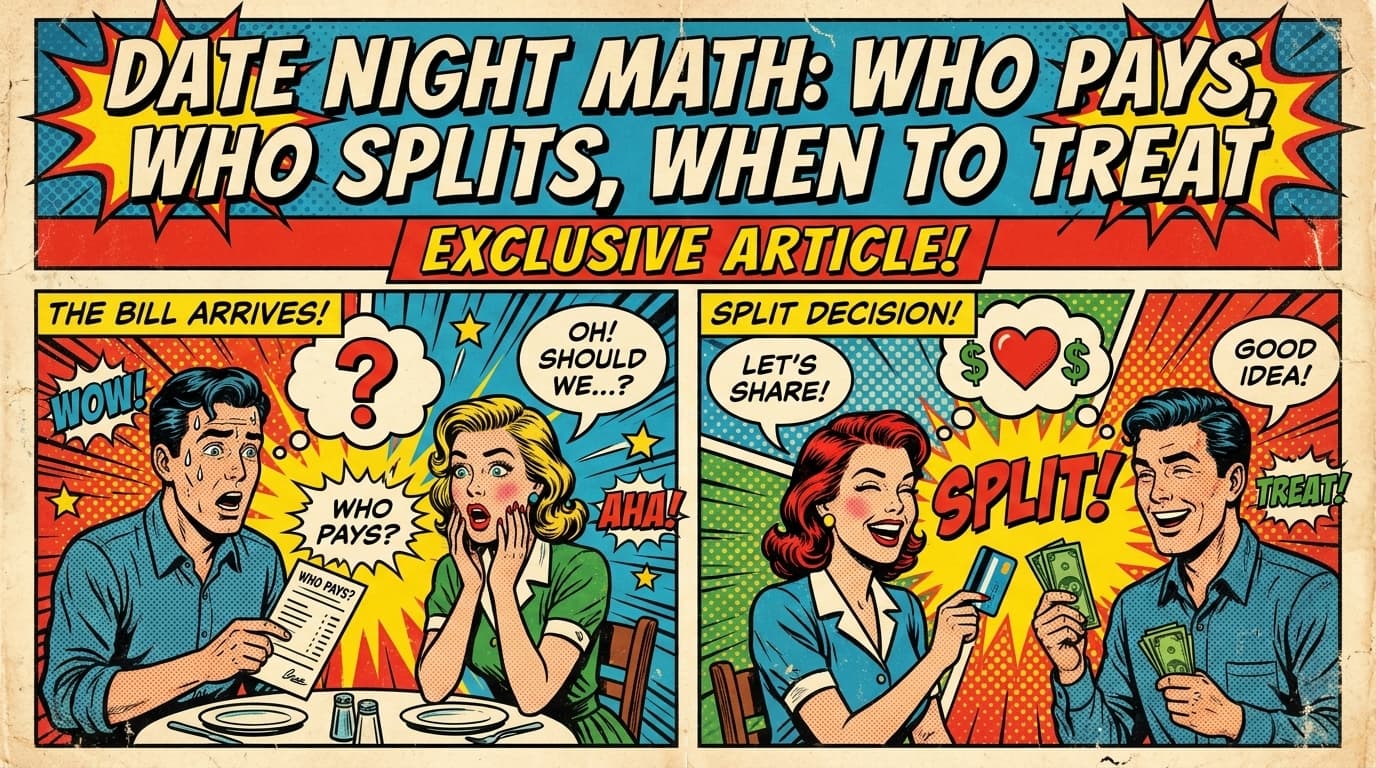
The check lands on the table. You both look at it. There's a very small, very specific five seconds where neither of you wants to move first.
This is the most-Googled micro-awkward of modern dating, and it's not actually one question. "Who pays on dates" changes answer depending on which date you're on, how long you've been together, and whether money is a shared thing yet or still two separate worlds.
Here's the complete answer, by stage.
First date: the clean rule
Default: whoever did the asking pays for the first date.
Not because of gender, not because of tradition, but because it's a low-friction signal. Inviting someone is already a small risk. Paying for their drink or coffee is a tiny reciprocal gesture that says "I meant it."
The invited party should reach for their wallet, half-heartedly, and accept graciously when the inviter insists. That's the whole dance.
Exceptions:
- Explicit splitting upfront. If the person you're meeting says "let's split" before the date, take them at their word and split.
- One of you is clearly broke. Don't make them expense a $60 dinner. Pick somewhere cheaper, or be gracious.
- You deliberately picked somewhere expensive. Your call. You pay.
Dates 2-5: reciprocation mode
By date two, you want to establish a rhythm. The cleanest one:
You alternate. They picked up date 1, you pick up date 2. They get date 3. You get date 4.
This takes the edge off every bill moment. Nobody is being "treated." Nobody is keeping score. You're just taking turns.
Alternatives that also work:
- Whoever invited pays, each time. Works if you're roughly matched in inviting energy. Breaks if one of you invites way more often.
- Split every time. Fine, but it skips the warmth of treating. Some people love this, some find it clinical.
- Activity-based. If one of you suggested an expensive activity (nice dinner, tickets, something they specifically wanted), they pay for that one. The other person picks a lower-key next date and covers it.
By the fifth-ish date, you should know the rhythm. If you don't, have the conversation: "How do you want to do the money thing?" That's a normal, not weird, thing to ask.
The awkward cases in early dating
Big income gap. If you know your date earns significantly more or less than you, adjust. The higher earner treating a little more often is fine, as long as it's not a running tally. The lower earner picking something cheaper for their turn is also fine.
You disagree about the rhythm. One of you wants to alternate, the other wants to split. Split is the safer compromise until you know each other better. You can evolve to alternating later.
One of you is traveling. If one person came to the other's city, the host tends to pay a bit more. It's a courtesy, not a law.
Group dates. If you're out with friends, you each cover your own bills or your share of a group bill. Don't "treat" each other in front of the group, it turns into a performance.
Long-term relationships: money gets weirder, not simpler
Once you're in a serious relationship, the question changes. It's no longer "who pays" for a specific date, it's "whose money is paying" for your date life overall.
Three real models:
Model 1: rotating, but from separate accounts
You alternate who taps their card. Both of you are spending your own money. Only works if your date-night spending is roughly symmetrical over time.
Breaks when: one of you starts planning nicer, pricier dates and the other plans cheaper ones. The "rotating" equality is fake if the amounts differ a lot.
Model 2: date nights come out of shared money
If you're yours-mine-ours, "date night" is a shared expense category. One of you pays at the restaurant but it gets logged as shared, not kept personal.
This is the cleanest model for most cohabiting couples. It removes the who-pays micro-decision entirely. The card used doesn't matter because the money was already pooled.
Model 3: one of you treats, explicitly
For anniversaries, birthdays, or a "I'm planning a surprise" moment, one person fully treats with their own money. That's not a split. That's a gift.
Healthy long-term couples do a mix: most dates come from shared money, but there are regular moments of individual treating that feel like actual treats, not shared pool withdrawals.
The "I want to treat you" problem
Sometimes one partner wants to treat, and the other pushes back ("let me pay, it's your birthday"). This can turn into a weird back-and-forth.
The rule: if someone says "let me treat you," let them, once. Say thank you. Don't fight about it. Then treat them back on the next appropriate occasion.
People who reject every treat are performing independence in a way that nobody is scoring. Let yourself be taken care of sometimes. Return the gesture when it's your turn.
The very practical "we owe each other" problem
If you're a newer couple or you're keeping finances fully separate, small date-related amounts build up fast. Movie tickets, cab back, snack at the grocery store.
Two options for handling it:
- Don't track micro-amounts. Anything under a threshold (say, $20) just gets absorbed. It roughly evens out.
- Use a split tracker. Everything gets logged, you settle up weekly or monthly with one transaction.
Both work. What doesn't work: Venmoing each other $11 for a movie ticket. That's the universe telling you to pick a better system.
Year 5+ in a relationship: the vibe shift
At some point, "who paid for dinner" stops being a meaningful question. You're sharing a life, not a ledger. Most long-term couples drift into Model 2 (shared pool) without realizing it.
If you're still mentally tracking who paid at year five, it's usually not because money is the issue, it's because something else is. A conversation about the bigger pattern, not the specific bills, is usually more useful than another round of "I paid last time."
TL;DR
- First date: inviter pays as default. The other person offers to split and accepts gracefully when refused.
- Dates 2-5: alternate turns. Clean, low-friction, not a scorecard.
- Long-term: date nights come from shared money, usually. That removes the micro-awkward from every dinner.
- Let people treat you. Graciously accept, graciously return.
- Mentally tracking every date-night dollar at year five is a signal, not a math problem.
Frequently asked questions
Who pays on a first date?
Default: whoever did the asking. The invited person offers to split or pay, the inviter insists and covers it. It's a low-friction signal of genuine interest, not a traditional gender rule. Exceptions: if you agreed upfront to split, or if one person picked somewhere deliberately expensive.
Should you split the bill on dates?
Splitting every time is fine but can feel clinical. Most healthy dating rhythms alternate who pays (one picks up this date, the other gets the next). In long-term relationships, date nights usually come from shared money, so the card used doesn't really matter.
Who should pay when one person earns significantly more?
The higher earner treating a bit more often is fine if it doesn't become a running tally. The lower earner can pick cheaper spots for their turns. What matters is that neither person feels like charity or like they're always fronting. For long-term couples, moving to a shared-pool model usually solves this cleanly.
Is it okay to split 50/50 on every date?
In early dating, yes, especially if both of you prefer it. In long-term relationships, splitting 50/50 at every date night is often a signal that finances feel more separate than the relationship actually is. Worth a conversation, not a panic. Shared-money setups usually feel more natural by year 2 or 3.
How do couples handle small shared expenses on dates?
Either ignore anything under a threshold ($20 or so) and trust it to roughly even out, or use a split-tracking app to log everything and settle up monthly in one transaction. What doesn't work: Venmoing each other $11 for a movie ticket. That's the universe telling you to pick a better system.