Joint Account, Separate, or Yours-Mine-Ours? The Honest Comparison
Joint vs separate accounts for couples, fully compared. When each setup works, when it breaks, and how to pick the one that matches how merged your lives actually are.

Anna
Supasplit Team
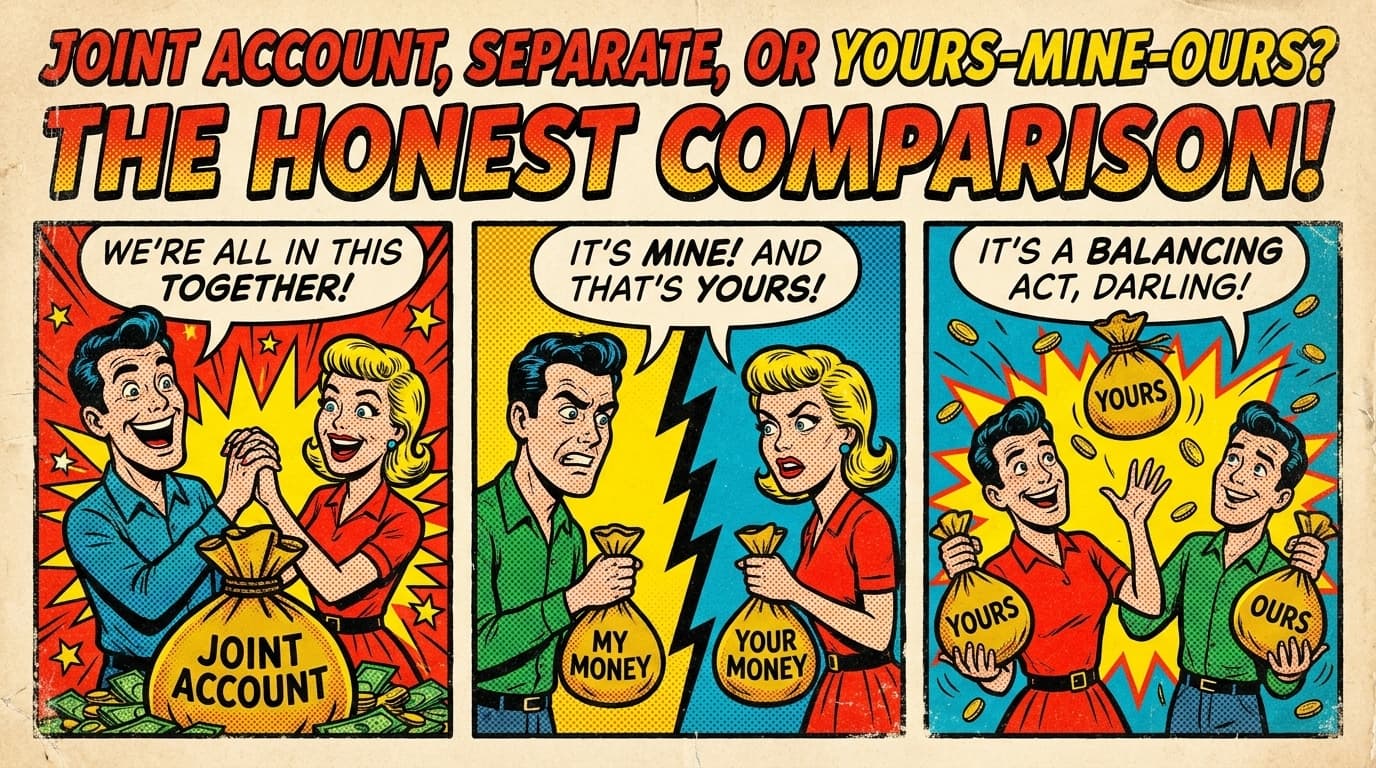
You're on the couch with your partner, phone out, hovering over the "Open Joint Account" button. One of you is excited. The other is quietly wondering if this is the thing that will end you.
Relax. It's a banking decision, not a blood oath. But it is the decision that shapes almost every other money conversation you'll have, so it's worth getting right.
Here's the honest comparison of joint, separate, and yours-mine-ours accounts, with the situations each one is actually built for.
The three setups (in one line each)
Fully separate: you both keep your own accounts, and whoever fronts a shared bill gets paid back.
Yours-mine-ours: you keep your own accounts AND add a joint account that pays shared bills.
Fully joint: one (or a few) shared accounts hold everything, and personal accounts basically disappear.
That's it. Every couple is some version of these three.
Fully separate: the "we're adults" model
Both of you keep the accounts you had before. Rent, utilities, groceries, all split in real time: one pays, the other reimburses via Venmo, Zelle, or a tracking app.
Works when:
- You're newer to cohabiting and want to keep things low-commitment
- Your incomes are close enough that a 50/50 split doesn't strain anyone
- You both enjoy tracking your own spending independently
- Religious, cultural, or legal reasons mean full merging isn't on the table
Breaks down when:
- You stop tracking. One of you fronts the Costco run, forgets to log it, and three months later neither of you can reconstruct who owes what.
- Your incomes diverge. Splitting 50/50 starts squeezing the lower earner while the higher earner has tons of breathing room.
- You want to save for something together. There's no "our" pool to put it in.
Hidden cost: the mental tax. Separate accounts mean remembering to log every shared thing, every time. If neither of you is the bookkeeper type, this model quietly rots.
Yours-mine-ours: the sweet spot for most couples
Three accounts: yours, theirs, and a joint one you both fund every month. The joint pays rent, utilities, groceries, streaming, and anything else you've labeled "shared." Your personal accounts pay for everything else, no questions asked.
Works when:
- You want shared finances without fully merging
- Incomes differ and you want to contribute proportionally
- You both like having spending autonomy on smaller stuff
- One of you is self-employed with variable income (joint contributions can smooth out the lumpy months)
Breaks down when:
- You don't update contributions as income changes. Set a yearly check-in.
- "Shared" is poorly defined and one partner keeps buying things they think are joint that the other doesn't
- The contribution math isn't transparent. Both of you need to understand how much each of you puts in and why.
Why it's the default for modern couples: it gives you a shared identity (the joint) without erasing either person's individual one. Most people who try this setup stay on it for years.
Fully joint: the all-in model
All income hits joint accounts. All expenses come out of them. Personal accounts either don't exist or are basically empty.
Works when:
- You're married or long-term committed with fully aligned financial goals
- Your incomes are close, or you genuinely think of money as "ours" regardless of who earned it
- You're combining households with significant shared goals (kids, a house, aging parents)
- You've been together long enough to trust each other's spending judgment
Breaks down when:
- One of you is a spender and the other is a saver, and there's no system for personal "fun money." Resentment builds fast.
- One partner starts feeling surveilled. Full merging without personal spending allowances is a recipe for secret credit cards.
- A breakup or separation becomes unusually messy because every account is tangled.
Fix for most of the breakdowns: even in a fully joint setup, give both partners equal personal allowances. Not permission-based, allocated. It's called a "fun money" line item and it's the difference between merged-healthy and merged-resentful.
The comparison table, in words
Separation of finances: fully separate > yours-mine-ours > fully joint.
Ease of splitting shared bills: fully joint > yours-mine-ours > fully separate.
Autonomy on personal spending: fully separate > yours-mine-ours > fully joint (unless fun-money allowances are set).
Ease of saving together: fully joint > yours-mine-ours > fully separate.
Ease of untangling if you break up: fully separate > yours-mine-ours > fully joint.
Read the table like this: there's no universally best setup. Pick based on which of those rows matters most to you right now.
How to decide
Ask yourselves five questions:
- How different are our incomes? Big gap? Yours-mine-ours with proportional contributions is almost always the play.
- How long have we been living together? Under a year? Start separate or yours-mine-ours. Full merge can come later.
- Do we have shared savings goals? If yes, you need at least a joint account, even if nothing else is merged.
- How comfortable are we each with the other seeing every transaction? If either answer is "not very," fully joint is off the table for now.
- What's our exit plan if things end? Not romantic, but real. The more merged, the harder the unwind.
Migration paths (because you'll probably change)
Most couples evolve: separate for the first year or two, yours-mine-ours once they've settled, and often (but not always) fully joint after marriage or a big life event.
You don't have to follow that path. But expect to change at least once. The couples who never revisit their setup are the ones who end up in a fight 4 years in because the system hasn't matched the relationship for 3 of them.
TL;DR
- Separate, yours-mine-ours, and fully joint are the three real options. Pick based on your actual situation, not a vibe.
- Yours-mine-ours is the modern default for most cohabiting or newly married couples. It balances shared identity with personal autonomy.
- Fully joint works for aligned, committed couples, but only if you build in equal personal allowances.
- Fully separate is fine early on, but the tracking tax catches up with you.
- Revisit yearly. The right setup at year 1 is rarely the right setup at year 5.
Frequently asked questions
Should couples have joint or separate bank accounts?
It depends on how merged your lives are. Early cohabitation often works fine with separate accounts. Long-term couples and married couples usually do better with either yours-mine-ours (a shared account plus personal ones) or fully joint. No setup is objectively best, match it to your situation.
What is a yours-mine-ours account setup?
Three accounts: one personal account for each partner and one joint account you both fund every month. The joint pays shared bills like rent and utilities. Personal accounts cover everything else, no questions asked. It's the most common setup for modern couples because it balances shared identity with personal autonomy.
Is it a bad idea to fully merge finances with your partner?
Not if you both genuinely want it and you build in equal personal spending allowances. Full merging without a 'fun money' line item is where resentment builds. With clear allowances and aligned goals, fully joint works great for long-term committed couples.
How do you fund a joint account fairly?
If your incomes are within about 25% of each other, equal contributions are fine. If they differ more than that, contribute proportionally to income. Revisit the contribution amounts at least once a year or whenever either income changes significantly.
What happens to joint accounts after a breakup?
Close the joint account once pending transactions clear, split the balance based on contributions (usually proportional, sometimes 50/50 if it was fully merged), and open separate accounts before closing if you don't already have them. Don't leave joint accounts open after a breakup, it just creates ongoing friction.