Proportional vs Equal Splitting: Which Is Actually Fair?
The proportional vs equal splitting debate, settled. When each method is fair, when it's not, and how to pick, with worked examples for couples and roommates.

Anna
Supasplit Team
"Fair" is doing a lot of work in this debate.
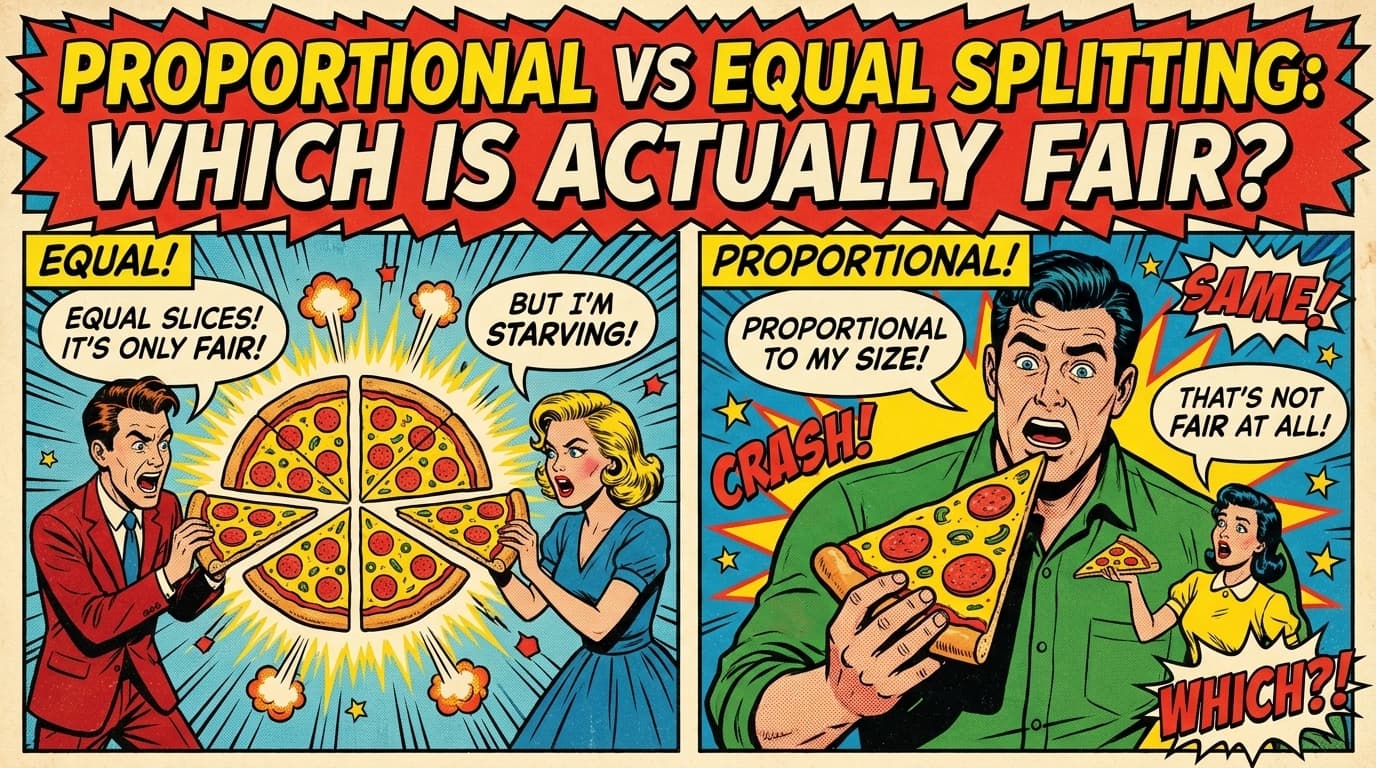
Equal splitting says: fair = everyone pays the same dollar amount. Proportional says: fair = everyone pays the same burden relative to what they earn.
They're both forms of fairness. They just measure it on different axes. This guide helps you figure out which one your situation actually needs.
Equal splitting, in one paragraph
Everyone pays the same dollar amount. Easiest math, least discussion needed. Works when the people splitting are in similar financial situations or when the amounts are small enough that any imbalance is rounding error.
Proportional splitting, in one paragraph
Everyone pays an amount proportional to their share of total income. Requires more math but reflects the reality that $600 means something very different to someone earning $40K vs someone earning $120K. Works when incomes differ meaningfully and the amount matters.
The 25% rule of thumb
The cleanest guideline:
- Incomes within 25% of each other → equal split is fine
- Incomes differ by more than 25% → proportional is usually fairer
Why 25%? Below that gap, equal splits end up feeling roughly proportional anyway, the difference between what each person "should" pay and what they do pay is minor enough that nobody's lifestyle is getting crunched by it.
Above 25%, the gap starts showing up as real month-to-month strain for the lower earner, and the higher earner is paying the same dollar amount that barely dents their budget.
Worked example: $3,000 in shared monthly expenses
Scenario: A couple with $4,500 and $7,500 take-home per month (60/40 gap). Shared expenses total $3,000/mo.
Equal split: $1,500 each.
- Lower earner: 33% of income to shared expenses, $3,000 left for everything else.
- Higher earner: 20% of income, $6,000 left for everything else.
Proportional split: 37.5% / 62.5% (based on income shares).
- Lower earner pays $1,125. Now 25% of their income → $3,375 left.
- Higher earner pays $1,875. Still 25% of their income → $5,625 left.
Under proportional, both partners have the same percentage of leftover income, the burden is equal even though the dollars aren't.
When equal is actually better
Equal isn't always wrong. Situations where it genuinely wins:
- Short-term or one-off events. A weekend trip, a dinner, a gift for a friend. The math of proportional isn't worth it for one-time small amounts.
- Close-to-equal incomes. If everyone in the split earns similarly, proportional is just equal with extra steps.
- No one wants to share income. Proportional requires knowing what each person earns. If people aren't comfortable sharing that, equal is the pragmatic choice.
- Groups of friends at casual hangs. Calculating proportional shares at a Friday dinner isn't a vibe. Split equally, move on.
When proportional is almost always right
- Rent in couples or roommates with unequal incomes. Biggest recurring cost, biggest impact on life. Worth the math.
- Long-term shared expenses in a household. Utilities, groceries, subscriptions.
- Vacations with budget mismatches. If one friend is stretching to afford the trip, equal-split luxury activities punish them.
The emotional piece: "I don't want charity"
This is the recurring objection to proportional splitting, usually from the lower earner.
It's worth taking seriously. Paying less for the same shared space can feel like being propped up, even when the math is clean. A few things that help:
- Frame it as math, not charity. "We're applying the same percentage to both our incomes" is different from "I'm helping you out."
- Agree on a review cadence. When your income goes up, the ratio moves with it. You're not locked into "being helped", you're locked into a system that adjusts.
- Consider yours-mine-ours. Proportional into a joint account for shared stuff, personal money stays personal. The ratio applies to a pool, not to specific bills.
The hybrid: "modified proportional"
Some households find equal feels too harsh and proportional feels too stark. The middle ground:
Start with a proportional base, but soften it. If true proportional would be 40/60, maybe you settle at 45/55. The higher earner still pays more, but not by the full amount the math dictates.
This isn't rigorously "fair" by either framework. But it's often the actual compromise people land on, and it tends to hold up because neither side feels strongly aggrieved.
What about other factors besides income?
People sometimes want to weight splits by:
- Hours spent at home (WFH pays more for utilities)
- Who uses the space more (car, streaming service)
- Debt load
- Savings rates
Resist most of this. Every factor you add is another thing to renegotiate when it changes. Stick to income-based unless there's a specific situation with an obvious fix (e.g., the WFH partner paying a bit more of the electric bill, just a small tilt, not a whole system).
The decision flowchart
Is the amount small (under ~$50) or a one-off? → Equal, move on.
Are incomes within ~25%? → Equal, unless someone strongly wants proportional.
Are incomes very different AND it's a recurring cost? → Proportional. This is what it's for.
Are incomes very different but it's a one-time thing? → Probably equal. Save proportional for recurring.
Is someone uncomfortable sharing income? → Default to equal and revisit later.
TL;DR
- Equal and proportional are both valid. They measure fairness on different axes, same dollars vs. same burden.
- The 25% rule: incomes within 25% of each other → equal is fine. Further apart → proportional is usually fairer.
- Small and one-off → equal. Recurring and significant → proportional.
- "I don't want charity" is a valid feeling. Address it with framing and review cadence, not by ignoring it.
- Hybrid splits are real. Most couples end up somewhere between pure equal and pure proportional, that's fine.
Frequently asked questions
What's the difference between equal and proportional splitting?
Equal splitting = everyone pays the same dollar amount. Proportional splitting = everyone pays an amount proportional to their share of total income. Both are fair by different definitions, equal measures dollars, proportional measures burden.
When should couples use proportional splitting instead of 50/50?
When incomes differ by more than about 25%, or when 50/50 would put one partner in a financially tight spot while the other has significant breathing room. Below that income gap, 50/50 is simpler and fine.
How do you calculate a proportional split?
Add up the total income of everyone in the split. Divide each person's income by the total, that's their percentage. Apply those percentages to the shared cost. Example: $4K + $6K = $10K total. Person A is 40%, Person B is 60%. For a $3,000 expense, A pays $1,200, B pays $1,800.
Is proportional splitting unfair to the higher earner?
Only if you define fair as 'equal dollars.' Proportional defines fair as 'equal percentage of income used', which means the lifestyle impact is equal even though the dollar amounts differ. Most people who earn more end up preferring proportional because it reduces resentment.
Should I use proportional splitting for small one-time expenses?
Usually not. The math isn't worth it for a $40 dinner or a single Uber. Save proportional for recurring household expenses like rent and utilities. One-offs are fine on equal or whoever-feels-like-it.