How to Split Rent When You Earn Way Less (or Way More) Than Them
When one roommate or partner earns significantly more, equal rent can feel brutally unfair. Here's how to split rent proportionally without it getting weird.

Anna
Supasplit Team
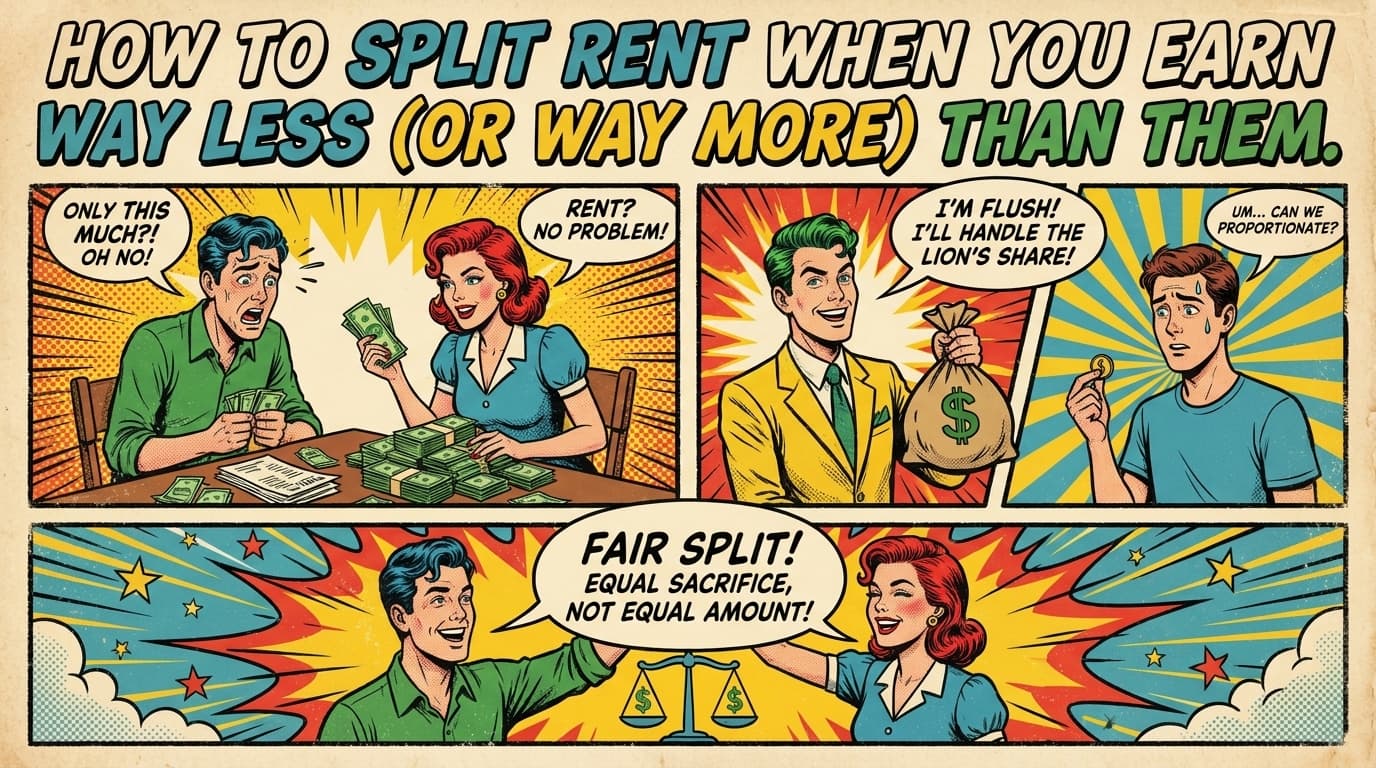
You make $3,200 a month after taxes. Your roommate makes $6,800. Rent is $2,400 for the apartment, so equal split puts you at $1,200 each.
For you, that's 38% of your income. For them, it's 18%.
Equal on paper, wildly unequal in how it actually feels.
This is the scenario proportional splitting is built for. But it's also the scenario most people fumble the conversation around, because nobody wants to be the one saying "I make less than you." Here's how to do the math and have the chat.
When to consider proportional rent
As a rough guide, proportional splitting starts being the obviously-right answer when:
- Your incomes differ by more than 25%
- Equal rent would eat more than 35% of one person's take-home (the traditional housing-affordability threshold)
- One of you has said "money's been tight" more than twice in casual conversation
Below 25% income difference, equal split is usually fine and simpler. Above that, you start hitting a wall where one person is constantly broke while the other has money for weekend trips and you both kind of resent it a little.
The math, explained simply
Proportional rent = each person pays their share of the total in proportion to their share of the total income.
Example:
- You earn $3,200/mo take-home. Roommate earns $6,800/mo. Total: $10,000.
- Your share of total income: 32%. Roommate's share: 68%.
- Rent is $2,400/mo. You pay $768. Roommate pays $1,632.
That's it. Take-home income, not gross. Ratios, not absolute numbers.
What about savings, debt, and other stuff?
Resist the urge to factor in everything.
Someone's student loan payments, car lease, medical bills, they're real, but layering all of them into the calculation makes it feel like a negotiation, and you are not negotiating a mortgage. You're deciding how to split rent.
Stick to the simple version: take-home incomes, divided into percentages, applied to shared rent. If someone has extreme circumstances (supporting a parent, massive medical debt), you can note that and adjust the ratio slightly, but don't build a rubric. Too much complexity invites constant renegotiation.
The conversation: who brings it up and how
If you earn less:
It's harder but not unreasonable to bring up. The script that works:
"Hey, can we chat about rent? With the gap in our incomes, 50/50 is leaving me pretty tight each month. Would you be open to splitting proportionally? I can show you the math."
Key moves: acknowledge the income difference openly (don't dance around it), frame it as "feel," offer the math instead of asking them to do it.
If you earn more:
This one is harder to initiate well, it can come off condescending. The script:
"Hey, I've been thinking, our rent split is kind of rough on you given how different our paychecks are. Want to try a proportional split for a few months and see how it feels?"
Note: "Rough on you" not "rough for you." You're acknowledging structural unfairness, not offering charity.
The objections you'll hear (and how to respond)
"I don't want to feel like I can't afford to live here."
This is real. The answer isn't "well you can't." The answer is: "That's not what this is. It's how much you're putting into a shared cost. You're still paying your rent, just at a ratio that matches what you earn."
"What if my income changes?"
Set a review cadence. Every 6 months, or any time someone gets a raise / switches jobs / starts freelancing, you redo the math. Not ad hoc, scheduled.
"This feels patronizing."
When it comes from the higher earner, it can. That's why it's better when the lower earner brings it up. But even then: the answer is "it's math, not charity. The dollar amounts just happen to be different."
What about by bedroom size?
Separate consideration. You can combine them:
- First split rent by bedroom size (master pays more than the small room)
- Then split those amounts proportionally by income within each room
Or pick one method and keep it simple. Most people don't need the hybrid.
A quick reality check
If you're 5 months into a lease and bringing this up now, that's fine, it's never too late to fix an unfair system. The conversation is the hard part, not the math.
And if you're reading this because equal rent has been slowly crushing you financially: it's not weird to ask for a fairer split. It's weirder to keep paying it silently and resenting your roommate by month 8.
TL;DR
- Proportional wins when incomes differ by more than 25% or rent is more than 35% of one person's take-home.
- Use take-home (net) income, not gross for the calculation.
- Don't overbuild the formula. Ratios based on income, applied to rent. Skip factoring in every personal expense.
- Bring it up cleanly, acknowledge the income gap openly, lead with the math.
- Review every 6 months or whenever someone's income meaningfully changes.
Frequently asked questions
How do you split rent when one person earns significantly more?
Use proportional splitting: each person pays a share of rent equal to their share of the household's take-home income. If you make $3,200 and they make $6,800, you pay 32% of rent and they pay 68%.
Is it fair to split rent by income instead of equally?
When incomes differ by more than about 25%, proportional splitting is usually fairer than equal, especially if equal split would eat more than 35% of one person's take-home pay. Below that gap, equal is simpler and fine.
Should you use gross or net income for proportional rent?
Use net (take-home after taxes and mandatory deductions). Gross doesn't reflect what actually hits your bank account, which is what determines real affordability.
How often should we revisit a proportional rent split?
Every 6 months, or any time one person's income changes meaningfully, raise, new job, going freelance, layoff. Don't make it ad hoc; put it on the calendar.
How do I bring up changing to proportional rent without it being awkward?
Acknowledge the income gap openly instead of dancing around it. Lead with 'I've been feeling tight each month' or 'I think our current split is rough on you', frame it as feel, offer the math, propose a trial period.