How to Split Bills With Roommates Without Losing Your Mind
A complete, no-nonsense guide to splitting rent, utilities, groceries, and shared costs with roommates, the methods that work, the scripts that keep things chill.

Anna
Supasplit Team
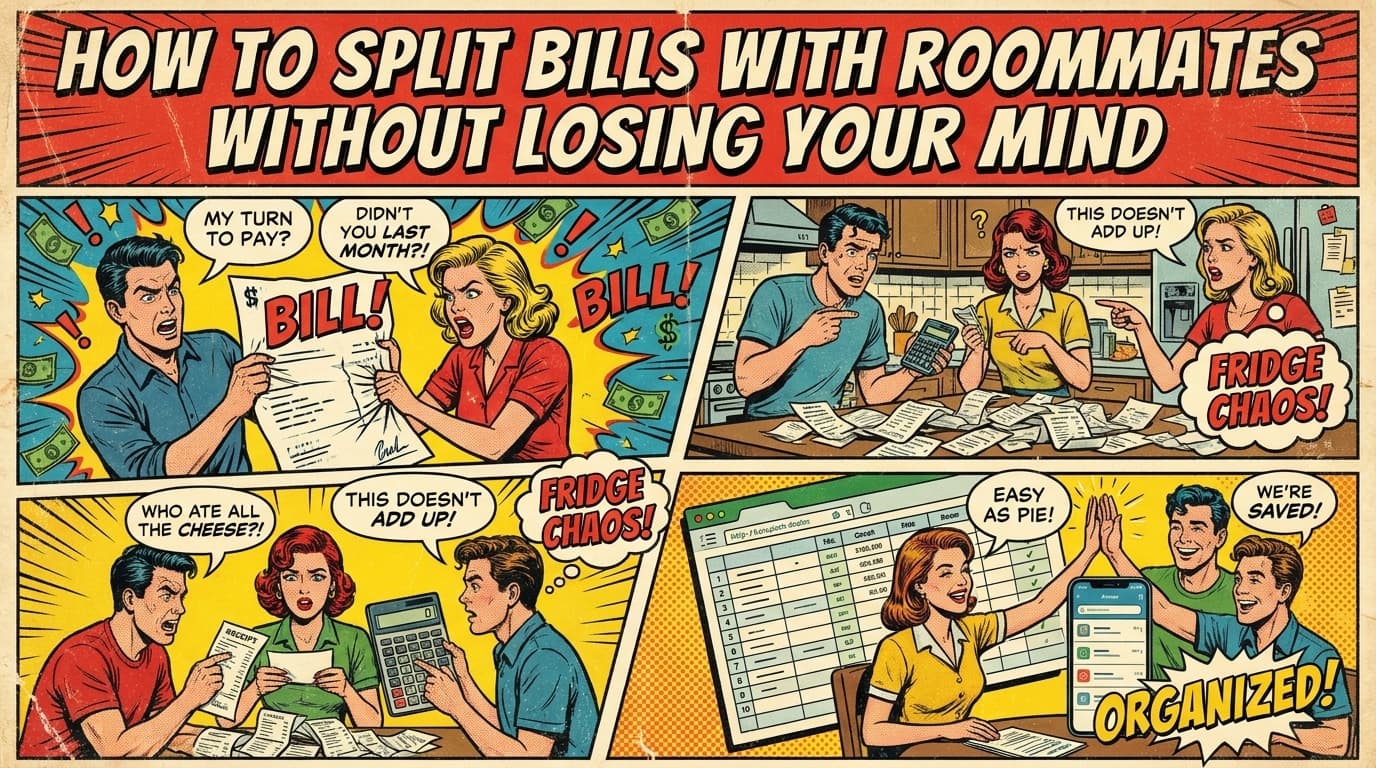
Living with roommates is great, until someone leaves their share of the electric bill on read for three weeks. Then it's a group chat war crime.
This is the complete guide to splitting bills with roommates so nobody ends up resenting anybody. It covers rent, utilities, groceries, shared subscriptions, security deposits, and all the awkward edge cases nobody teaches you about before you move in. Whether you're a first-time renter or you've done the roommate dance before, this walks you through every decision you actually need to make.
The one rule that makes everything else easier
Decide how you'll split things before you need to split anything.
Most roommate money drama isn't about the amount, it's about one person feeling like a new rule was sprung on them. If you sit down on move-in day and agree on a system (even a loose one), ninety percent of future fights never happen.
Splitting rent: three methods that actually work
1. Equal split
Everyone pays the same. Clean, simple, works when bedrooms are similar in size and everyone earns roughly the same.
2. By bedroom size or amenities
Bigger room = bigger rent. Master with en-suite = more. Tiny box room with a shared bathroom = less. The common math: measure each room in square feet, divide by total square feet of all private spaces, that's each person's percentage of rent.
Works great when rooms are genuinely different. Gets weird if you start haggling about closet depth.
3. By income (proportional)
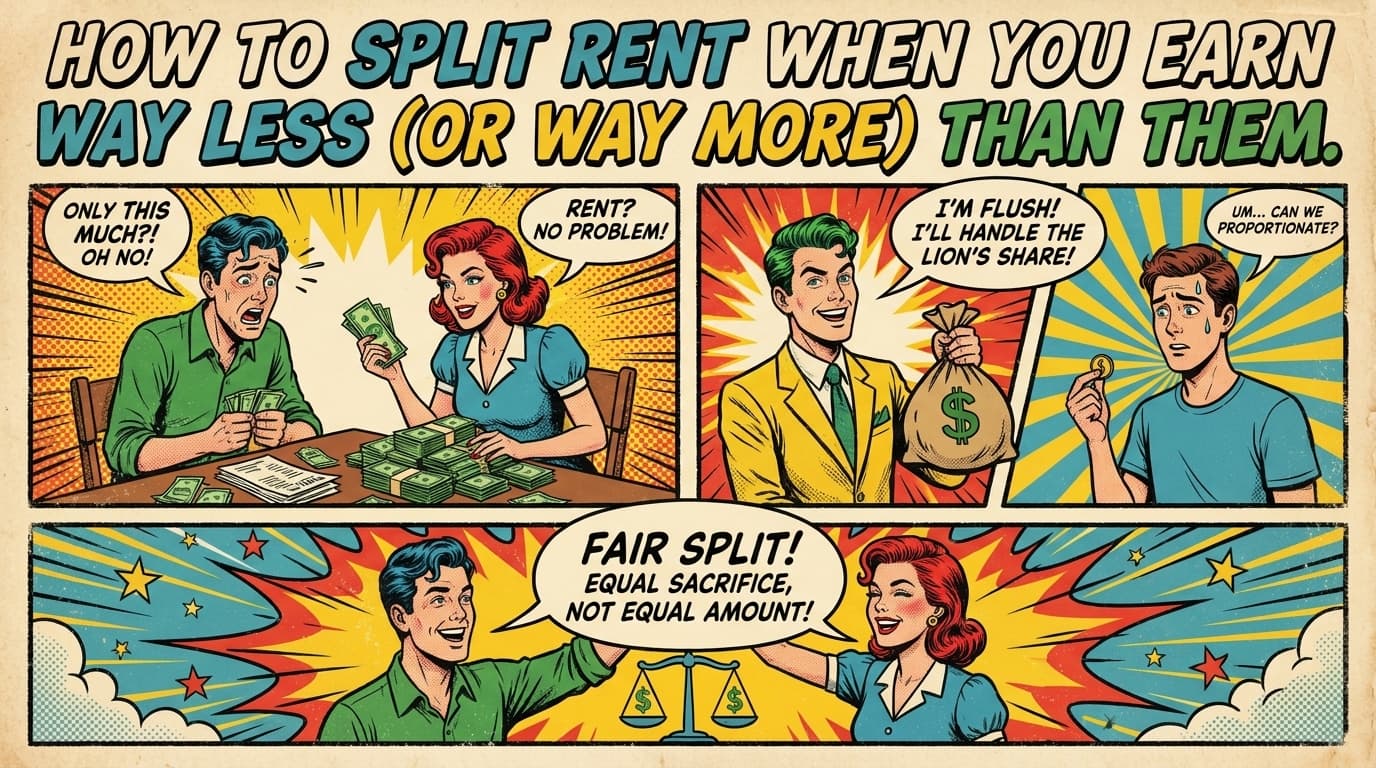
Each person pays rent proportional to what they earn. If you bring in $4K/mo and your roommate brings in $6K/mo, you'd pay 40% of rent and they'd pay 60%.
This is the move when incomes are very different and you want the housing burden to feel equitable. It's also the most awkward one to propose, see the script section below.
Which method wins? No single answer. Quick decision tree:
- Similar rooms + similar incomes → equal
- Different rooms + similar incomes → by room
- Very different incomes (close friends/partners only) → proportional
Splitting utilities without a spreadsheet from hell
Utilities are where roommate math gets stupid fast. Here's the simple version:
Split equally: internet, water, trash/recycling, streaming services
Split by usage (sort of): electricity and gas, if one person is a work-from-home all day person and another is out 10 hours a day, then a 60/40 or 55/45 tilt toward the home body is fair.
Do not bother tracking: shared cleaning supplies, paper towels, dish soap. Just take turns buying the household round. Trying to itemize dish soap is a red flag for your own sanity.
Groceries: the biggest "small" fight
Three approaches, pick one and commit:
The separate-shelves system. Everyone buys their own food. Nothing is shared except staples (olive oil, salt, paper towels) which you take turns restocking. Low friction. Slightly sad fridges.
The shared-cart system. You do grocery runs together (or take turns) for everything and split the total. Works great if you cook together and have similar diets. Breaks down fast if one of you is a meal-prep athlete and the other survives on string cheese.
The hybrid. Staples and shared meals are split. Personal snacks and special stuff is yours alone, marked if needed. This is what most successful roommate setups actually do.
Shared subscriptions (the one nobody thinks about)
Netflix, Spotify, Hulu, HBO, YouTube Premium, Apple One, these add up. $60-80/month across all of them, easy.
The play: one person puts each subscription in their name (spread it around so nobody's fronting everything), and everyone Venmos their share monthly. Or better, use a bill-splitting app that auto-charges the same $6.50 every month without anyone having to ask.
A missed $5 monthly transfer is the dumbest way to ruin a friendship and it happens constantly. Automate it.
Security deposits and move-in costs
Split the deposit the same way you split rent. If rent is 50/50, deposit is 50/50. If rent is 60/40, deposit is 60/40.
The important bit: write down, somewhere, exactly what each person put in. When someone moves out, they get back exactly what they put in (minus any damage they caused).
This also applies to:
- First/last month's rent
- Broker fees
- Any "move-in fee" the landlord charged
Do NOT let the first person to move out get "their deposit back" out of the current deposit held by the landlord. That's not how it works. They get reimbursed by the replacement roommate coming in.
Moving in / moving out: the fair split for shared stuff
Couch bought together. Kitchen set. The cheap IKEA coffee table. When someone leaves, who keeps what?
The rule that prevents 95% of fights: whoever paid for it at the time owns it. If you both chipped in, whoever is keeping it buys out the other person for their share of the current (not original) value. Used furniture depreciates fast, don't haggle over a $300 couch like it's a mortgage.
For consumables (paper towels, dish soap, random pantry stuff), it's a wash. Don't count those.
The scripts for awkward money conversations
"Hey, your half of the electric is overdue, can you send it today?"
Direct. No apology. No "sorry to bother you." It's a bill, not a favor.
"Want to do proportional rent? I make about $X, you make about $Y, would feel more fair if we split by income."
Only bring this up if you're close. Lead with "would feel more fair", that makes it sound collaborative instead of accusatory.
"I noticed a few bills slipped through this month. Can we do a quick sync on what's what?"
The de-escalation play when things have gotten a little fuzzy and nobody wants to be the bad guy.
"We should probably put this stuff in an app so neither of us has to remember."
The cleanest way to propose automation without sounding like you don't trust your roommate. You don't trust time. Time is the enemy. Not them.
The actual fight isn't about money
Most roommate money fights aren't about the money. They're about feeling like you're being taken advantage of, or feeling like someone's watching every dollar you spend. An app solves both, it removes the judgment from the equation and just shows the math.
If you're keeping running totals in your head or on a crumpled sticky note, you're going to resent someone eventually. It's just how brains work. Externalize it.
A 10-minute roommate money setup (do this today)
- Agree on how rent splits (equal, by room, or proportional).
- Decide who's on each utility account.
- Pick a grocery system (separate / shared / hybrid).
- List every shared subscription and assign an owner.
- Pick a bill-splitting app and add everyone to it.
- Pick a day of the month when things settle up.
That's it. The whole point is to make the system run itself so you never have to think about it again.
TL;DR
- Talk about money on move-in day, not month three.
- Split rent by room or income if equal doesn't actually feel equal.
- Automate everything you can. A forgotten $5 is the leading cause of passive-aggressive roommate vibes.
- Externalize the math. Your brain shouldn't be doing bookkeeping.
- Keep receipts on shared stuff so moving out isn't a negotiation.
Frequently asked questions
What's the fairest way to split rent with roommates?
Equal when rooms and incomes are similar; by room size when bedrooms are genuinely different; proportional to income when incomes are very different (and you're close enough to have that conversation). Pick one on move-in day and stick to it.
Should we split utilities equally or by usage?
Split fixed costs equally, internet, water, trash, streaming. For electric and gas, equal is fine in most cases, but consider a 55/45 or 60/40 tilt if one person is home all day while others are out.
How do we handle groceries without fighting?
Pick one of three systems: separate (everyone buys their own), shared (split the cart), or hybrid (staples shared, personal food separate). The hybrid approach is what most successful roommate setups actually use.
Who keeps shared furniture when a roommate moves out?
Whoever paid for it originally owns it. If you both chipped in, the person keeping it buys out the other for half the current used-value (not the original price). Don't haggle over a two-year-old couch.
What if my roommate keeps forgetting to pay me back?
Automate it. A bill-splitting app sends friendly reminders on a schedule so you're not the one chasing. If they're still flaking after that, it's not a money problem, it's a roommate problem.