My Roommate Won't Pay Their Share. Now What?
Your roommate is dodging rent, utilities, or the grocery bill. Here's the exact playbook, escalation, scripts, legal options, and when to move on.

Anna
Supasplit Team
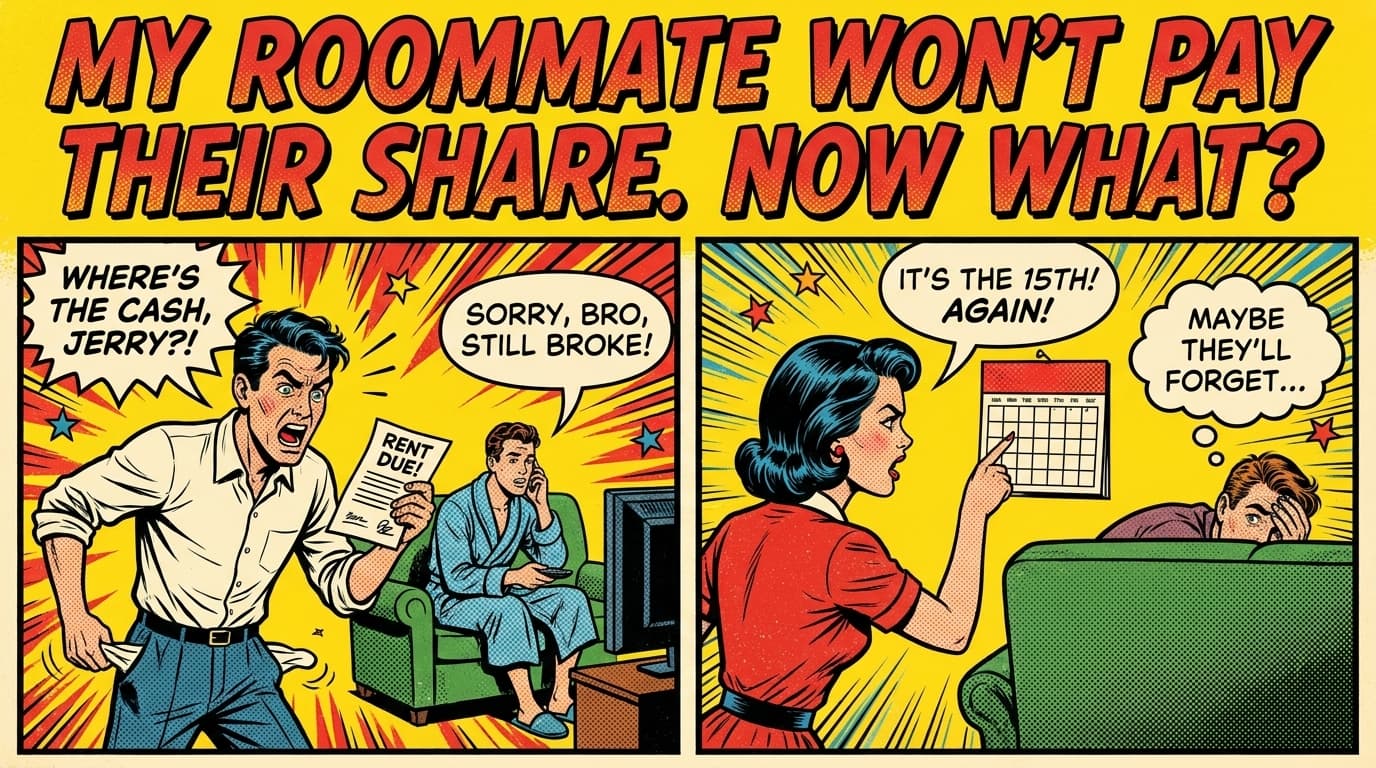
You've paid the full rent three months in a row. Your roommate keeps saying "I got you next week." Next week never comes.
This guide is the escalation ladder. Four levels, increasingly firm, with scripts and legal considerations for the worst case. Use them in order. Skip steps and you either nuke the relationship prematurely, or you end up as the doormat who funded someone else's apartment for six months.
Before you start: figure out what you're dealing with
There are three different versions of "roommate won't pay" and they each get a different approach:
- The flaker, they have the money, they just forget or avoid the transaction. Fixable with systems.
- The broke, they genuinely can't pay this month. Fixable with a plan.
- The freeloader, they're choosing not to pay, full stop, and they're banking on you covering. Fixable only by removing yourself from the situation.
You don't always know which one you're dealing with at first. The escalation ladder helps you figure it out fast.
Level 1: The neutral reminder
One text, short, non-accusatory, no emoji softeners:
"Hey, just a reminder your half of rent ($1,200) is due. Let me know when you can send it over."
That's it. Not "hey sorry to bug you." Not "I hate to ask but." Not "just checking in 😅." Those all code as "I feel bad about bringing this up" and train your roommate to keep not paying.
If they send it within a day or two: case closed. They were a flaker. Fix the system next month, auto-reminders, scheduled transfers, apps.
Level 2: The follow-up with a deadline
No response in 48 hours, or "I got you next week" answers that haven't materialized. Send:
"Hey, circling back on rent. Can you send by [specific date, 3 days out]? I've fronted it the last [X] months and I can't keep doing that."
Two moves here: (1) you're naming the pattern ("last X months"), and (2) you're giving a specific deadline. "Soon" is not a deadline.
Level 3: The in-person conversation
Text stops working once there's real avoidance. Time for a real conversation, in the apartment, not at dinner with other people.
Lead:
"I need to talk about the rent situation. I've covered your share [X] months in a row now, and that can't be the new normal. What's going on?"
Then, and this is important, shut up. Let them fill the silence. The answer you get here will tell you which category they're in.
Options for what you do next:
If they're broke: "Can we work out a payment plan? You pay me back $[X] a month until the debt is cleared, while you also start paying current rent on time." Put it in writing (text chain, email, whatever).
If they're evasive or get defensive: "This isn't sustainable for me. If things don't change starting this month, I need to look at other options, which might include looking for a different roommate."
That's not a threat. That's a statement of what's true.
Level 4: The exit plan
Nothing got better after Level 3. You're subsidizing an apartment for someone who isn't paying.
Your actual options:
Option A: Ask them to leave. Depending on your lease (see below), this may or may not be doable. If you're both on the lease, you can't unilaterally evict them, but you can leave, or you can work with the landlord to have them removed if they're behind on rent owed to the landlord directly.
Option B: Leave yourself. If the lease allows subletting or replacement, find someone to take your spot. You stop carrying their weight.
Option C: End the lease. Sometimes the cleanest path is everyone out, end of lease, start fresh.
In all three cases, document everything. Save texts. Save the Venmo/Cash App history showing who paid what. If this ends up in small claims court (it might), this is your evidence.
The legal stuff (briefly)
If you're on the lease and they're on the lease, you're both obligated to the landlord for the full rent. Their not paying doesn't reduce the landlord's claim against you. This is why landlords don't usually care about your internal split, they just want the total, from someone.
If they owe you money (because you fronted their share), that's a debt between you two. Small claims court is your remedy, typically for amounts up to a few thousand dollars depending on your state/country. The bar to file is low, but also: the bar to collect even if you win is real. Judgments don't pay themselves.
Most people choose to eat the debt to end the relationship faster. That's often the rational call, especially for amounts under a few hundred dollars. Your time and mental peace have value too.
The scripts you actually need
First reminder: "Hey, just a reminder your half of rent ($X) is due. Let me know when you can send it."
Escalation: "Circling back on rent. Can you send by [date]? I've fronted the last [X] months and I can't keep doing that."
In-person open: "I need to talk about the rent situation. What's going on?"
Payment plan: "Can you pay me back $[X]/month until the back-rent is cleared, while also paying this month's on time?"
Exit: "This isn't sustainable for me. I need to look at other options."
Preventing next time
Once this situation resolves (for better or worse), the systems matter.
Future roommates: do the money conversation on move-in day. Put shared expenses in an app that sends automatic reminders. Set a monthly settle-up date. Don't let debts accumulate past a single cycle.
TL;DR
- Escalate in four clear steps, neutral reminder, follow-up with deadline, in-person conversation, exit plan.
- Don't over-soften. Empathy in tone, clarity in content.
- Figure out fast which kind of non-payer you have, flaker, broke, or freeloader. Each gets a different fix.
- Document everything. Screenshots, texts, Venmo history.
- Small claims is available but annoying. Most people eat sub-$500 debts to end the relationship faster.
Frequently asked questions
What do I do if my roommate won't pay rent?
Start with a neutral text reminder. If that doesn't work, follow up with a specific deadline. If it's still unresolved, have an in-person conversation and figure out whether they're broke (need a payment plan) or freeloading (need an exit plan).
Am I legally responsible for my roommate's share of rent?
If you're both on the lease, yes, the landlord can collect the full rent from either or both of you. Their not paying doesn't reduce your legal obligation to the landlord, though it creates a debt between you and them.
Can I take my roommate to small claims court for unpaid rent?
Yes, for amounts typically up to a few thousand dollars depending on your state or country. The filing is cheap, but collecting on a judgment can be hard. Many people choose to eat smaller debts to end the relationship faster.
How do I ask a non-paying roommate to move out?
If you're both on the lease, you usually can't unilaterally remove them, but you can end the lease, leave yourself, or work with the landlord if they're also behind on rent to the landlord directly. Document everything either way.
What if my roommate says they can't pay this month?
If it's genuine, work out a written payment plan: they pay current rent on time going forward, plus a set amount each month until the back-rent is cleared. Get it in writing (text counts) and stick to it.