When Friends Want to Splurge and Others Can't: Planning Fair
Your friend group has wildly different incomes. Can you still take a trip together? Yes, with an opt-in layer and a few honest conversations.

Anna
Supasplit Team
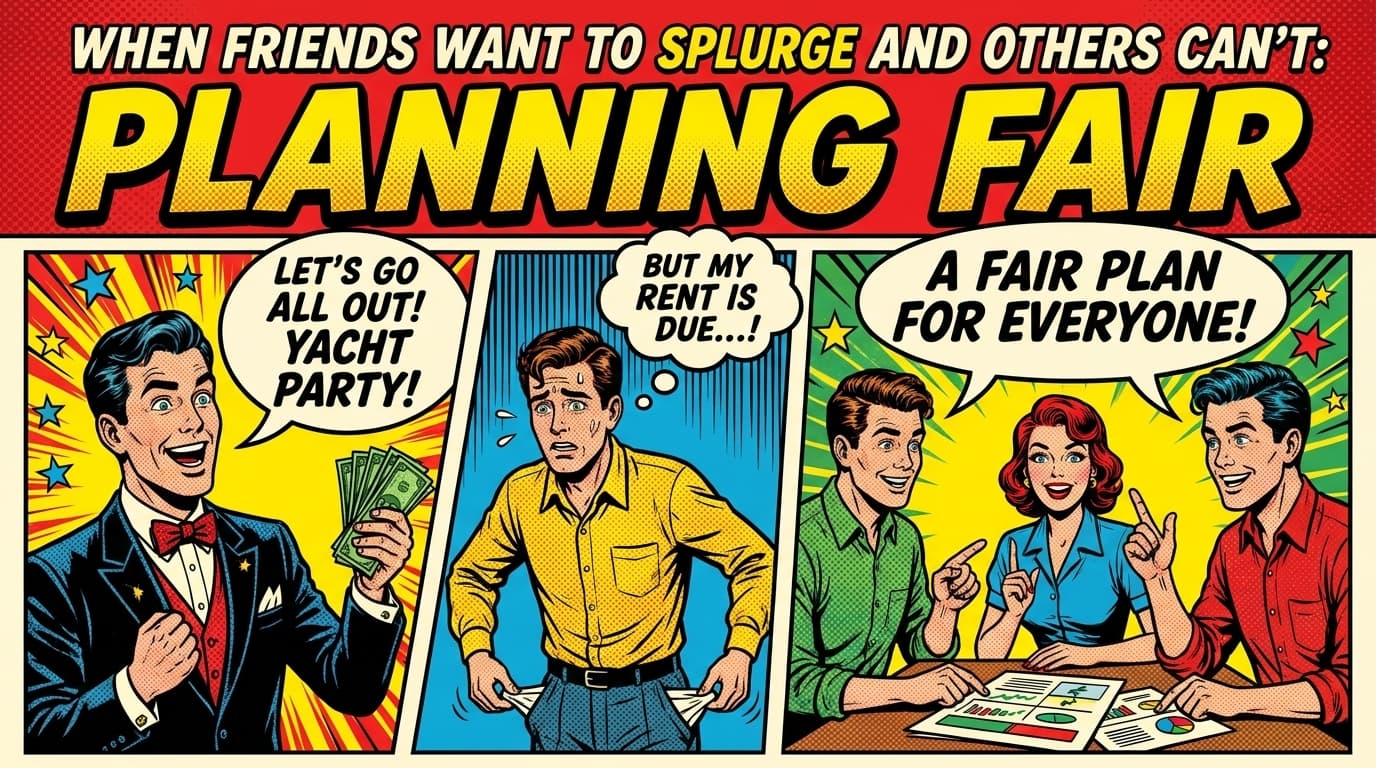
You want to go to Tulum with your college friends. One of them just got promoted. One of them is a grad student. One of them has two kids and a mortgage. Can this trip happen? Yes. But not if everyone pretends the budget gap doesn't exist.
Here's how to plan a group trip across wildly different budgets without anyone feeling priced out or forced to overspend.
The core idea: layer the trip
One trip, two layers.
- Core layer: Everyone does this. Lodging, group meals, shared transport, one anchor activity per day.
- Opt-in layer: Splurge stuff. The fancy dinner. The private snorkel charter. The bottle service. Anyone joins or skips without justification.
The core layer is planned to the lowest-budget person. The opt-in layer is where the higher-budget friends get their splurge fix. Done right, nobody feels left out AND nobody feels held back.
Step 1: Get the real numbers
Budget conversations are cringe. Everyone's better off doing them anyway. See the full budget meeting guide for the script.
Quick version: get every person to state a single number for the all-in trip cost they're comfortable with. Not a range. The range is where people hide.
Once you have the numbers, the lowest is your core-trip ceiling.
Step 2: Design the core trip to the lowest budget
This is the move most groups get wrong. They average the budgets. 'Okay, range is $800-$3,000, let's aim for $1,800.' That's $1,000 over the lowest person's limit. They'll either bail or go into debt.
Do not average. Plan to the lowest hard-line number. The higher-budget people can spend more via opt-ins.
Example: lowest budget is $1,100 all-in for a 4-night trip. Your core trip needs to fit in there:
- Flight: $350
- Lodging: $350 (split share of a modest Airbnb)
- Groceries + coffee: $120
- Anchor activities: $150 (one per day)
- Transportation + buffer: $130
Total: $1,100. That's the trip everyone does.
Step 3: Build the opt-in layer
Now plan the splurges. Each one has a cost and a 'who's in?' moment.
- Day 2 dinner at the nice restaurant: $150 per head. Who's in?
- Day 3 private boat: $180 per head. Who's in?
- Last-night cocktails at the rooftop place: $60 per head. Who's in?
Anyone can say no to any of these with zero explanation. The rule is: 'I'll pass this time' is a full sentence.
Step 4: Respect both sides of the gap
This is where trips get emotional. A few specific moves:
If you're the higher-budget friend:
- Don't propose a trip that prices out your friends, then act surprised when they can't come. Plan within their range.
- Don't cover things for them without asking. 'I'll just pay for her dinner' is generous in isolation, patronizing as a pattern. It turns friends into recipients.
- Don't make them feel like the reason you 'had to' book a cheaper hotel. They're not ruining your trip. You're choosing to travel together.
- If you want to splurge on opt-ins, do it. You don't have to shrink yourself to make the budget friend feel okay.
If you're the lower-budget friend:
- Say your number. The whole plan rides on honesty here. If you say $2,000 when the real number is $900, you're going to resent everyone for the whole trip.
- Skipping opt-ins is normal. 'I'll pass' is a full answer. Nobody needs a story.
- Don't apologize for skipping the $200 activity. It's a price tag, not a moral failing.
- Bring what you CAN bring. Plan the hike. Pick the Airbnb. Cook a dinner. Contribution isn't only money.
The 'I want to treat them' impulse
If a higher-budget friend wants to cover a specific opt-in for the budget friend ("Come to the dinner, it's on me"), do it rarely and sincerely. Once a trip, maybe.
The script: 'Hey, I really want you at this dinner, can I cover your meal tonight? No strings, just my thing.' Let them say no without awkwardness. If they say yes, don't bring it up again. Ever.
What kills this move: doing it constantly, then mentioning it later. Or doing it performatively so the group sees it. The whole point is it's low-key.
The Airbnb problem
The biggest budget blowup on group trips is lodging. Two failure modes:
- Higher-budget people push for a $450/night villa. Lower-budget person can't say no without feeling like the problem.
- Lower-budget people suggest a $90/night hostel. Higher-budget people secretly wish they were at the villa.
Fix: agree on a lodging range in the budget meeting. Look at options inside that range. Present 2-3 real listings to the group. Pick the one most people prefer.
On splitting: room size matters. See the Airbnb split guide for why equal-per-head is often unfair. Sometimes a lower-budget friend volunteers for the smaller room and pays less. Great, let that happen.
The food problem
Fancy dinners are the second blowup zone. Two fixes:
- Propose a per-head range before booking. 'Tuesday dinner, aiming for around $40-60 a head. Flag if that's off.' Lock it in, everyone knows.
- Pick a mix of meals. One or two 'fancy' meals as opt-ins, rest are casual or cooked in the Airbnb. This hits both budget tiers naturally.
When the gap is too big
Sometimes the gap is just too wide to bridge. You want to go to Italy for 10 days, $4,500 all-in. Your friend genuinely can't do more than $1,000 in travel this year. That's a different trip.
The right move: plan the expensive trip with the people who can afford it, AND plan a separate, cheaper weekend with the friend who can't. Both things can be true. Don't force the lower-budget friend onto a trip that'll crush them financially just because of the optics.
They know. They'd rather be honestly included in a cheap weekend than grudgingly included in a trip they can't afford.
TL;DR
- Two layers: core trip everyone does, opt-in layer for splurges. The core is planned to the lowest budget.
- Don't average budgets, plan to the lowest. Higher-budget friends spend more via opt-ins.
- 'I'll pass' is a full answer for any opt-in. No explanation required.
- Higher-budget friends shouldn't 'cover' the budget friend as a pattern. Rare and sincere, yes. Constant, no.
- If the gap is too big, plan two things. One expensive trip, one cheaper weekend. Both are real friendship.
Frequently asked questions
How do you plan a group trip when friends have different budgets?
Design the trip in two layers. The core layer (lodging, shared meals, anchor activities) is planned to the lowest hard-line budget so everyone can do it. The opt-in layer (fancy dinners, splurge activities) is available for anyone who wants to spend more, with zero pressure to join.
Should a group trip budget be averaged across all friends?
No. Averaging forces the lower-budget people to overspend. Plan the core trip to the lowest hard-line budget, then let higher-budget friends add splurges through opt-ins. This is the only structure that works across wide income gaps.
Is it okay for a friend to skip expensive activities on a group trip?
Yes, completely. 'I'll pass this time' is a full sentence. A healthy group treats skipping as normal and doesn't require explanations or justifications. If skipping one activity feels awkward, the group culture needs adjustment, not the person skipping.
When should a higher-budget friend pay for a lower-budget friend?
Rarely, and sincerely. Covering a single dinner or activity once a trip can be a generous move if it's specific, quiet, and never mentioned again. Doing it constantly turns friends into recipients and creates resentment on both sides.
What if the budget gap is too big to plan one trip?
Plan two things: the expensive trip with the friends who can afford it, and a cheaper weekend with the friend who can't. Forcing someone onto a trip that'll crush them financially just for appearances is worse than being honest and planning a separate adventure together.