Splitting a Studio With a Roommate: Curtains, Bills, and Sanity
Splitting a studio apartment with a roommate is the most intense roommate situation possible. Here's how to make it work financially and emotionally.

Anna
Supasplit Team
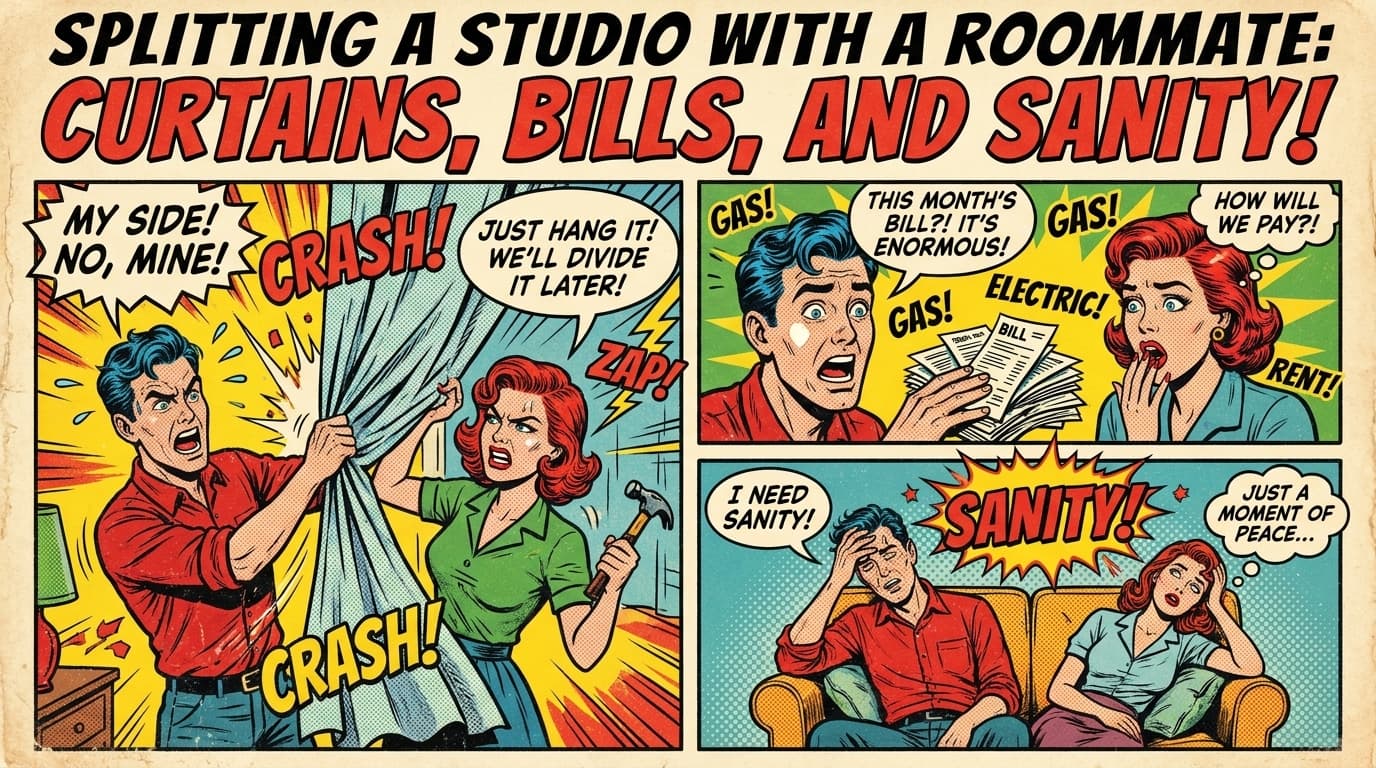
A studio apartment is one room. Sharing it with a roommate means sharing the room you sleep in, work in, eat in, and exist in. Yes, people do this. Yes, it can work. Yes, the financial and emotional setup has to be sharper than for any other living situation.
Here's how to split costs and space when there's literally nowhere to retreat to.
First: should you actually do this?
Splitting a studio is almost always financially driven. The rent is cheaper than two separate places, you're getting through grad school, you moved to a new city and can't afford solo yet.
Before you commit, be honest with yourself:
- Can you live without privacy for 6-12 months?
- Is the other person OK with that too?
- Are you going to be home a lot, or rarely?
- Are you both relatively non-confrontational, or will small things become big things?
- What's your fallback if it doesn't work?
If you've answered "yes, yes, similar schedules, can talk about issues, I have a backup plan," proceed. If not, look at other options.
The rent split
If the studio has separable areas (a divider, a loft, a Murphy bed), rent can be split based on which area each person takes.
If the studio is one open room with one bed and one couch:
- The person in the bed usually pays slightly more.
- The person on the couch (or the futon, or the air mattress) pays slightly less.
- A 55/45 or 60/40 split is typical.
If it's truly identical setups (two beds, two desk areas), 50/50 is fine.
Don't try to over-engineer this. The dollar differences in a studio rent split are usually less than $100. Don't spend more energy negotiating than the gap.
Utilities are simple
With two people in a small space, utilities split nearly always 50/50.
Reasoning:
- Small space means small absolute bills (a 400 sq ft studio's electric is much less than a 1,500 sq ft house's).
- You're both in the space the same hours.
- HVAC is one zone, one temperature, both of you affected.
- Hot water heater serves both.
- Internet is a flat fee.
Don't bother with WFH tilts or usage tracking in a studio. The math isn't worth it.
The divider question
Most successful studio-roommate setups invest in some kind of divider:
- Ceiling-mounted curtain rod with heavy curtains
- Tall bookshelf (also storage)
- Folding screen or room divider
- Free-standing wardrobe (storage + visual barrier)
The divider isn't a wall. It doesn't block sound. But the visual separation helps massively for psychological privacy.
Who pays for the divider:
- Joint household expense, split 50/50.
- Or one roommate buys it and they keep it after move-out.
- Treat it like furniture: shared cost if shared, individual cost if owned.
More on splitting furniture costs in our moving-out guide.
Headphones and noise rules
The single most important household rule for a studio: headphones for any audio after a certain hour.
Typical rules:
- 9 or 10 PM onward: headphones for videos, music, calls.
- Earlier in the day: be reasonable but not strict.
- Calls: try to take calls in the building hallway, stairwell, or coffee shop. Or coordinate so the other roommate is out.
This isn't optional. In a studio, one person watching TV at 11 PM means the other person can't sleep. There's no "my room" to retreat to.
Schedules matter more than usual
If one roommate is on a 9 AM start and the other works the late shift, you're never both home at the same time. Studio living becomes easy.
If you both work from home, never travel, and have similar hours, studio living becomes much harder. You're literally in the same room all day.
Before moving in, compare schedules. If they overlap heavily, plan for things like:
- One person works from a coffee shop or coworking space some days
- Designated quiet hours for focus work
- Standing arrangement that one of you takes calls outside the apartment
This is part of the affordability tradeoff. You're saving on rent by working out of a café occasionally.
Groceries and the tiny fridge
Studio kitchens are usually small. Limited fridge space. Limited cabinet space. Limited counter space.
Kitchen rules to set up day one:
- Fridge shelf assignments (top shelf yours, middle mine, etc.)
- Cabinet space split clearly
- Communal vs. personal food rules
- Cooking schedule (cooking at the same time in a small kitchen is tough)
Groceries usually stay separate. The space and shopping patterns don't merge well in a studio. See the general grocery roommate guide.
Guests
The rule that prevents most studio fights: guests need to be coordinated.
Specifically:
- Overnight guests: probably not, unless both roommates explicitly agree.
- Daytime guests: heads-up the other roommate.
- Partners: "hangs out a lot" is one thing, "basically lives here" is a violation of the lease and the studio capacity.
In a one-bedroom or larger, your roommate's overnight guest is annoying. In a studio, your roommate's overnight guest is sleeping six feet from you. The rules have to be different.
Write this into your roommate agreement explicitly.
Sound-blocking gear that actually helps
Investments that improve studio quality of life:
- White noise machine ($30-50): masks ambient sound during sleep.
- Noise-canceling headphones ($150-400): for work, calls, focus.
- Sleep masks: helps when one person stays up late.
- Curtain dividers with sound-absorbing fabric: visual + slight audio improvement.
For the white noise machine specifically, household expense (split 50/50). Personal headphones and masks are individual.
What if it's not working?
If the studio arrangement isn't working at month two, address it explicitly:
- What's not working? Be specific. Sound? Sleep? Privacy? Schedule overlap?
- Are there fixes (better dividers, headphone rule, scheduled out-of-house days)?
- If not, what's the timeline for one of you finding a new place?
Don't let resentment build for months in a 400 sq ft space. It compounds fast.
The practical reality: most studio-roommate setups have a built-in 6-12 month horizon. People aren't doing this forever. Knowing that going in keeps everyone sane.
The exit plan
Have one. "What's our plan for the end of this?"
Is the goal:
- Save money for X months, then both move to separate places?
- Save money until one of you can afford solo?
- Stay together as roommates but move to a one-bedroom or larger?
- Get through grad school and reassess?
Knowing the timeline makes the day-to-day frictions manageable. "Yes the headphone rule is annoying, but I'm only doing this for nine months" is a totally different feeling than "is this my life now."
TL;DR
- Studio living with a roommate is intense. Be honest about whether you can do it before committing.
- Rent splits in a studio: 50/50 or 55/45. Don't over-engineer the math.
- Utilities: 50/50. Bills are small, both of you are in the space the same hours.
- Invest in a divider, headphones, white noise. The right gear makes a studio livable.
- Headphones-after-10 rule is non-negotiable. No retreat space in a studio.
- Coordinate schedules and guests explicitly. A studio doesn't have room for surprises.
- Have an exit plan. 6-12 months is the typical horizon. Knowing the end date makes the present easier.
Frequently asked questions
How do you split rent in a studio with a roommate?
If both people have identical setups (two beds, two desk areas), 50/50 is fine. If one person has the bed and the other is on a couch or futon, a 55/45 or 60/40 split toward the bed-user is typical. The dollar gaps in a studio split are usually small, don't spend more energy negotiating than the difference.
Should we split utilities equally in a studio?
Yes, almost always. Studios are small enough that utility bills are small in absolute terms, both roommates are in the same space for the same hours, and HVAC is one zone serving both. The math of trying to track usage isn't worth it for a small studio.
How do you create privacy in a shared studio?
Invest in a divider, ceiling-mounted curtain, tall bookshelf, folding screen, or free-standing wardrobe. The divider doesn't block sound, but visual separation matters a lot psychologically. Pair it with strong audio rules (headphones after 10 PM) and white noise machines, which together approximate the privacy a wall would give.
Can two people legally live in a studio?
Often yes, but always check the lease. Some leases limit occupancy to one person in a studio or require landlord approval for a second. Many jurisdictions also have occupancy limits based on square footage. Verify before moving someone in, an unauthorized second occupant is a lease violation that can lead to eviction.
How long is reasonable to share a studio?
Most studio-roommate setups have a 6-12 month horizon. People aren't doing this forever, it's a savings push or a transitional period. Knowing the end date going in makes the daily frictions much more tolerable. Be honest with yourself and your roommate about the timeline.