The WFH Roommate Tax: Splitting Utilities When One Person Is Always Home
When one roommate works from home and cranks the AC all day, splitting utilities 50/50 stops being fair. Here's how to adjust the math without making it weird.

Anna
Supasplit Team
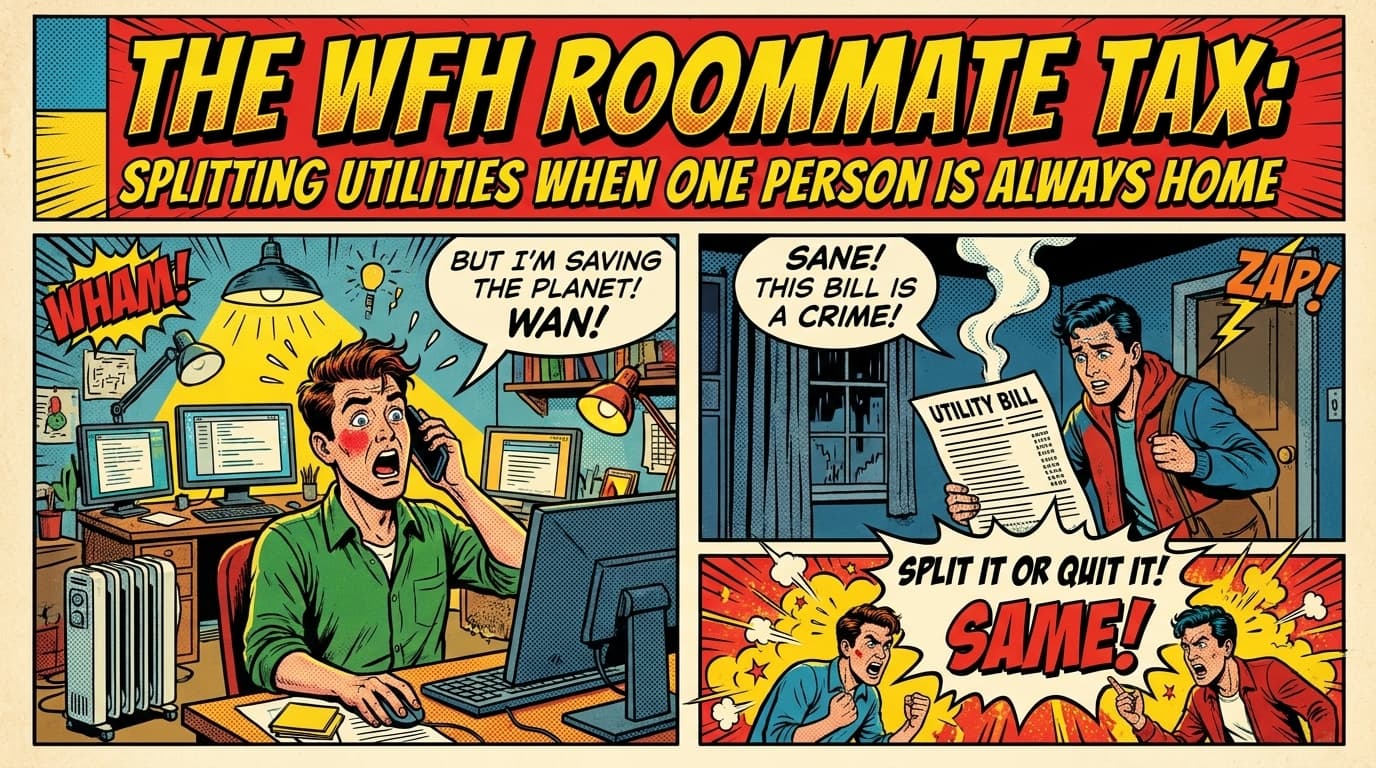
You're at the office nine hours a day. Your roommate works from home, lights and AC on from 8am to 8pm, plus the 4K TV running in the background "for noise."
The utility bill shows up. $220. Your roommate cheerfully suggests splitting it 50/50.
You stare at the ceiling for a moment and wonder if this is the hill.
It shouldn't be. Here's the fair math, the actual conversation script, and the rules that keep utility splits from becoming a quiet roommate resentment engine.
The core problem
Fixed utility costs (internet, water, trash, streaming) are roughly the same no matter who's home. Variable costs (electricity, gas) scale with use. When one roommate uses dramatically more than another, an equal split means the low-use roommate subsidizes the high-use one.
It's not about the money. A few extra dollars a month isn't going to ruin anyone. It's about the feeling of paying for something you didn't use, month after month. That feeling compounds.
The simple fix: tilt, don't itemize
You don't need a spreadsheet. You need a small, agreed tilt on the variable utilities.
Light WFH difference (one person home 1-2 days a week): Split 50/50. It's rounding error.
Moderate WFH (one full-time remote, one full-time in-office): Split variable utilities 55/45 or 60/40 toward the remote person. Fixed utilities stay 50/50.
Heavy WFH + bad habits (full-time remote, AC cranked, 3 monitors, space heater in winter): 60/40 or 65/35 on variable utilities. Possibly a conversation about specific habits.
That's the whole framework. No meters, no hourly tracking, no weird math.
Which utilities count as "variable"?
Fixed (always split equally):
- Internet
- Water
- Trash / recycling
- Streaming services
- Homeowners or renters insurance
Variable (adjust by usage pattern):
- Electricity
- Gas / heating
- Water, if one of you does very different amounts of laundry or showering (usually not worth tracking)
The real-world tilt is almost always on electric and gas. Water is usually close enough to equal that tracking the difference isn't worth the friction.
Having the conversation
If you're the at-office roommate:
The worst way to bring it up is passive-aggressively staring at the thermostat. The best way is casual, before the next bill shows up.
"Hey, I've been thinking about utilities. Since you're home way more than me, want to split electric and gas more like 60/40? The internet and water can stay even. Seems more fair."
Short. Non-accusatory. Offers a specific number so they don't have to do emotional labor to respond.
If you're the WFH roommate:
You might actually want to bring this up yourself. It reads as generous and gets ahead of any resentment.
"I realize I'm using way more electric than you since I'm home all day. Want me to cover a bigger share? Like 60/40?"
This is the move that separates good roommates from great ones.
The nuclear option: separate the accounts
Some pairs just put the electric and gas bills in the WFH person's name, and the internet in the other person's name. Each pays their own. The WFH person eats the full utility cost of being home, the other person eats the full cost of the internet everyone uses.
This works if you've done the rough math and it comes out close to what a tilt would be. It has one big advantage: you never have to talk about it again.
When the usage really is wild
Sometimes it's not just "they work from home." It's space heaters running 24/7 all winter, a gaming PC mining crypto, a 75-gallon aquarium with lights and filters. In that case, fair isn't a 60/40 tilt, fair is a specific line item.
"Electric would be $140 without your space heater, and $220 with it. You cover the $80 difference" is a reasonable framing. Not hostile, just accurate.
What about guests and partners staying over?
If your roommate's partner is over 3-4 nights a week for months on end, that's a third person in the apartment. Fair-use-wise, utilities should reflect that. Not a separate bill, just a nudge in the tilt:
"Since [partner] is here most weeks, want to do 55/45 on utilities?" is a reasonable nudge. It's also usually the move that leads to the "should we just make them pay rent" conversation, which is its own thing.
TL;DR
- Split fixed utilities equally (internet, water, trash). They don't scale with use.
- Tilt variable utilities (electric, gas) 55/45 or 60/40 toward the WFH person. Don't itemize.
- Have the conversation proactively before resentment sets in. If you're the WFH person, offer the tilt first.
- Specific usage, specific cost. Space heater all winter? That's a line item, not a tilt.
- Don't renegotiate retroactively. Change going forward, leave the past alone.
Frequently asked questions
How should roommates split utilities when one person works from home?
Keep fixed utilities (internet, water, trash, streaming) at 50/50. Tilt variable utilities (electric, gas) 55/45 or 60/40 toward the at-home roommate. Avoid hour-by-hour tracking, pick a fixed ratio and stick with it.
Is it fair to split electric bills equally if one roommate is always home?
Not really. Electricity scales with use, so the at-home roommate consumes meaningfully more than the at-office one. A 60/40 or 55/45 tilt toward the WFH person is the common fair adjustment.
How do I bring up tilting the utility split without it being awkward?
Raise it casually, before the next bill arrives, with a specific number. 'Want to do 60/40 on electric since you're home way more than me?' is non-accusatory and gives them something concrete to respond to.
Should I track exact usage with a smart meter?
Only if you genuinely enjoy that. For most roommates, a fixed tilt (like 60/40) beats hourly tracking because it doesn't require ongoing effort and doesn't create a new renegotiation each month.
What if my roommate's partner is basically living with us?
Nudge the utility tilt to reflect three people using the apartment instead of two. 'Since [partner] is here most of the week, want to do 55/45?' It's also often the start of the bigger 'should they contribute to rent' conversation.