Renters Insurance With Roommates: Joint Policy, Separate, or Skip It
Should roommates share a renters insurance policy or get their own? Here's how renters insurance actually works in shared apartments, and what to do about it.

Anna
Supasplit Team
Renters insurance is the bill everyone thinks they can skip. It's cheap, it's optional in most leases, and nothing's ever happened to you before. So why pay $15 a month?
Then the kitchen fire happens, or your laptop gets stolen, or your roommate's friend slips in your apartment, and you very rapidly learn what renters insurance actually does. And whether you split a policy or have your own becomes a real question.
Here's the no-bullshit answer.
What renters insurance actually covers
A standard policy ($15-30/month) covers three things:
Personal property: your stuff, if it's stolen, damaged in a fire, or destroyed in a covered event. Replacement value or actual value depending on the policy.
Liability: if someone gets hurt in your apartment, or you accidentally damage someone else's property, the policy covers you up to a limit ($100,000-$500,000 typically).
Additional living expenses: if the apartment becomes unlivable (fire, major water damage), the policy covers a hotel and meals while you find a new place.
It does NOT cover:
- The building itself (that's the landlord's insurance)
- Roommates' stuff under your policy (your stuff only)
- Damage caused by negligence (leaving a candle burning)
- Many specific events (earthquakes, floods, sewer backups, usually require add-ons)
Do roommates need separate policies?
This is the real question. There are two camps.
Camp 1: Separate policies for each roommate.
This is what most insurance professionals recommend. Reasons:
- Each policy covers that person's personal property at full value.
- If you have a claim, only your stuff is on your policy, simpler claim handling.
- Liability follows you, not the apartment. If you (not your roommate) accidentally cause damage, your policy responds.
- Moving out is clean. You take your policy with you.
- Cost: $15-25/month each, so $30-50 for two roommates total.
Camp 2: Joint policy listing all roommates.
Legal in some states, not all. Reasons people pick it:
- Slightly cheaper overall (one policy fee instead of two)
- Single document, single payment
- Easier admin
Reasons to avoid it:
- Coverage limits are shared, not per-person. A $30,000 personal property limit split across three roommates means $10,000 each in practice.
- A claim by one roommate affects everyone's history with that insurer.
- Many insurers won't issue joint policies for unrelated roommates anyway.
- Move-out is messy. The remaining roommate has to re-paper the policy.
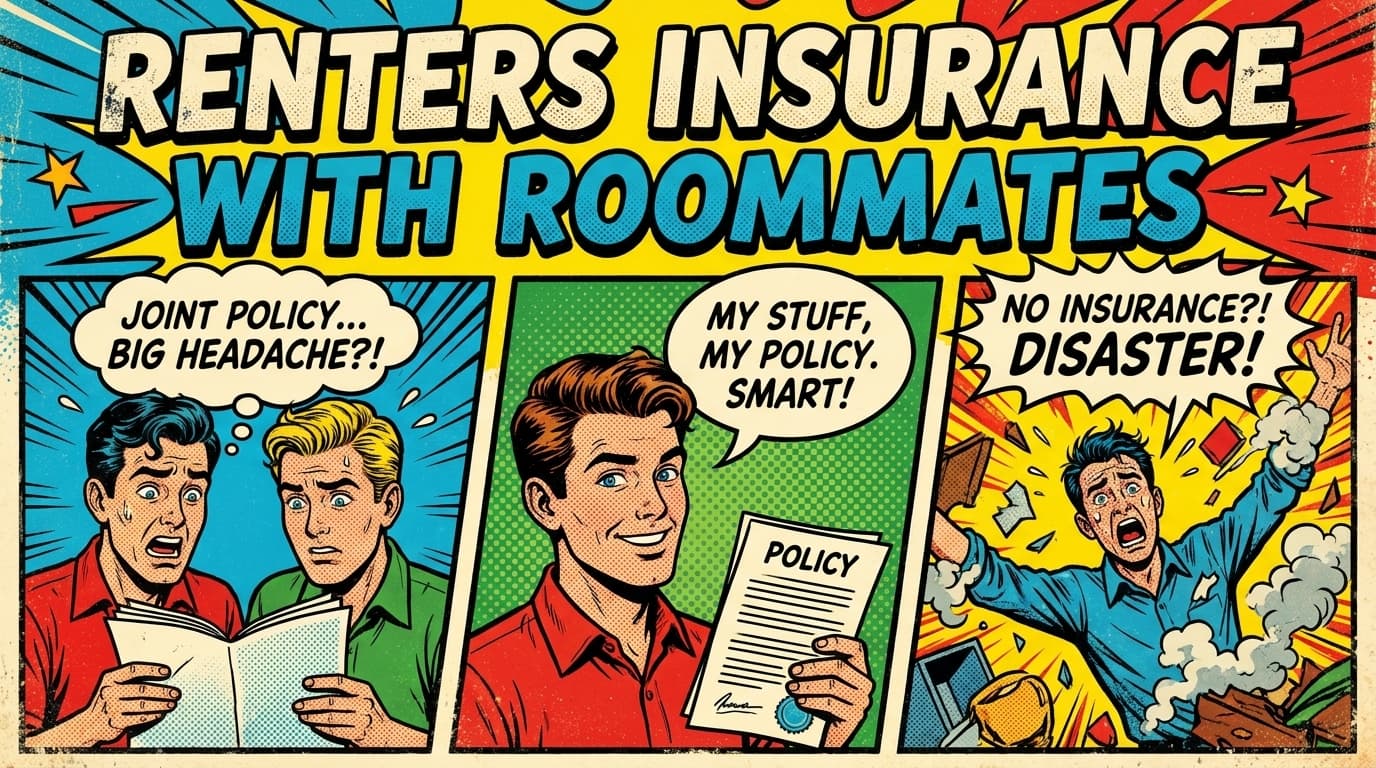
The cleanest answer: each roommate gets their own policy. It's a few extra dollars a month per person and avoids basically every complication. Don't split. Each pays their own.
When the lease requires renters insurance
Increasingly common: the landlord requires every tenant to carry renters insurance with the landlord listed as an interested party.
In that case:
- Each roommate gets their own policy.
- Each lists the landlord as an interested party.
- Each provides proof of coverage to the property manager.
- One joint policy usually doesn't satisfy a lease that names each tenant individually.
No splitting involved. Each pays their own.
What if one roommate refuses?
This happens. One roommate sees renters insurance as a waste of money and doesn't want to pay for it.
If the lease doesn't require it, that's their call. The risks they're taking:
- If their stuff is stolen, they get nothing.
- If they cause damage (their kitchen fire), they're personally liable. Could be financially ruinous.
- If they hurt themselves cooking, no medical coverage assistance.
The risks for the rest of the household:
- If a roommate without insurance causes an event that damages others' stuff, you're going through your own policy and that policyholder is on the hook for the deductible.
- A roommate without insurance can't cover their share of additional-living-expenses if you all need to relocate after an incident.
The rest of the roommates can't force them to get insurance. You can make it a requirement in the roommate agreement you write together at move-in.
Liability is the underrated piece
Most roommates think of renters insurance as "protection for my stuff." The bigger value is liability.
Real examples that have actually triggered liability claims:
- A guest slips in your kitchen and breaks their wrist.
- Your dog bites a delivery person.
- A candle starts a fire that damages a neighbor's apartment.
- You leave a faucet running, the apartment below floods, their ruined furniture is on you.
Without liability coverage, you're personally responsible for these costs. With insurance, your policy pays up to the liability limit.
For $20/month, $300,000 of liability coverage is genuinely cheap protection. Don't skip it.
What insurers are most common for renters
The usual suspects (no endorsement, just commonly available):
- Lemonade (app-based, fast)
- State Farm, Allstate, Geico (traditional)
- Nationwide, Liberty Mutual
- USAA (military families)
Shop around. Same coverage can vary $5-10/month depending on insurer. Most quotes take 5 minutes online.
How to actually pay for it
Because each roommate has their own policy, there's nothing to split. Each handles their own auto-pay.
The only thing to coordinate at move-in:
- Confirm everyone got a policy if the lease requires it.
- Compare what's covered, so nobody assumes someone else's policy covers them.
- Note the deductibles. If a claim happens, the deductible comes out of the policyholder's pocket, not the household's.
If you do go joint
If you and a roommate are determined to go joint (siblings, partners, or two close roommates who trust each other), confirm with the insurer:
- Are both names actually on the policy?
- What's the coverage limit per person?
- Who is liable if someone files a claim?
- What happens at move-out?
Document the answers. And split the bill equally, since both of you are covered equally. But honestly, separate policies are usually less work and more coverage.
What about renters insurance for sublets or short-term roommates?
If someone's only there for two months, they probably won't get their own policy. Two paths:
- They sign a sublet agreement that holds them liable for damage they cause, and they don't have stuff worth insuring.
- They get a short-term policy (some insurers offer monthly policies).
For the household's protection, the sublet agreement is the key document here.
TL;DR
- Don't split renters insurance. Each roommate gets their own policy. Coverage limits per person matter more than the $5 savings.
- Liability is the underrated piece. $300,000 coverage for $20/month is cheap protection from a real risk.
- If the lease requires it, each tenant needs proof. Joint policies usually don't satisfy the requirement.
- A roommate without insurance is their own risk. You can encourage but not force. Put it in your roommate agreement at move-in.
- Shop around. Same coverage varies $5-10/month between insurers.
Frequently asked questions
Should roommates share a renters insurance policy?
No, in almost every case. Each roommate should have their own policy. Shared policies have shared coverage limits (which leaves everyone under-protected), get messy at move-out, and many insurers won't write them for unrelated roommates anyway. The few dollars saved per month aren't worth the complications.
How much does renters insurance cost per roommate?
Typically $15-25 per month for a standard policy. Cost varies based on location, coverage amount, and deductible. Each roommate pays their own, there's no split because the policy covers that person's stuff and liability only.
What does renters insurance actually cover?
Three main things: your personal property (stuff stolen or damaged), liability (if someone gets hurt in your apartment or you damage someone's property), and additional living expenses if the apartment becomes unlivable. It does NOT cover the building itself or your roommate's stuff.
What if my roommate refuses to get renters insurance?
If the lease doesn't require it, they can technically skip it, but they're taking real risks (zero protection for their stuff, personal liability for any damage they cause). The risk for the household is that if they cause an incident, they're personally on the hook for damages and may not have the funds. Many roommates make insurance a requirement in their roommate agreement.
Does my renters insurance cover my roommate's stuff?
No. Your policy covers your personal property only. If your roommate's laptop is stolen, your policy doesn't replace it, theirs would (if they have one). This is one of the main reasons everyone should carry their own policy rather than relying on a single shared one.