Security Deposit Drama: Who Gets What When Someone Moves Out
The security deposit is the most forgotten roommate fact and causes the most move-out fights. Here's how to split, track, and return it without drama.

Anna
Supasplit Team

It's move-out day. The landlord mails back the deposit check. It's $2,700, a little less than the $3,000 you put down because of "carpet wear."
Your roommate says, "Cool, let's split it 50/50, so $1,350 each."
You stare at them. You put down $1,800 of the original deposit. They put down $1,200. You are not splitting it 50/50.
And now you have two weeks to figure this out, except nobody wrote anything down 14 months ago when you moved in.
Here's how to split a security deposit fairly, track it so nobody forgets, and handle the drama when someone moves out mid-lease.
Rule one: the deposit is not shared money
The most common roommate mistake: treating the deposit as a collective pot that gets split equally at the end. It's not.
A security deposit is the sum of each roommate's individual contribution. Whatever you put in is whatever you get back, minus your share of any damage.
If you contributed $1,800 and your roommate contributed $1,200, and the full deposit comes back, you get $1,800 and they get $1,200. End of story.
The problem is nobody writes this down. So 14 months later, when the check arrives, memory gets fuzzy and suddenly both people remember contributing equal amounts.
How to split the deposit when moving in
Three common approaches:
Equal contributions. Both put in half. Simplest. Only fair if you're also splitting rent equally.
Proportional to rent. If you pay 60% of rent (bigger room, higher income, whatever), you put in 60% of the deposit. This is the cleanest default when rent isn't 50/50.
Whoever can front it. One person pays the whole thing up front, the other pays their share back over the first 1-3 months. Fine if you track it and actually settle.
Whichever you pick, document it. The note just needs to say: "Deposit of $3,000 paid [date]. A contributed $1,800. B contributed $1,200."
That's it. Email it, screenshot it, pin it in your shared notes. You'll thank yourself in 14 months.
When damage happens: who pays
Landlords deduct from the deposit for damage. The fair rule:
- Shared damage (scuffed walls in the living room, worn carpet in the hallway): split by whatever ratio you split rent, or 50/50.
- Individual damage (hole in the wall of your bedroom, stain on their carpet): that person covers it, full stop.
- Normal wear and tear: landlords sometimes try to charge for this, it's often not allowed. Push back before you split anything.
You don't have to litigate every scratch. But a $400 dent in the door your roommate's partner kicked in during an argument? That's theirs, not a shared cost.
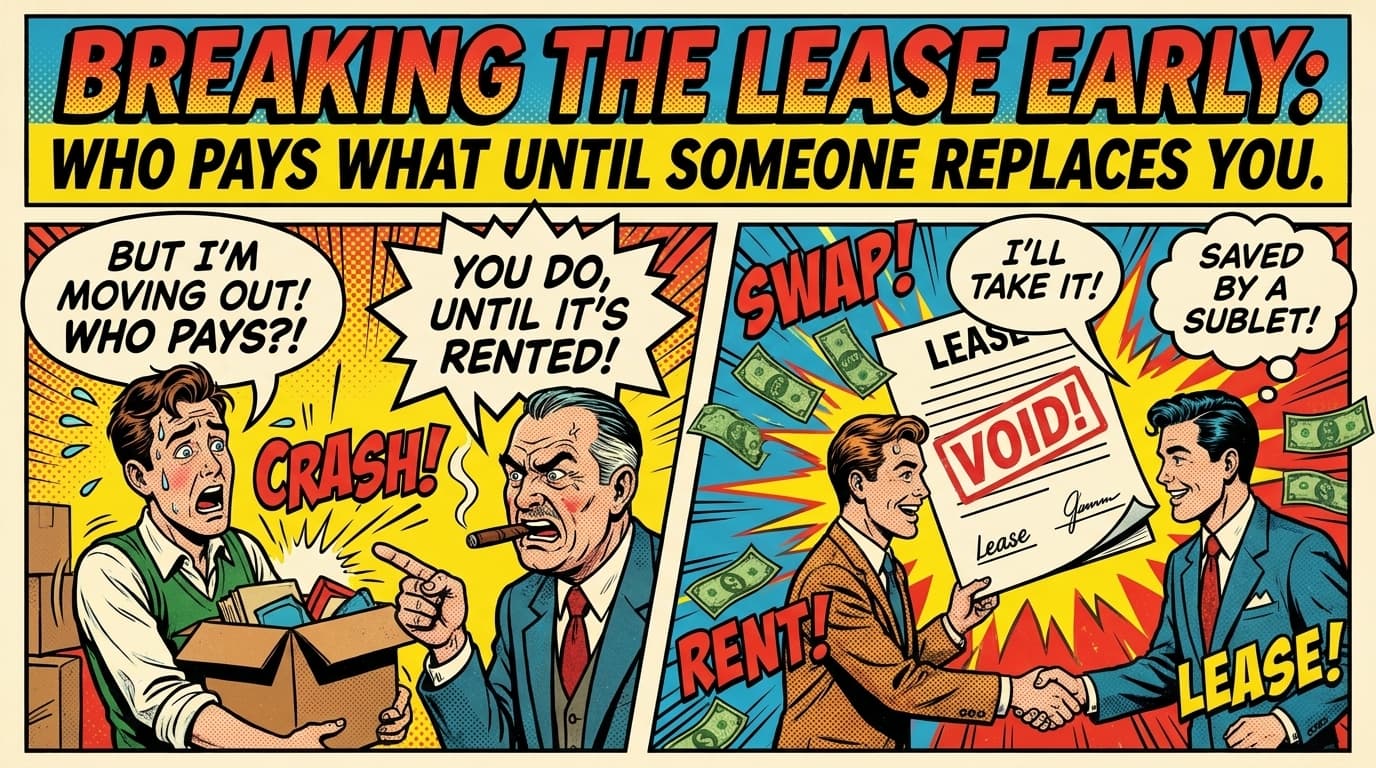
The mid-lease move-out scenario
Here's where it gets complicated. Someone is leaving six months in, a new roommate is moving in, and the deposit is sitting with the landlord for another eight months.
The rule: the outgoing roommate's deposit share should be paid back by the incoming roommate, not by the remaining roommate, and not by the landlord.
Why: the landlord isn't going to release the deposit until the whole lease ends. So if the outgoing roommate wants their money now, it has to come from the replacement, not from thin air.
The flow looks like this:
- New roommate moves in.
- New roommate pays the outgoing roommate directly for their share of the deposit.
- At end of lease, new roommate gets that share back from the landlord (minus damage).
Write this into the arrangement before the new roommate signs on. "You're paying $1,200 now, it becomes your deposit, you get it back when the lease ends." Crystal clear.
What if your roommate contributed nothing?
Sometimes one roommate fronts the whole deposit and the other "will pay them back." A few months pass. No money.
The answer here is firm: either they pay you their share, or they have no claim on any of the deposit at end of lease. Don't eat it.
If that conversation is getting avoided, raise it now, not at move-out. "Hey, I covered your $1,200 when we moved in. Can we set up a plan for you to pay that back over the next three months?" If they resist, that's useful information about your roommate and also about what the end of the lease is going to look like.
The move-out math
When the deposit check arrives (hopefully in full), here's how you divide it:
- Start with each person's original contribution.
- Subtract any damage charges that are clearly individual.
- Split any shared damage charges by your rent ratio.
- Each person's final share = contribution minus their portion of damages.
Example:
- Deposit returned: $2,700 (of $3,000, $300 deducted for shared carpet wear).
- You put in $1,800. Shared damage share: $150. You get back $1,650.
- They put in $1,200. Shared damage share: $150. They get back $1,050.
- Total: $2,700. Checks out.
Run the math on paper. Both agree. Then split the check.
A reality check
Security deposits are surprisingly emotional. People get weirdly defensive at move-out because the money feels like "ours," and splitting it equally feels like the fair move even when it isn't.
The fix is never at move-out, it's always at move-in. Write down who paid what. Both agree it's each person's individual contribution, not a shared pool. Revisit it when anyone moves out.
Do the paperwork now, avoid the drama later.
TL;DR
- Deposit contributions are individual, not a shared pot. Each person gets back what they put in, minus their share of damage.
- Write it down on move-in day: exact amounts, dates, who paid. Email it to both of you.
- Shared damage splits by rent ratio. Individual damage falls on that person alone.
- Mid-lease move-outs: incoming roommate pays outgoing roommate directly, becomes the new deposit holder.
- The fight happens at move-out, but the fix happens at move-in. Paperwork early, drama avoided later.
Frequently asked questions
How do roommates split a security deposit?
Each roommate's deposit contribution is individual, not shared. Whatever each person put in on move-in day is what they get back at move-out, minus their share of any damage charges. Equal split only applies if both put in equal amounts.
What happens to the security deposit when one roommate moves out early?
The outgoing roommate should be paid back by the incoming replacement roommate, not by the remaining roommate or the landlord. The new person's payment becomes their deposit, which they get back at the end of the lease.
Who pays for damage charges deducted from the deposit?
Individual damage (hole in your bedroom wall, stain on their carpet) is paid by the responsible person. Shared damage (worn carpet in common areas) is split by your rent ratio or 50/50. Normal wear and tear shouldn't be deducted at all, push back if the landlord tries.
Should I trust a verbal agreement about the deposit?
No. Memory gets fuzzy after a year of living together. Write down each person's contribution with dates and dollar amounts on move-in day, email it to both of you, and keep a copy in a shared folder. This is the single biggest move-out dispute saver.
What if my roommate never paid their share of the deposit?
Either they pay you their share now with a plan you both sign on, or they have no claim on any of the deposit at the end of the lease. Don't absorb their portion quietly. Raise it the moment you notice, not at move-out.