How to Actually Write a Roommate Agreement (Not Just Use a Template)
Templates are a starting point, not the finish line. Here's how to write a roommate agreement that reflects your actual situation and prevents real fights.

Anna
Supasplit Team
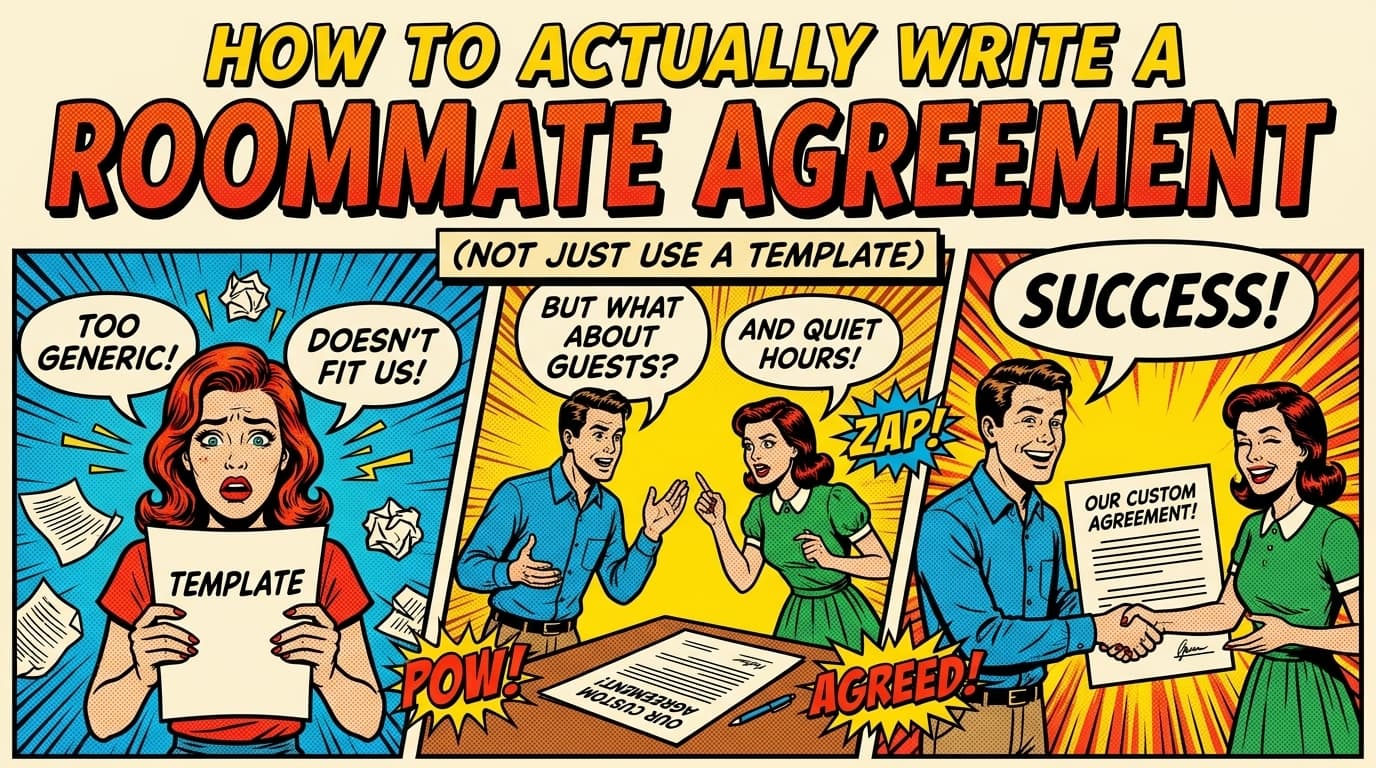
Templates are great. Templates also fail constantly because they're generic, and your living situation isn't.
If you actually sit down and write your own roommate agreement, the document does more for you than any template can. Not because the wording is better. Because the act of writing it forces you to talk about the things that quietly become fights.
Here's how to actually write one, step by step.
Step 1: schedule the conversation, don't ambush it
"Hey, can we sit down sometime this week to write down how we want to handle stuff?" beats "Hey real quick, let's write the rules" on the way out the door.
Give everyone time to think about what they care about. The conversation goes way better when nobody's caught off guard.
Schedule it for somewhere you can actually focus. Coffee table, kitchen table, anywhere with a notebook or a laptop. Not while one of you is making dinner.
Block 60-90 minutes. You'll need it.
Step 2: start with money, because money causes the most fights
Open with the part everyone's been avoiding. Get the money stuff settled first while everyone is still energized.
Questions to answer:
- What's our split on rent? Equal? By room size? By income?
- Who pays which utility bills, or do we have a shared fund?
- How does each utility get split (equal, by usage, with a tilt for WFH)?
- What about groceries: shared or separate carts?
- Subscriptions: who pays for what, who reimburses?
- How do we handle one-off shared purchases (a new couch, a vacuum)?
- Do we have a household emergency fund (for stuff like a broken washer)?
The specific answers matter less than the fact that everyone agrees. Write them down as you go.
Step 3: cover house operations
Once money is locked in, move to daily life questions. This is where templates often fall flat because the answers are deeply personal.
The usual list:
Cleaning
- How often do common areas get cleaned?
- Whose responsibility is what (kitchen, bathroom, living room)?
- Rotation or zones?
- Hire a cleaner monthly? Who arranges, how to split?
Kitchen
- Shared dishes or individual?
- Whose food is whose?
- Who buys the toilet paper, paper towels, dish soap ("household goods")?
- Can someone eat your leftovers?
Bathroom
- Shower curtain replacement, towel washing
- Personal toiletries: separate
- Shared toiletries: who buys?
Trash and recycling
- Who takes it out when
- What's recyclable
- Bin rotation
Laundry
- Order of operations (asking before throwing in)
- Shared detergent or individual
- What about delicates left in the dryer
If this sounds nitpicky, that's because it is. And the nitpicks are exactly what becomes a fight in month four. Get them out of the way now.
Step 4: rules about people in the space
The other big category. Often the trickiest.
Guests
- Overnight guests: how often is OK?
- Partners staying multiple nights a week: at what point are they basically a roommate?
- Parties or gatherings: how much notice, how big?
- Guests using shared spaces (eating from shared groceries, doing laundry)
Quiet hours
- Weeknights: from what time?
- Weekends: looser or same?
- Specific instruments, music volume, parties
Pets
- Allowed at all?
- New pets require everyone's agreement?
- Who pays for pet-related damage?
- Pet duty rotation if shared
Smoking and substances
- Indoor smoking (vape, weed, anything) rules
- Outdoor smoking expectations
- Anything else relevant in your household
Romantic relationships
- New partner staying over: norms
- Breakup with someone who'd been in the apartment a lot: how to handle
- Long-term partner moving in: process for that decision
These conversations are the awkward ones. Have them.
Step 5: emergency and exit planning
The part most agreements skip and most roommates wish they had.
Emergencies
- Apartment is uninhabitable (fire, flood, infestation): who handles what?
- Medical emergency for one roommate: emergency contact info shared
- Lockouts: spare key plan
One of us wants to leave early
- What's the notice period?
- Who's responsible for finding a replacement?
- What if the lease isn't transferable: how is rent covered until the lease ends?
- See our breaking the lease guide for the deeper version.
One of us breaks the agreement repeatedly
- What's the conversation flow?
- At what point is someone asked to leave?
- How is move-out handled in that case?
Death or major illness (rare but real)
- Emergency contact info shared
- Plan for handling their things, lease responsibility
Nobody enjoys writing this section. Future-you really appreciates it.
Step 6: write it down, cleanly
Use Google Docs, a notes app, anything where everyone has access. Format it readable. Each section labeled, bullet points for specifics, no dense paragraphs.
Don't use "shall" or legal language. Plain English. "We agree to take out the trash on Sundays" beats "It is agreed that household waste shall be removed weekly on the Sabbath."
When the draft is done, everyone reads it. Makes edits. Signs (or just dates and checks-off on the digital version).
Keep a copy each.
Step 7: revisit it
A roommate agreement isn't a fossil. Plan to revisit it:
- After 3 months (everyone's been living the rules, what needs adjusting?)
- After a new roommate joins or one leaves
- After any significant change (new pet, new long-term partner, work-from-home shift)
- Yearly, ideally
The agreement is a living document. Updating it is way easier than rebuilding household norms from scratch when something changes.
What if a roommate doesn't want to write one?
This happens. The classic objection: "We don't need to formalize this, we're adults."
Reframe it: "I'd rather have it in writing so we don't have to keep relitigating stuff. Five hours now saves five thousand awkward Slack messages later."
If they still resist, that's information. People who refuse to put boundaries in writing are often the same people who later argue that the boundaries weren't real because they were never agreed to. Note that and decide whether the housing arrangement is right for you.
When templates do help
A template gives you the categories to think about, the headings to organize under, and reasonable defaults for things you don't have strong opinions on. Use one as a scaffold (our free template is a starting point), then customize ruthlessly.
The template alone won't save you. Your edits will.
TL;DR
- Schedule the conversation properly. Don't ambush. Give everyone time to think.
- Start with money, because that's where most fights actually live.
- Cover house operations, including the nitpicky stuff (toilet paper, dishes, cleaning).
- Plan for guests, quiet hours, pets, partners. The people-in-the-space rules.
- Address emergencies and exit scenarios. Easier to write before they happen.
- Write in plain English, sign, keep a copy each, revisit every 3-6 months.
Frequently asked questions
How do I start writing a roommate agreement?
Schedule a 60-90 minute conversation with all roommates ahead of time. Don't ambush anyone. Start with money (rent, utility splits, shared expenses) because that's where most fights actually live, then move to house operations and people rules. Write as you discuss so the document grows naturally.
Is a roommate agreement legally binding?
Not in the way a lease is. You can't take a roommate to small claims court for not doing dishes. What an agreement does is establish clear shared expectations, which is what most roommate disputes are actually about. The value is in the conversation and the documented norms, not in legal enforceability.
What should I do if my roommate refuses to sign an agreement?
Reframe it as effort-saving rather than rule-imposing: 'I'd rather not relitigate this every month, can we just write it down?' If they still refuse, that's information. People who decline to put expectations in writing often dispute those expectations later by claiming they never agreed. Consider whether this housing arrangement is right for you.
How often should we update the roommate agreement?
Revisit it about every 3-6 months, and any time something significant changes (new roommate, new pet, partner moving in, big shift in work-from-home patterns). The agreement is a living document. Updating it is much easier than rebuilding norms from scratch when conflict emerges.
What's the difference between writing my own and using a template?
Templates give you categories and reasonable defaults. Writing your own forces the actual conversations that prevent fights. Use a template as a scaffold for organization, then customize heavily based on what your specific roommates care about. The act of personalizing is where most of the value comes from.