Breaking the Lease Early: Who Pays What Until Someone Replaces You
Moving out mid-lease? Here's who's on the hook for rent, fees, and the gap until a replacement moves in, plus how to keep the roommate relationship intact.

Anna
Supasplit Team
You got a new job in another city. Start date is in three weeks. Your lease has seven months left.
Your roommate's face, when you tell them, says everything. They're happy for you. They're also doing fast math on whether they can afford this place alone.
Breaking a lease early with a roommate is one of the highest-stakes money conversations in shared housing, and one of the least-discussed. Here's who's actually on the hook for what, and how to handle it without burning the friendship.
The core principle: you leaving isn't their problem to solve
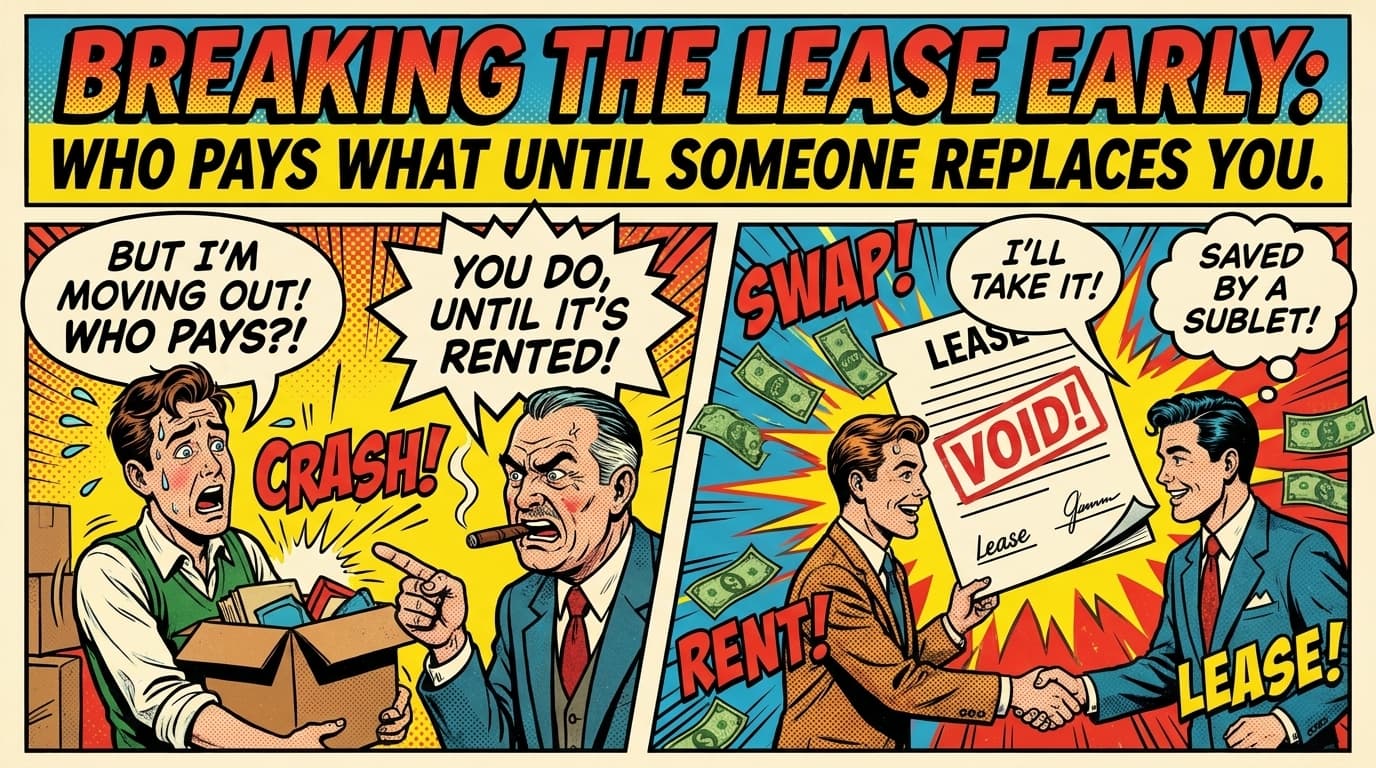
When you signed the lease, you and your roommate signed a shared obligation to the landlord. If you leave, the landlord still wants the full rent every month. They don't care who pays it.
What that means practically: the person leaving is responsible for their share of rent until either (a) a replacement moves in, or (b) the lease ends. Full stop.
The remaining roommate shouldn't have to cover your share while you're gone. They also shouldn't have to find your replacement on their own. Both are on you.
This is the most forgotten rule of roommate move-outs. People leave, stop paying, and assume the situation will "work itself out," meaning the remaining roommate eats the cost and the relationship quietly dies.
The actual checklist
As the leaving roommate, here's what you owe:
- Your share of rent until a replacement moves in. Or until the lease ends, whichever comes first.
- Any lease-breaking fee the landlord charges. If you break the lease unilaterally, that's on you. The remaining roommate shouldn't pay.
- Your share of utilities until move-out day. Obvious, but worth saying.
- The work of finding a replacement. Post listings, do showings, vet candidates. Your problem, not theirs.
- Cleanup and repair of your space. Any damage you caused in your room comes out of your deposit, not theirs.
You do not owe:
- Compensation for the hassle (beyond the above).
- A "finder's fee" to the remaining roommate.
- A portion of their rent after a replacement moves in and takes over your share.
The replacement math
Here's where things get sticky. Common scenarios:
Best case: You find a replacement before your move-out date. They move in, take over your share, done. You pay nothing after move-out.
Gap case: You leave on day 30. A replacement moves in on day 60. You owe 30 days of your share ($900 if rent is 1,800/2 = 900) to the remaining roommate. Pay it before you leave or on a clear schedule.
Long gap: Two months pass, no replacement. You're paying 2x your share in two places, your old rent and your new place. Painful, but your obligation.
Lease ends before replacement found: You keep paying your share until the lease ends. Same obligation.
Worst case: You leave, don't pay, and tell your roommate "good luck." This is how lifelong roommate relationships die.
How to find a replacement (the leaving roommate's job)
Start immediately. The minute you know you're moving, you should be posting.
- Post on Facebook roommate groups and local housing groups. These are more active than Craigslist for most cities now.
- Spread via your network. Text every friend-of-a-friend. Most good roommates come through 2nd-degree connections.
- Screen the candidates. Job, income, references, move-in date, vibes. Don't stick your remaining roommate with someone sketchy.
- Get the remaining roommate's approval. They live there. They have veto power. Respect it.
The remaining roommate's veto on candidates is the most important part. If they say no to someone, that's a no, no matter how much you like the candidate. You're leaving, they're staying.
What to agree on before you pack
Sit down with your roommate. Write this out. Both sign.
- Move-out date: exact date you're gone.
- Rent coverage: you pay your full share for X months until a replacement is found or the lease ends.
- Utilities: you cover your share through move-out day. New roommate takes over from move-in.
- Deposit: your deposit share gets paid back by the incoming replacement, not the landlord. Document this.
- Furniture/shared stuff: what you're taking, what you're leaving, what needs to be bought out.
- Veto process: remaining roommate has final say on replacements.
- Timeline to find replacement: reasonable target, like 45-60 days.
- What happens if no replacement by X date: you keep paying your share until the lease ends.
This takes 20 minutes and prevents months of friction.
The lease-breaking fee question
Many leases have an explicit "break fee" (often 1-2 months rent) that lets you exit cleanly. Read your lease.
If you're invoking the break fee, that fee is yours alone. You're the one breaking the lease. The remaining roommate isn't paying a fee for your decision.
If the break fee releases both of you from the lease, and the remaining roommate actually wants to stay, they'll need to sign a new lease in their name. Their problem then, and their responsibility. But if the break fee kicks them out too (against their will), you're in bigger territory, and you probably owe them genuine help finding a new place, not just the fee split.
The "we both want to leave" case
Sometimes the conversation is mutual: you got a job elsewhere, they realized they want to move back in with family. Both leaving, nobody wants to stay.
This is simpler. You both break the lease together, both pay any break fees (split 50/50 or by rent ratio), both stop paying on move-out day. The landlord re-rents the place.
No replacement hunting, no coverage gaps. Just a clean mutual exit.
Keeping the friendship
Most roommate relationships survive a mid-lease move-out. The ones that don't, usually lose it in the first 48 hours after the announcement, when the remaining roommate realizes they might have to carry rent alone.
Things that help:
- Announce it as early as possible. More runway = less panic.
- Lead the conversation with "here's what I'm going to do to make this smooth" not "I'm leaving, good luck."
- Actually do the replacement-finding work. Don't outsource it.
- Pay what you owe on time, every time. Your financial reliability in the transition is what they'll remember five years from now.
TL;DR
- Your share, your problem, until a replacement moves in. The remaining roommate doesn't cover your rent.
- Finding the replacement is the leaver's job. Post, screen, present candidates. Remaining roommate has veto.
- Write it down before you pack. Move-out date, coverage period, veto process, deposit handoff, all in writing.
- Break fees are on the person breaking the lease, not the one who's staying.
- Announce early, handle the work, pay on time. That's what keeps the friendship intact.
Frequently asked questions
Who pays rent when one roommate breaks the lease early?
The leaving roommate pays their share of rent until a replacement moves in or the lease ends, whichever is first. The remaining roommate shouldn't have to cover any of the leaver's share. This is the core rule and the most-forgotten one.
Is the leaving roommate responsible for finding a replacement?
Yes. The person breaking the lease does the posting, screening, and candidate presentation. The remaining roommate has veto power on who actually moves in because they're the one who'll live with the new person.
Who pays the lease-breaking fee if my roommate moves out early?
The roommate breaking the lease pays the break fee. If the break fee forces the remaining roommate out against their will, the leaver often owes more than just the fee, including help finding a new place. Read your lease carefully.
How long should it take to find a replacement roommate?
Plan for 45 to 60 days. Start the day you know you're moving. Set a specific target date in the written agreement, and agree in advance on what happens if no replacement is found by then (usually the leaver keeps paying their share until the lease ends).
What happens to my security deposit if I move out mid-lease?
The landlord holds the deposit until the lease actually ends. Your share should be paid back to you directly by the incoming replacement roommate on their move-in day, not by the landlord. Document this in writing so nobody forgets at end of lease.