The Month-to-Month Roommate Agreement (For Loose Living Situations)
Not signing a year-long lease together? Here's the month-to-month roommate agreement template for short-term, flexible, or trial-period roommates.

Anna
Supasplit Team
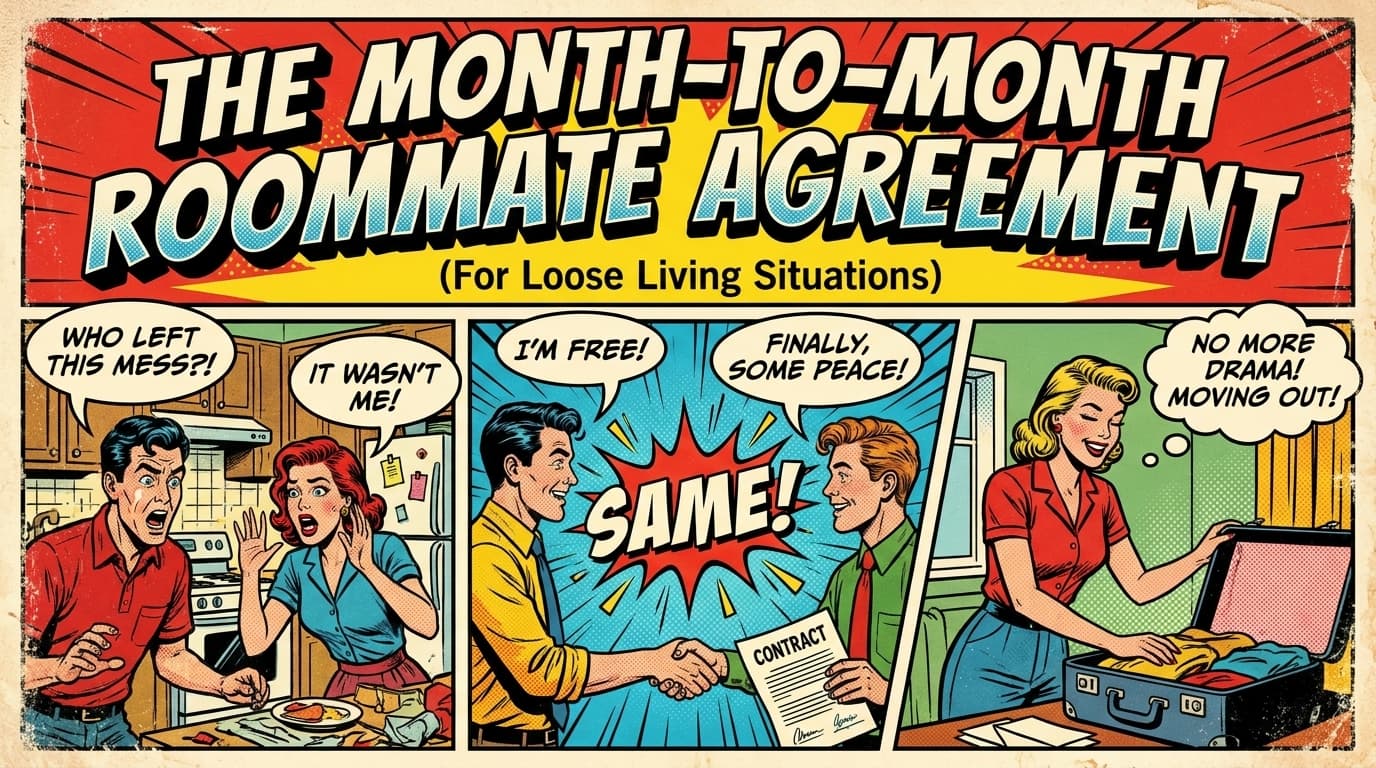
Not every roommate situation comes with a year-long lease signed in triplicate. Sometimes it's a friend crashing for a few months until they find a place. Sometimes it's a trial run with a new partner. Sometimes the apartment itself is on a month-to-month lease and nobody knows how long anyone's staying.
Month-to-month roommate setups need agreements too. Different from year-lease agreements because the timeline is fuzzier and the exit is fast. Here's how to set one up.
When you need a month-to-month roommate agreement
Four common scenarios:
1. You're on a month-to-month lease yourself. Either the landlord prefers it or you couldn't commit to a year. You're bringing in a roommate to split the cost, but neither of you knows how long the arrangement will last.
2. A friend is staying with you temporarily. They lost their housing, they're between leases, they're moving cities and need a landing pad. It's open-ended in nature, paid monthly.
3. You're trial-running a long-term roommate situation. You're not sure if you actually want to live with this person, so you agree to a 30-day trial before signing a longer commitment.
4. You're a homeowner taking in a roommate without a formal lease. You own the place, they pay you monthly to live there, no traditional lease.
All four benefit from a written agreement, even if it's two pages.
Why month-to-month needs more clarity, not less
Counterintuitively, the more flexible the arrangement, the more important the paperwork. Reasons:
- There's no underlying lease to fall back on for shared rules.
- Notice periods are shorter, so both sides need to know when things can end.
- Money has to be handled cleanly because the relationship may end suddenly.
- It's emotionally fraught (often friends-of-friends, recent partners), and feelings make money harder.
A short written agreement removes ambiguity from a fundamentally ambiguous situation.
What to include
Keep it one to two pages. Cover:
The basics
- Names of everyone involved
- Address
- Start date (and a tentative or open-ended end)
- Notice period to end the agreement (typically 30 days)
Money
- Total monthly rent the roommate pays
- Due date and method (Venmo, bank transfer, cash)
- Late fees (if any)
- What's included (utilities, internet) vs. extra
- Security deposit amount, if any
Shared expenses
- How utilities are split (equal, by room, by use)
- Who fronts which bills and how reimbursement works
- Groceries: shared or separate carts?
- Subscriptions like Netflix or shared streaming
House rules
- Quiet hours
- Guest policy (overnight guests, partners staying over)
- Cleaning expectations
- Smoking, pets
- Kitchen, bathroom, common area norms
Move-out
- Notice period
- Cleaning expectations on departure
- Security deposit return conditions
- What happens if either side gives notice
Signatures and date
- Both (or all) parties sign
- Date and keep copies
The whole thing should fit on two pages. Less if you're tight on the wording.
The notice period: 30 days is standard
In most US states, the legal default for month-to-month tenancy is 30 days' notice to terminate. Either side, no reason required.
For a roommate (not a tenant under the law, but a contributor to shared housing), 30 days is also the right default. It gives the leaving roommate time to pack, and the staying party time to find a replacement or absorb the rent.
Shorter notice (14 days) makes sense if:
- The arrangement was explicitly described as short-term
- The room is easy to refill in your market
- Both sides are flexible
Longer notice (45-60 days) makes sense if:
- The market is competitive and finding a roommate takes time
- The rent is significant and you can't easily cover it solo
- You're in a small town where rental turnover is slow
Pick a notice period and write it down.
What if you're a homeowner taking in a roommate?
Legally this is sometimes called a "lodger" arrangement rather than a tenancy. Rules vary by state.
In most states:
- Homeowners taking in a single lodger have wider latitude than landlords.
- You can usually evict a lodger more quickly than a tenant.
- You don't typically need to register the arrangement.
BUT the second you take in two or more lodgers, you become a landlord under the law in many states, and tenancy rules kick in. Check your state's specifics.
For a single lodger:
- Use a month-to-month roommate agreement, not a formal lease.
- Document the rent, the notice period, and the rules.
- Keep records of payment.
- If issues arise, treat it as you would a friend overstaying, not a tenant.
Handling money cleanly
For month-to-month, simpler is better:
Rent: monthly transfer, fixed due date. Use Venmo, Zelle, or bank transfer. No cash.
Utilities: the easiest setup is "rent includes utilities" with a fixed monthly amount. Less precise, less admin. If utility bills spike unexpectedly, host absorbs the variance.
Shared expenses (groceries, subscriptions): if you're sharing groceries, track them. If you're splitting Netflix or Spotify, agree to a monthly amount. Use an app to track or settle weekly so it doesn't pile up.
Security deposit: keep it modest (half-month's rent or one month's rent). Hold it in a separate account. Return it after move-out if everything is OK.
When the trial period ends
If the agreement is a 30-day trial:
- At day 25 or so, sit down and decide. Continuing? Ending? On the same terms or different ones?
- If continuing, either renew the same agreement or switch to a year-long one if you both want stability.
- If ending, the move-out date is the end of the trial, no extra notice required.
Don't let the trial period quietly become indefinite. The whole point was to have a checkpoint, use it.
When things end fast
Sometimes a month-to-month situation goes sideways quickly. The roommate stops paying, brings someone problematic into the apartment, or just becomes impossible to live with.
Your options depend on legal setup:
- You're both on the lease: you may need a formal eviction process, even with 30-day notice in the agreement.
- They're your sublet/lodger: you have more flexibility, but still need to give whatever notice is in your agreement or required by state law.
- They're a friend crashing without payment: they're a guest, not a tenant, and you can ask them to leave.
When in doubt, give written notice that complies with state law, document everything, and consult a local tenant-landlord resource if it gets contentious.
TL;DR
- Month-to-month arrangements need agreements, possibly more than long-term ones. Less underlying structure to fall back on.
- Keep the agreement to one or two pages. Cover rent, utilities, rules, notice, deposit.
- 30 days' notice is the standard for ending the arrangement, in writing.
- Bundled rent including utilities is the easiest financial setup for short arrangements.
- Use a security deposit (half-month or one month) held in a separate account.
- Don't try to force someone out informally. State laws protect tenants and lodgers, follow proper notice.
Frequently asked questions
Do I need a written agreement for a month-to-month roommate?
Yes. Even for short or open-ended arrangements, a one-page written agreement clarifies rent, utilities, notice period, and house rules. The flexibility of month-to-month makes ambiguity more likely, not less, which is why writing it down matters.
What notice period should a month-to-month roommate give?
30 days is the standard, matching most state laws for month-to-month tenancies. Shorter notice (14 days) works if the arrangement was explicitly short-term and the market is fast. Longer notice (45-60 days) makes sense in slower rental markets where replacements are harder to find.
How much security deposit should I collect from a month-to-month roommate?
Typically half a month's rent to one month's rent. Hold it in a separate account, not commingled with your spending money. Return it after move-out if there's no damage and the room is left clean. The deposit protects you against early-departure rent loss and minor damages.
Can I just ask my month-to-month roommate to leave?
You need to give whatever notice is in your agreement or required by state law (usually 30 days). Even informal arrangements have legal protections in most states. Never try to force someone out by changing locks, removing their belongings, or cutting utilities, those moves are illegal almost everywhere.
What's the difference between a month-to-month roommate and a lodger?
A roommate is usually a co-tenant sharing rent in a shared space. A lodger is someone you (the homeowner or primary tenant) house in your space for payment, often with fewer legal protections than a tenant. The specific rules vary by state. Either way, a written agreement clarifies the arrangement.