When You Earn Way More (or Less) Than Your Partner: A Playbook
A real playbook for couples with unequal incomes. How to split bills fairly, handle lifestyle mismatch, and keep money from becoming a wedge.

Anna
Supasplit Team

You make $140K. Your partner makes $55K. Or swap the numbers, doesn't matter. You're the couple whose incomes don't match, and every piece of generic money advice kind of ignores that.
This is the actual playbook. How to split bills, where lifestyle mismatch sneaks in, and how to stop money from quietly becoming the thing you fight about instead of the thing it is (just numbers, plus feelings).
Name the gap first
Before any system, both of you need to name the gap out loud. Not the dollar amounts necessarily, but the ratio.
"I earn about 2.5x what you earn right now." "My paycheck is about 40% of yours."
People who have been together for years sometimes haven't actually said this sentence. They've danced around it with "I make more" or "you make less." Naming the ratio makes the rest of the conversation possible.
Why: every splitting method downstream depends on the ratio. Every lifestyle decision does too. You can't design a fair system without the input.
The core split question
The big choice is between:
- 50/50: equal dollars out of each paycheck
- Proportional: equal percentage of each paycheck
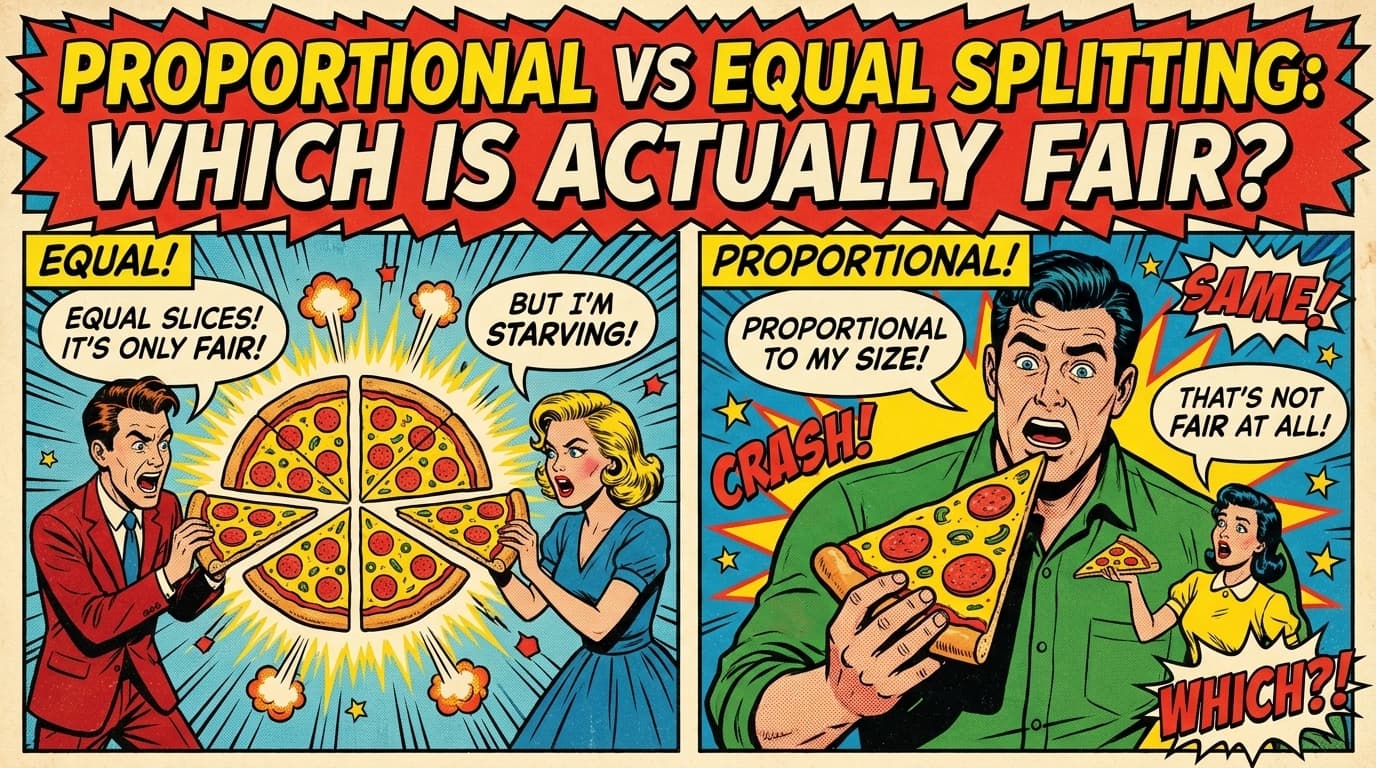
With unequal incomes, 50/50 starts punishing the lower earner fast. Here's the math everyone eventually runs:
Rent is $3,000. You make $8,000/mo, your partner makes $4,000/mo.
- 50/50: each pays $1,500. You have $6,500 left. Partner has $2,500 left.
- Proportional: you pay $2,000 (67%), partner pays $1,000 (33%). You have $6,000 left. Partner has $3,000 left.
Under 50/50, your partner is spending 38% of income on just their share of rent. That's brutal. Under proportional, you're both spending 25%, equal burden.
The decision flowchart:
- Incomes within 25% of each other? 50/50 is fine, simpler.
- Incomes differ by more than 25%? Proportional is almost always fairer.
- Incomes differ by more than 50%? Proportional is necessary, not just preferred.
The emotional objections (on both sides)
Proportional is the fair math. It's also where couples get stuck emotionally.
If you're the higher earner, you might feel:
- "I'm paying for their life, not just our shared life."
- "I worked hard for this income. Why am I paying more just because they earn less?"
- "If this ever ends, I will have subsidized them for years."
If you're the lower earner, you might feel:
- "Proportional makes me feel like a charity case."
- "I don't want my contribution to be smaller. It feels infantilizing."
- "If I'm not paying equally, do I get equal say?"
All of these are real. All of them are also addressable.
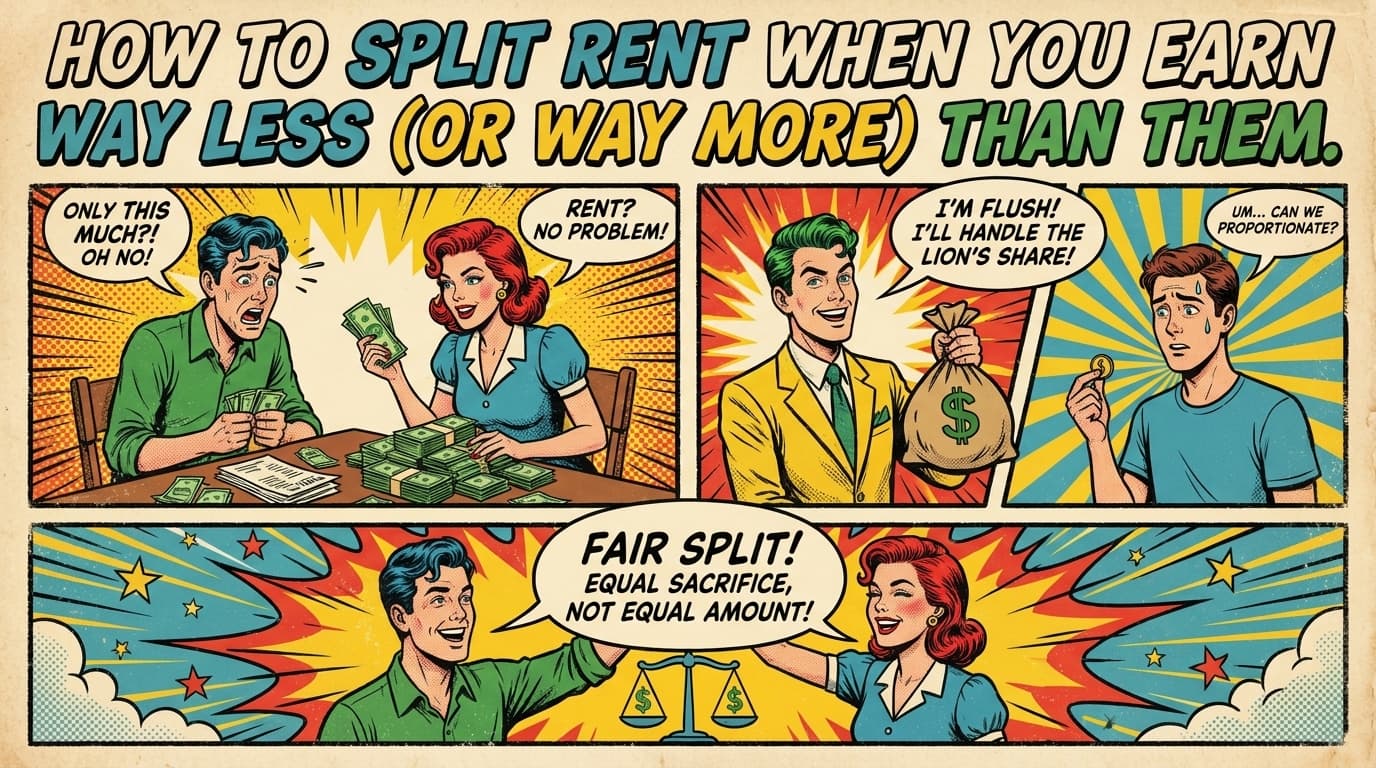
For the higher earner: proportional isn't "paying for their life." It's paying for your shared life in a way that doesn't crush them. The lower earner's breathing room translates directly into quality of life you both experience. You're not being penalized for success, you're using it to make the shared life livable.
For the lower earner: proportional is math, not charity. You're both contributing the same percentage of what you earn. That's equal sacrifice. "Less money" isn't the same as "less contribution" when incomes differ. And yes, you get equal say. Always.
The lifestyle mismatch problem
Even with a fair split, unequal incomes create a secondary issue: the higher earner can afford things the lower earner can't. Nice dinners, weekend trips, a gym that costs $200/month.
Without explicit conversation, two patterns emerge:
Pattern A: the higher earner scales up, the lower earner tries to keep up, and the lower earner ends up financially stretched.
Pattern B: the couple lives at the lower earner's level, and the higher earner slowly resents what they can't enjoy.
Both bad. Workable approaches:
- The higher earner treats sometimes, explicitly, without expecting reciprocity. The gift is real, not a loan.
- Separate "personal splurge" budgets. The higher earner's is bigger, and that's fine. The lower earner isn't obligated to match.
- Shared lifestyle decisions get made at the lower earner's comfortable rate. If the higher earner wants more, they cover the gap or do it solo.
The accounts question
With unequal incomes, the account setup matters more than with matched incomes.
Fully separate: usually the worst fit. Proportional is harder to manage when everything's split transaction-by-transaction and the lower earner is constantly reimbursing Venmos they can't quite cover.
Yours-mine-ours: usually the best fit. Proportional contributions go into a shared pool that pays shared bills. Personal money stays personal. Nobody tracks individual bills.
Fully joint: works for committed couples with aligned goals, but only if you build in equal personal allowances. Without that, the higher earner can feel watched and the lower earner can feel dependent. Both corrosive.
Big purchase decisions
When incomes are uneven, big-purchase conversations get weird.
Examples:
- Buying a house: who's putting in what for the down payment?
- Vacation: can the lower earner afford the kind of trip the higher earner wants?
- Furniture: does the higher earner pick the couch because they're paying more for it?
The rule: decision power is equal, not proportional. Both of you weigh in equally, even if one of you is contributing more dollars. Higher income doesn't buy more vote.
For down payments specifically: document what each of you contributed, in writing. Even if you're not married, especially if you're not married. A house bought with uneven contributions, if separated later, requires that documentation. Don't let it live in memory.
Income changes
Incomes shift. Raises, promotions, job losses, career changes, kids and the parent who stays home. The ratio that defined your current split won't hold forever.
Revisit the ratio:
- Once a year, as a scheduled thing
- Immediately after any income change over ~10%
- Immediately after any big life event (marriage, kid, move)
Adjust the contributions, don't just let them drift. A couple where the lower earner's income doubled but they're still paying "their old share" is a couple with a quiet resentment machine.
When the gap is enormous
If one of you earns 5x the other or more, most "50/50 vs proportional" framing breaks down. At that point you're often talking about:
- Pretty much all shared expenses coming from the higher earner
- The lower earner contributing in non-financial ways (caregiving, household management, emotional work) that offset the cash gap
- Separate conversations about long-term security (what happens if the relationship ends, who owns what, is there a prenup or postnup)
This isn't wrong or bad. It's just a different relationship. The couples who make this work are explicit about it. The ones who don't make it work are the ones pretending the gap isn't there.
TL;DR
- Name the ratio out loud. You can't design fairness around a number you haven't said.
- Over 25% income gap: proportional is almost always fairer than 50/50.
- Address the emotional objections on both sides. They're real and they don't disappear with better math.
- Yours-mine-ours with proportional contributions is the default modern setup for unequal incomes.
- Decision power is equal, not proportional. Higher income doesn't buy more vote.
- Revisit the ratio yearly and after any big income change.
Frequently asked questions
How should couples with unequal incomes split bills?
Proportional to income is almost always fairer when incomes differ by more than 25%. Each partner pays a percentage of shared expenses equal to their share of combined income. That way the burden is equal even if the dollars aren't. 50/50 works fine when incomes are close but starts punishing the lower earner fast as the gap widens.
Is proportional splitting fair to the higher earner?
It's fair by the definition of 'equal burden' rather than 'equal dollars.' You're both using the same percentage of income. The higher earner still has way more disposable income left over. Most higher earners who try proportional prefer it because it prevents the lower-earner squeeze that quietly erodes the relationship.
How do you handle lifestyle mismatch when one partner earns much more?
Three moves that work: the higher earner treats sometimes, explicitly, without expecting reciprocity; each partner has separate personal splurge budgets; shared lifestyle decisions are made at the lower earner's comfortable rate. What doesn't work: the higher earner quietly picking up every check, or the couple pretending the gap doesn't exist.
Does the higher earner get more say in financial decisions?
No. Decision power is equal, not proportional. The higher earner contributing more dollars doesn't translate into more vote on where those dollars go. Both partners weigh in equally on big purchases, big vacations, big financial decisions. Otherwise the money relationship becomes a power relationship, and that corrodes everything.
How often should couples revisit their income split?
At least once a year, scheduled, not when it becomes a problem. Also immediately after any income change of roughly 10% or more, and after big life events (marriage, kid, move). Letting the ratio drift while incomes change is how resentment builds silently for years.