Tipping on Vacation: The Cheat Sheet for 20+ Countries
Tipping 20% in Tokyo is offensive. Tipping nothing in New York is worse. A fast, honest cheat sheet for tipping on vacation across 20+ countries.

Anna
Supasplit Team
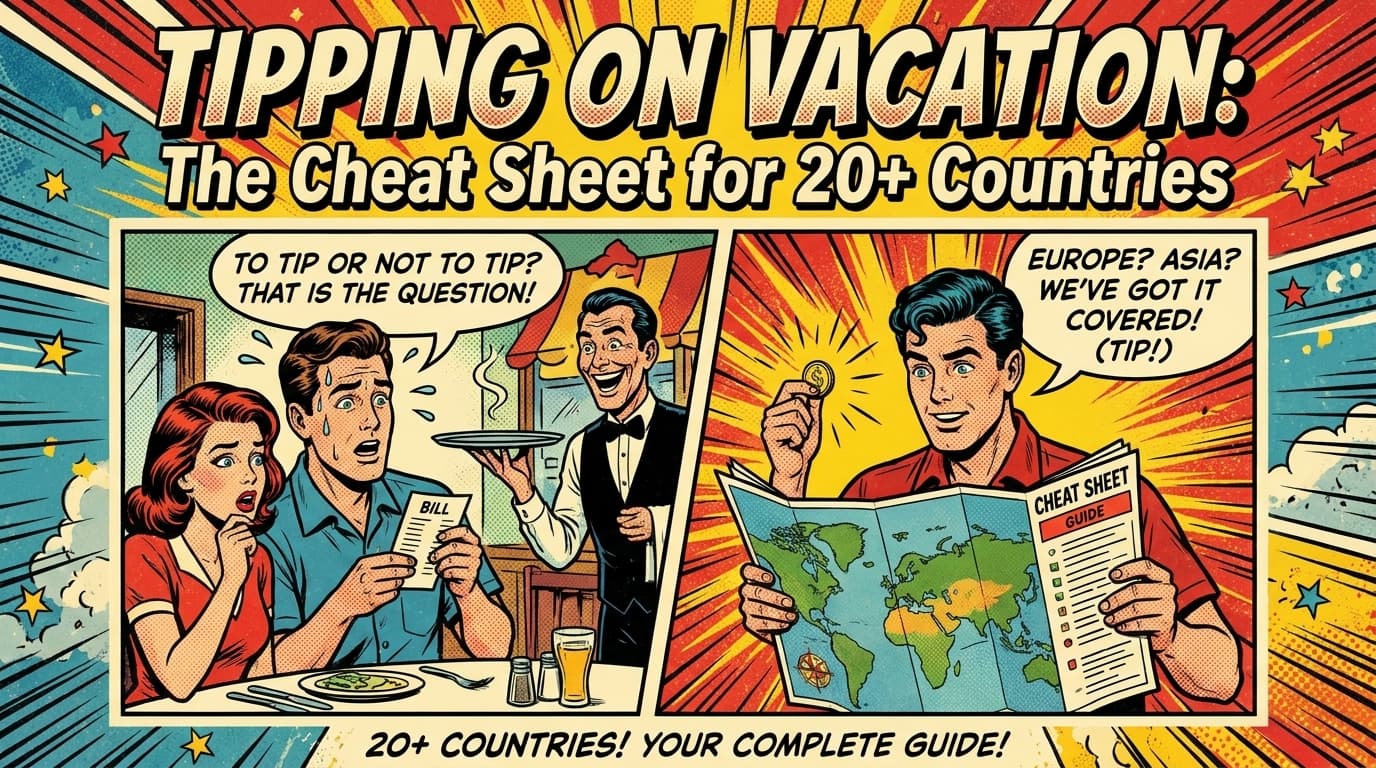
You just finished dinner in Lisbon. The bill is 68 euros. Your friend is pulling out a 15 euro tip because 'that's what we do back home.' The server is eyeing you like you're being weird, because you are.
Tipping travels badly. Here's the cheat sheet.
The one rule that covers most of the world
Outside the US and Canada, 10% is already generous. 5% is normal in most of Europe. Zero is fine in Japan, South Korea, and most of East Asia, where tipping can actually insult the staff.
If you remember nothing else: don't export American tipping. 20% in Paris marks you as a tourist and makes future travelers' lives harder when staff start expecting it.
The cheat sheet
North America
- United States: 18-22% at sit-down restaurants, $1-2 per drink at bars, 15-20% for taxis/rideshares, $2-5 per bag for hotel bags. See our full US tipping guide.
- Canada: 15-18% at restaurants, similar to US for other services. A bit lower than US but same general vibe.
- Mexico: 10-15% at restaurants (service usually not included), 10-20 pesos per bag for bellhops.
Western Europe
- France: Service is included by law ('service compris'). Round up or leave 5-10% for great service. Don't tip 20%.
- Italy: Service charge ('coperto' or 'servizio') often already on the bill. Leave a few euros on top if you loved the meal. No percentage expected.
- Spain: 5-10% at restaurants is generous. Round up at bars. No tipping for quick espresso or beer at the counter.
- Portugal: Similar to Spain, 5-10% is polite, not required.
- Germany: Round up or 5-10%. Tell the server the total amount you want to pay when they take the card, don't leave cash on the table.
- Netherlands: 5-10%. Service included but rounding up is appreciated.
- UK/Ireland: 10-12.5% at restaurants (often already added). Round up taxis. Buy the bartender a drink instead of tipping.
- Switzerland: Service included by law. Round up or leave small change.
- Greece: 10% at restaurants is standard, round up for taxis.
Nordics
- Sweden, Norway, Denmark, Finland, Iceland: Tipping not expected. Round up for great service. Servers are paid properly, the math isn't on you.
Eastern Europe
- Poland, Czech Republic, Hungary: 10% at restaurants is the norm. Hand it directly to the server, not on the table.
- Croatia: 10% at restaurants, round up at bars.
East Asia
- Japan: Do not tip. It can genuinely confuse or offend staff. If service was exceptional, a small gift or a thank-you note works better. High-end ryokans may include a service charge.
- South Korea: Also no tipping. Service charge sometimes added at high-end places.
- China (mainland): Tipping is not customary. In Hong Kong, service charge is usually added.
- Taiwan: No tipping expected. Service charge at nicer restaurants.
Southeast Asia
- Thailand: Rounding up is common, 10% at nicer restaurants. Service charge often already on the bill.
- Vietnam: Tipping becoming more common in tourist areas, 5-10% is fine. Not expected for locals.
- Indonesia (Bali): 5-10% at restaurants. Service charge often included, check the bill.
- Philippines: 10% if service charge isn't already added.
- Singapore, Malaysia: Service charge added to most bills. No additional tip needed.
Middle East
- UAE: 10-15% at restaurants. Service charge often added but goes to the house, not staff, so a cash tip for the server still lands.
- Turkey: 10% at restaurants. Round up taxis.
- Israel: 12-15% at restaurants, service not usually included.
Australia & New Zealand
- Tipping not expected. Round up for great service. Staff are paid a proper wage.
Latin America
- Argentina: 10% at restaurants. Cash tips preferred due to inflation.
- Brazil: 10% often added as 'serviço,' optional to add more.
- Costa Rica: Service charge usually added (10%), extra is a bonus.
- Peru: 10% at restaurants that cater to tourists, otherwise rounding up.
Who splits the tip when you're in a group
The tip is part of the bill total, so it gets split the same way as the bill itself. If six of you are splitting the dinner equally, split the tip equally. If you're itemizing by what each person ordered, add each person's share of the tip proportional to their pre-tip order.
A dumb argument to avoid: the person who ordered a cheap salad shouldn't tip less just because their salad was cheap. Service is labor. If you were sitting at the table for two hours, you get 1/6 of the service. Tip by the share of the total, not by the size of your order.
Tipping on cards vs cash
- Cash to the server directly is the most reliable in most countries, especially outside the US. It bypasses the house taking a cut.
- Card tip on the machine works in the US, Canada, UK, Australia. Tipping percentage buttons are standard.
- European card machines often don't have a tip option at all. You tell the server the total when they process the card.
- Cash in local currency beats cash in dollars everywhere outside the US. Don't hand a $1 bill to a waiter in Rome, they can't easily use it.
The 'service charge' trap
A service charge is not a tip. In many countries (UK, Italy, UAE, Thailand) a 10-15% service charge gets added to the bill automatically. That money usually goes to the restaurant, not directly to the server.
If you want to tip the server personally, leave cash on top. If you don't, it's fine to leave it at the service charge. You haven't stiffed anyone.
When in doubt, watch the locals
If you're at a local spot (not a tourist trap), look around. Are locals leaving a tip? How much? Mirror that. You'll never offend anyone by tipping the local norm, and you'll over-tip yourself into irrelevance if you import US expectations everywhere.
TL;DR
- Do not export US tipping. 20% is a US-Canada thing. Most of the world runs on 5-10% or nothing.
- Japan, Korea, Nordics: no tip. Round up at most. Don't insist.
- Europe: 5-10% is generous. Service is often included, check the bill first.
- Cash in local currency beats cards for tips outside the US.
- Split the tip the same way you split the bill. It's part of the total, not a separate math problem.
Frequently asked questions
Do you need to tip 20% when traveling abroad?
No. 20% is a US and Canada norm. In most of Europe, 5-10% is generous. In Japan, South Korea, and the Nordics, tipping isn't expected at all and can feel awkward. Tipping 20% everywhere overpays by a lot and can actually insult staff in some cultures.
Is it rude to not tip in Japan?
No, it's the norm. Japan doesn't have a tipping culture, and trying to tip can confuse or mildly offend staff. The same applies in South Korea and much of East Asia. A sincere thank-you is the expected appreciation.
How do I know if a service charge is already on my bill?
Look for lines labeled 'service,' 'servizio,' 'coperto,' 'service compris,' or 'gratuity.' If one of those is on the bill, the tip is already included. You can leave a little extra cash for great service, but you don't need to add another percentage.
Should I tip in cash or on the card when traveling?
Cash in local currency is usually the safer bet, especially outside the US. It goes directly to the server and bypasses the restaurant's share. In the US, UK, Canada, and Australia, card tipping is standard and works fine.
How should a group split the tip at a restaurant abroad?
The tip is part of the bill, so split it the same way you split the bill. If you're splitting equally, split the tip equally. If you're itemizing, add each person's share of the tip proportional to their pre-tip order. Don't make the cheap-salad person pay a smaller tip, service is labor and everyone used the same table.