Restaurant Tabs Abroad: Tipping, Tax, and the Tourist Trap
Splitting a restaurant bill in a foreign country has currency, tipping, service charges, and the tourist trap surcharge to deal with. Here's how to handle it cleanly.

Anna
Supasplit Team
Five of you are eating dinner in a Rome trattoria. The bill is 243 euros. It says 'coperto 15 euros' at the bottom. There's a 'servizio' line for 10%. One of you wants to add another 20% because 'that's what we do.' Another one is confused about which currency to pay in. Welcome to splitting a restaurant bill abroad.
Here's how to handle it without doing math while your pasta gets cold.
The order of operations
Before you even start splitting, understand the bill. Work through it in this order:
- Check for service charge or cover charge. Many countries (Italy, France, UK, Turkey) add these automatically.
- Check the tax line. Some countries (most of Europe) have VAT baked into prices. US-style 'tax added on top' is not normal abroad.
- Decide on the tip. Based on country norms, not American habit. See our tipping by country guide.
- Then split.
Skipping step 1 is how you end up tipping 25% on top of an included 12% service charge and overpaying by 10% of the entire meal.
Service charges are not tips
'Service compris' in France. 'Servizio' in Italy. 'Service charge' in the UK. These are mandatory fees added to the bill that typically go to the restaurant, not directly to the server.
You do not need to tip on top of them. A small cash top-up for exceptional service is fine, but it's optional. Treat the service charge as part of the bill total for splitting purposes.
Cover charges ('coperto') are also not tips
In Italy, 'coperto' is a per-head fee for bread, setup, the privilege of sitting. It's not a tip. It's not a scam. It's just how Italian restaurants price things.
For splitting purposes: add it to the total and split per person. Everyone got their seat.
Know what's in your bill
A typical European restaurant bill might look like:
- Food: 180 euros
- Drinks: 45 euros
- Coperto (5 euros x 5 people): 25 euros
- Servizio 10%: 25 euros (pre-tip total x 10%)
- Total: 275 euros
The 275 euros is the bill. You're not adding 20% on top. You might round up to 280 euros and leave a 5-euro cash tip on the table for great service. That's it.
The exchange rate question
Everyone paid a different way. Your card charged in dollars. Your friend's card charged in euros then converted. Someone else paid cash. When you split, what rate do you use?
Pick one:
- The restaurant's price (in local currency), converted to the settlement currency using the day's rate. Cleanest for the group math.
- Each person's actual card/cash cost. More accurate for each individual's actual spend, but messy to reconcile.
Most groups use option 1. Log the bill in the local currency, convert at the day's rate, and split from there. Little differences in card exchange rates are your bank issues, not a group math problem.
See the multi-currency trip guide for the full approach.
Equal split vs. itemized
Same rules as splitting at home. See the salad vs. steak guide.
Short version:
- Everyone ordered similar amounts: split equally. Don't be weird about it.
- Orders were very uneven: itemize. The person who had a 20-euro salad isn't picking up a share of someone's 60-euro lobster.
- Drinks cost varied a lot (one person had 4 cocktails, another had water): separate drinks from food, or itemize drinks.
The tourist trap surcharge
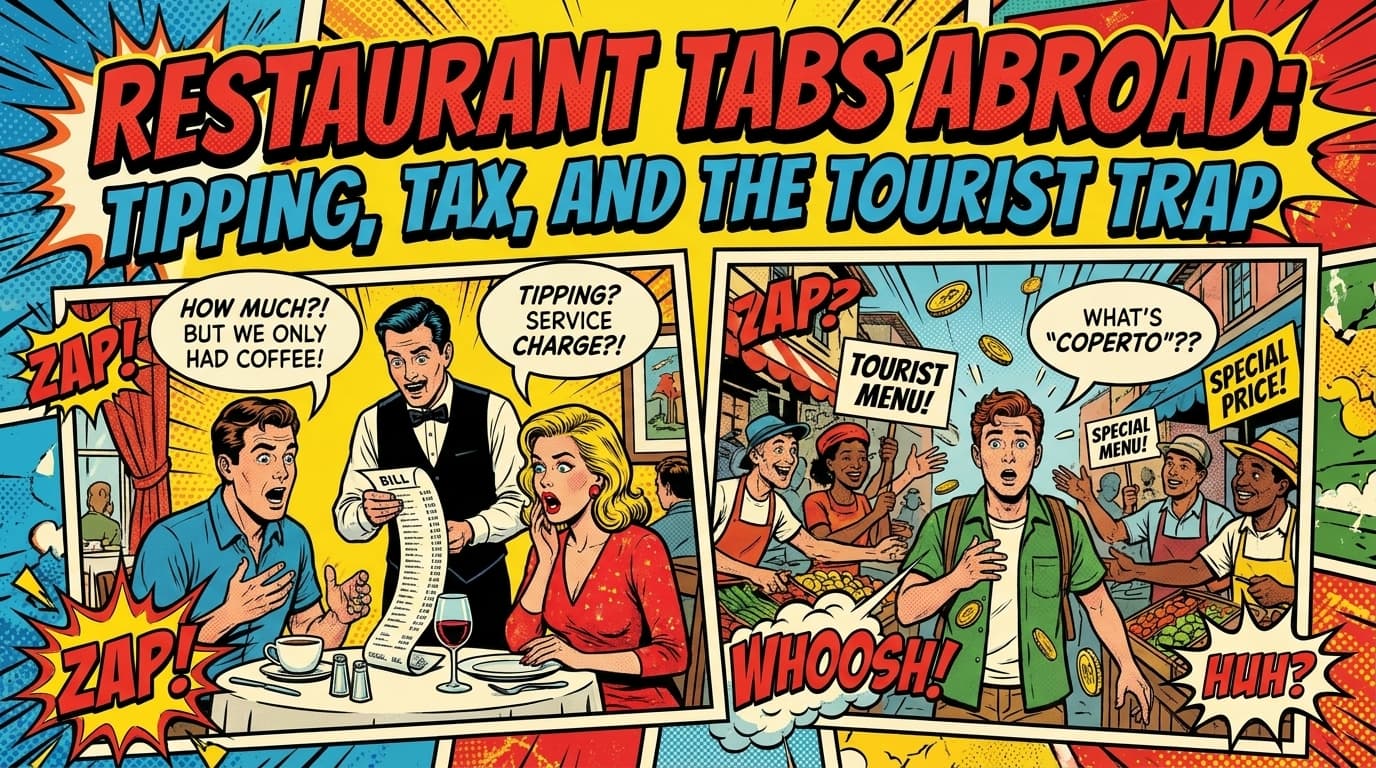
In some cities (Venice, Paris, parts of Barcelona), tourist-area restaurants have 'English menu' prices that are 20-40% higher than the same dish on the local menu. Or a 'tourist tax' on the bill. Or a mysterious 'location surcharge.'
This is not a tipping situation. It's the price of the meal. Split the bill as it was charged. You can choose not to go back, but pay the bill you ordered.
If you suspect you were overcharged versus the menu (an item costs more than what was listed), quietly flag it to the server with the menu. Most of the time it's a genuine mistake. If it's not, you have more decisions to make, but that's a scam problem, not a split problem.
How to actually pay
Two common paths:
Path A: One person pays the bill, everyone else reimburses. Clean, fast. Open the split app, log the total, assign shares, everyone Venmos or uses the app to settle. Works best when one person has a card with no foreign transaction fees.
Path B: Split at the table. Hand the server multiple cards and say 'split equally across these.' Works in the US, sometimes in the UK, rarely in continental Europe, almost never in Asia. Don't ask servers in places with busy Friday nights to do four-card splits. They'll hate it, and it'll be slow.
Path A is almost always better abroad. One card charges, the rest settle digitally.
Cash vs. card abroad
- Cash for tips in most places, directly to the server. Bypasses the house cut.
- Card for the bill if your card has no foreign transaction fees. Rate is usually fine.
- Have small cash bills for places that don't take cards. Many casual restaurants in Italy, Spain, Portugal, parts of Japan still prefer cash.
The 'we'll just figure it out at the end of the trip' trap
Big trap. Restaurants are where the bulk of trip expenses live, and memory gets blurry fast. Three days later, nobody remembers what that 185-euro dinner was, or who was there, or whose birthday it was.
Log every shared meal at the table, in the app, before the plates are cleared. 30 seconds. You'll be able to reconstruct the trip in two minutes when you get home instead of two hours.
TL;DR
- Check the bill for service charges and cover charges before adding a tip. Often they're already included.
- Tip at local rates, not American rates. 5-10% in most of Europe is generous, zero in Japan is correct.
- Log the bill in local currency, convert at the day's rate for the group split.
- One person pays, others reimburse is the cleanest path for group bills abroad.
- Log every shared meal the same night or the math goes sideways.
Frequently asked questions
How do you split a restaurant bill when traveling in a foreign country?
Check the bill first for service charges and cover charges that might already be included. Apply the local tipping norm, not your home country's. Log the total in local currency, convert to your settlement currency at the day's exchange rate, and split among the diners equally or itemized depending on how uneven the orders were.
Do you tip on top of a service charge abroad?
Usually not. Service charges in Europe, the UK, and many other countries are mandatory fees that typically go to the restaurant, not the server. Treat them as part of the bill. A small cash tip directly to the server for exceptional service is optional, but layering a percentage tip on top is overpaying.
What is a 'coperto' on an Italian restaurant bill?
It's a per-person cover charge for your seat, bread, and table setup, common across Italy. It's not a tip, not a scam, just part of the pricing model. Include it in the bill total and split per person when the group reconciles.
Should I pay the bill in local currency or my home currency?
Always pay in local currency when given the choice. Card machines that offer to convert to your home currency ('Dynamic Currency Conversion') use bad rates and add fees. Your own bank's conversion is almost always cheaper.
Is it rude to ask a restaurant abroad to split a bill across multiple cards?
In continental Europe and most of Asia, yes, it's often inconvenient for the server and not common. In the US, UK, and Canada it's fine. The cleaner move everywhere is to have one person pay the whole bill and have the others reimburse digitally after, using a split app.