The Pitcher Problem: Who Pays for Shared Drinks Everyone Sipped
Pitchers, bottles of wine, shared cocktails. When everyone had some but nobody knows how much, here's how to split fairly without tracking sips.

Anna
Supasplit Team
The unfair moment nobody sees coming
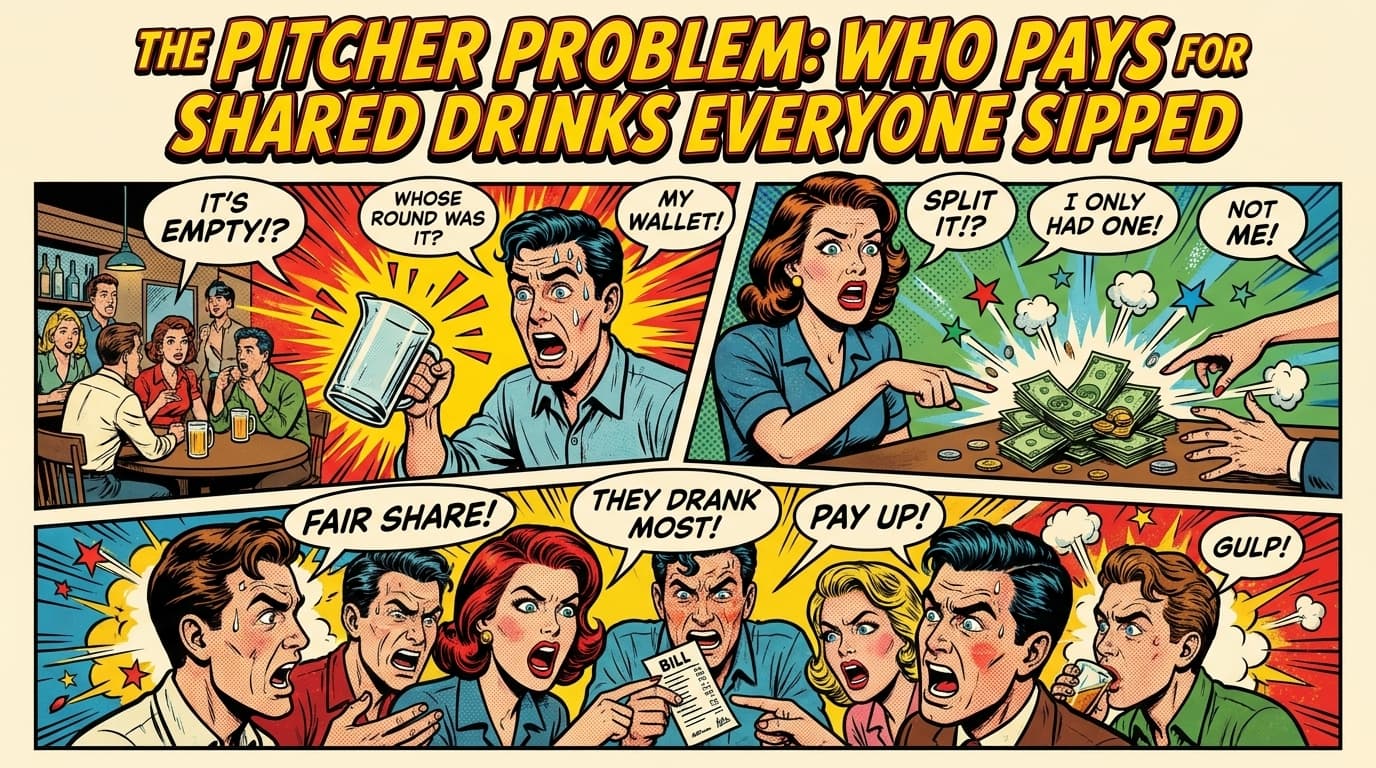
Four people at a table. One pitcher of sangria, $48. Somebody pours the first glass. Somebody else tops it up. Somebody gets refilled three times without asking. By the end, one person had five glasses, one had a single glass, and two are somewhere in the middle.
Then the bill arrives. Equal split? The person who had one glass is basically paying for the heaviest drinker's night. Fully individual? Impossible, nobody tracked sips.
Shared drinks are where bill-splitting gets slippery, because the math you need doesn't exist. You can't put a receipt to a pour.
Here's the playbook for splitting shared drinks fairly without making it weird or turning into a measurement conversation.
Why shared drinks are structurally different from shared food
Shared food is usually binary: you ate the shared calamari or you didn't. One appetizer, split among people who ate it. Easy.
Shared drinks are continuous. Pours vary. Nobody's tracking. The cost per drink is often wildly different from the cost per bite of food. A $58 bottle of wine split "equally" can mean a $15 hidden charge to the person who had half a glass out of politeness.
That's why the default rule for food (split equally among consumers) doesn't quite work for drinks. You need a slightly different framework.
The four fair ways to split shared drinks
1. Equal split (only when it's actually equal)
If everyone genuinely drank roughly the same, split the shared drinks equally among drinkers. This is fine, and it's how most friend groups handle it by default.
The test: did anyone at the table have noticeably more or fewer pours? If the answer is yes, equal stops being fair.
Best for: similar drinkers, casual vibes, drinks that went around evenly.
2. Drinkers-only split
Somebody at the table had water or soda. They don't pay for the shared bottle. This is the most commonly missed rule.
If a pitcher costs $48 and 4 out of 5 people at the table drank from it, that's $12 each for the drinkers, and the non-drinker pays $0 of it.
Obvious, but groups forget this all the time when they default to a whole-table equal split.
Best for: any table where one or more people didn't drink the shared item.
3. Rough-split by pours
If the pours were visibly uneven, do a rough visual split. The logic:
- Heavy drinkers (3+ pours): two shares
- Medium drinkers (1-2 pours): one share
- Non-drinkers: zero shares
For a $60 bottle at a table of 4 where one person had most of it, two were medium, and one abstained, the split is roughly: heavy drinker pays $30, mediums pay $15 each, non-drinker pays $0.
You don't need exact measurements. Rough shares based on what everyone saw.
Best for: clearly uneven pours where a blanket split would feel off.
4. Order individually, skip sharing
The cleanest move: don't share at all. Everyone orders their own glass, their own beer, their own cocktail. Then splitting drinks becomes trivial, pay for what you ordered.
This is the correct move when the group has wildly different drinking habits. Insisting on a shared pitcher and then struggling to split it isn't more social, it's just less clean math.
Best for: mismatched drinker groups, check-conscious nights, any table with one very heavy and one very light drinker.
The "I had like half a glass out of politeness" situation
Classic trap. You don't drink much. Someone ordered a $62 bottle of wine "for the table." They pour you a glass. You sip it slowly so you're not rude. You finish maybe a third of it.
And now you're being charged a full share.
Two fixes:
Decline the pour. When the bottle arrives, a friendly "actually I'm good on wine tonight, just water for me." Done. You're out of the split.
Speak up at bill-time. "I had a tiny bit of the wine, let me kick in like $5." Say a number. Most of the time the group goes "yeah no worries" and you're done. The script saves you $15 and takes 5 seconds.
The "round" problem
Somebody says "let's do a round of shots!" Now shots are on the bill. Some people love shots. Some people took the shot just to not be That Person.
The rule: rounds are only fair if they're willing rounds. If you announce a round and someone says "not for me," they're out. No shame. No paying.
Groups that force participation in rounds and then split them equally are creating quiet resentment. Don't be the person who does that.
Who pays for the "for the table" bottle nobody asked for
Situation: one person ordered a $95 bottle of wine "for the table" without checking with anyone. Nobody agreed, but now it's on the bill.
The person who ordered it pays for it. Full stop.
You don't get to unilaterally spend the group's money. If someone wanted a $95 bottle, they should have checked first. The absence of check = they're paying.
If this feels harsh, it's not, it's just the correct consequence of ordering without group consent. And stating it as a norm ("if you order something shared without checking, that's on you") prevents this from happening in the first place.
The bar-tab version
Same principles apply to an open bar tab:
- One drink each, roughly equal cost: equal split.
- Very mismatched consumption: itemize or do rough shares.
- Non-drinkers: out of the drinks portion entirely.
- Someone ordering $18 craft cocktails while others have $6 beers: never equal. Always itemize drinks.
Bar tabs are where equal-splitting goes most wrong, because drink prices vary by 3x and consumption varies by 5x. Fixing it is always worth the 30 seconds of math.
The line everyone should feel comfortable saying
"I'm going light on drinks tonight, can we just split the drinks separately?"
Say it when the table is about to order. Takes 4 seconds. Gets you out of carrying the cost of someone else's cocktail habit. Nobody is going to push back on this.
If someone does push back, that's the tell. Heavy drinkers who insist on equal-splitting are the same people who lose friends gradually over the course of years. Not a coincidence.
TL;DR
- Equal split only when drinkers were actually equal. If pours were uneven, use rough shares.
- Non-drinkers don't pay for drinks, ever. This is the most commonly forgotten rule.
- Whoever ordered the $95 bottle without checking pays for it. No group consent = no group split.
- Declining a pour is always fine. You're not being awkward, you're being clear.
- Bar tabs with mixed drink types = always itemize drinks. Price-per-drink swings are too big for equal to work.
Frequently asked questions
How do you split a shared pitcher or bottle when people drank different amounts?
Use rough shares based on what everyone saw. Heavy drinkers (3+ pours) get two shares, medium drinkers (1-2 pours) one share, and non-drinkers zero. You don't need exact measurements, just an honest visual read on the pours. This takes 10 seconds and avoids the unfairness of equal-splitting.
Should non-drinkers pay for a shared bottle of wine?
No. If someone didn't drink, they're not part of the bottle's split. This is the single most-forgotten rule at group dinners, where people default to dividing everything across the whole table. Always separate drinkers from non-drinkers when splitting shared alcohol.
What if someone ordered an expensive bottle for the table without asking?
Whoever ordered it pays for it. You don't get to unilaterally spend the group's money on a $95 Cabernet and then ask them to cover their share. Naming this norm out loud, 'if you order shared stuff without checking, that's on you', stops it from happening in the future.
How do you split a bar tab fairly?
If everyone had roughly the same drinks at the same prices, equal is fine. If there's a mix of $18 craft cocktails and $6 beers, always itemize drinks. Bar tabs are where equal-splitting goes most wrong because drink prices vary by 3x or more and consumption varies by 5x.
How do I politely get out of paying for shared drinks I barely had?
Say it at bill time: 'I had just a little of the wine, I'll kick in like $5.' Name the number yourself. Most groups will say 'yeah no worries' and move on. Five seconds of mild self-advocacy saves you from paying a full share of something you had one polite sip of.