5 Fair Ways to Split a Bill When Everyone Ordered Differently
When the orders at your table ranged from a $14 salad to a $62 steak, equal splitting stops being fair. Here are five methods that actually work.

Anna
Supasplit Team
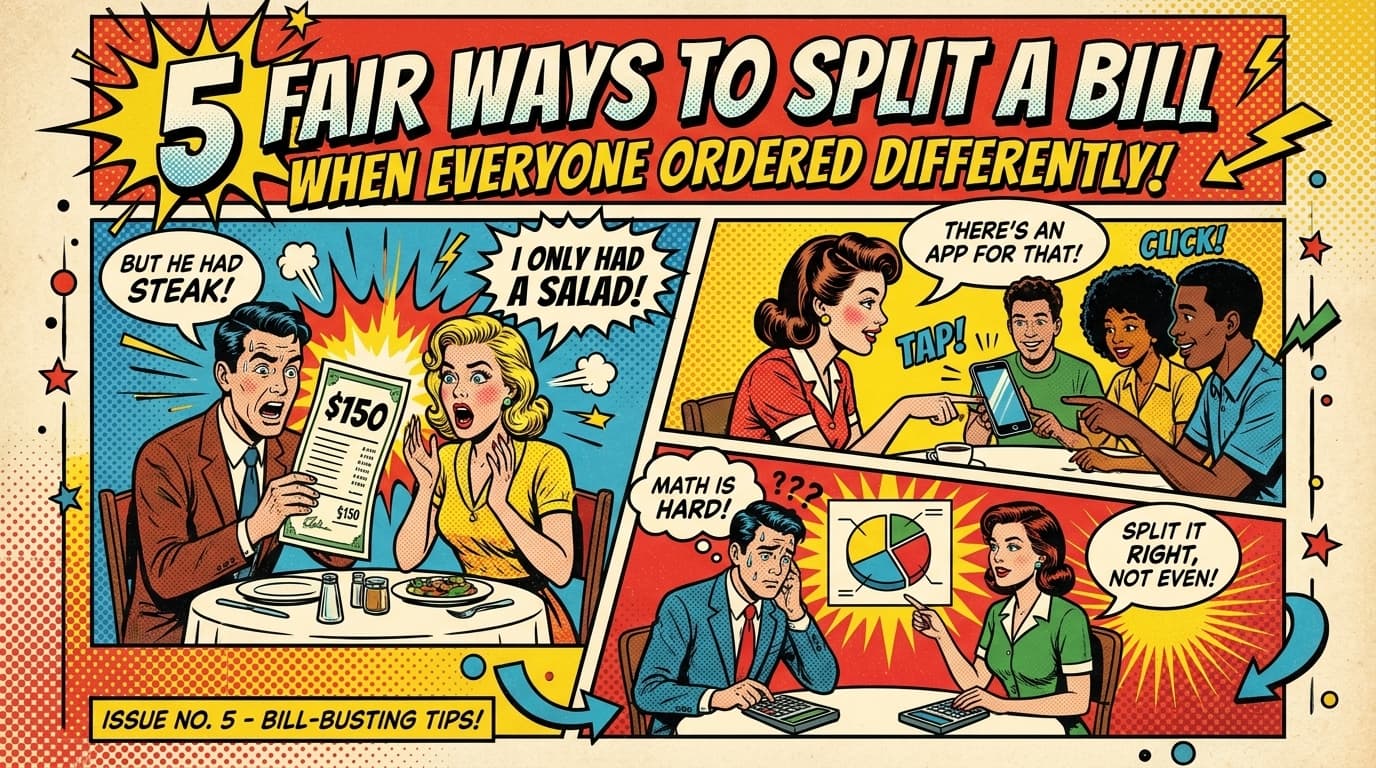
The bill arrives. Someone got soup. Someone got a steak, three cocktails, and dessert. The group default is "let's just split it."
Equal splitting works when orders are roughly the same. When they're not, "let's just split it" is a quiet transfer of money from the light eater to the heavy spender. Here are five methods that are genuinely fair, ordered from easiest to most precise.
1. Itemized split (the fairest, always)
Everyone pays for what they ordered, plus their proportional share of tax and tip.
The math: your subtotal divided by the total subtotal, times the total with tax and tip. For a $14 order on a $120 bill with $30 in tax and tip, you'd pay $14 + (14/120 × $30) = $17.50.
A receipt-scanning app does this in 10 seconds. So does a basic calculator if you're patient. Most modern servers will also split the check line-by-line if you ask before ordering.
Best for: casual dinners, lunches, mixed groups, anywhere orders varied meaningfully.
The script: At the start, before anyone has ordered:
"Mind if we do itemized? Keeping it simple on my end tonight."
2. The "shared + individual" split
Everyone pays for their own entrée and drinks. Appetizers, shared sides, and bottles of wine that went around the table get split equally.
This is the hybrid move, it's easier than full itemization but still fair when most of the cost was people's main orders.
Best for: tapas dinners, sushi where you passed rolls, family-style Italian, brunches with a communal pitcher of mimosas.
3. Equal split with a "drinks adjustment"
Everyone splits the food equally, then drinks are itemized. This is the one that specifically fixes the "one person had five cocktails and everyone else had one beer" problem.
Drinks are where bills go sideways fastest, especially at restaurants where cocktails are $16-20 and beer is $8. Splitting food equally is usually fine. Splitting drinks equally is usually not.
Best for: groups where orders were similar in the food but wildly different in the alcohol.
4. Round-robin (the slow burn fair split)
One person picks up the whole bill tonight. Someone else gets the next one. Over a few months of friendship it evens out.
This only works if:
- Everyone in the rotation genuinely cycles through (not "technically one day I'll pay")
- The price of meals is roughly similar across the rotation
- Nobody silently keeps score
It's the easiest method when it works and the most resentful when it doesn't. Close friend groups sometimes do this well. Mixed-income groups almost always don't.
Best for: tight friend groups with similar financial situations and a genuine shared understanding.
5. The "proportional by order size" split
If you don't want to fully itemize but equal feels wrong, here's a middle path: divide the bill by people's rough order size.
Four people, two had "small" dinners and two had "big" ones. Instead of 25/25/25/25, do 20/20/30/30. You don't need exact receipts, just a visual rough-split.
Works well at a group of 4-6 where itemizing feels like overkill but equal is clearly off.
Best for: friend groups who want fairness without spreadsheet energy.
Which one should you use?
Quick decision tree:
- Orders similar: equal, don't overthink it.
- Orders different in food: itemize or "shared + individual."
- Orders similar in food, wild in drinks: equal food + itemized drinks.
- Close friends, similar finances: round-robin (if you can trust it).
- Rough fairness without receipt math: proportional by order size.
The real tip: say the method before the meal
Whichever method you pick, name it before anyone orders. Said at the start, it's chill and forgettable. Said at the bill, it feels like you're scrambling to avoid paying.
Scripts:
"Let's itemize tonight, easier on everyone."
"Should we do equal or split by order size?"
"I'm getting this one, you grab next?"
All of these are better than silently splitting equally and seething. Nobody is going to be mad at you for suggesting a clean system.
TL;DR
- Itemized is always fair. It's the default when in doubt.
- Shared + individual works when most of the bill was mains and some stuff was truly shared.
- Equal food + itemized drinks fixes 80% of the "it's not fair" problem at group dinners.
- Round-robin is elegant when it works, toxic when it doesn't. Use with caution.
- Name the method before ordering. Every script lands better at the start of the meal than at the bill.
Frequently asked questions
What's the fairest way to split a bill when orders were very different?
Itemized splitting, each person pays for what they ordered plus their proportional share of tax and tip. A receipt scanner does the math in 10 seconds, and it removes every source of 'is this fair' tension.
How do you handle shared appetizers and sides when splitting a bill?
Split shared items equally among the people who ate them, then itemize the entrées and drinks. This 'shared plus individual' model is the most common middle ground between full itemization and flat splits.
Is it fair to split drinks equally if one person drank way more?
No. Drinks are where equal splitting goes wrong fastest, especially at restaurants with $18 cocktails. A good compromise is equal on food, itemized on drinks.
How do you bring up splitting the bill item by item without being weird?
Say it before ordering: 'Mind if we do itemized tonight?' At that point it's a non-event. If you wait until the bill arrives, it feels defensive. Kick off the meal with the method and it stays casual.
Can we just split the bill equally if it's mostly fair?
Yes, equal is fine when orders were genuinely similar. The rule: if the highest and lowest tabs at the table differ by more than 40%, equal stops being fair. Below that, equal saves friction.