The Rental Car Split: Insurance, Gas, Drivers, Damage
Renting a car for a group trip means splitting more than gas. Here's how to split the rental cost, insurance, additional drivers, and what happens if it gets damaged.

Anna
Supasplit Team
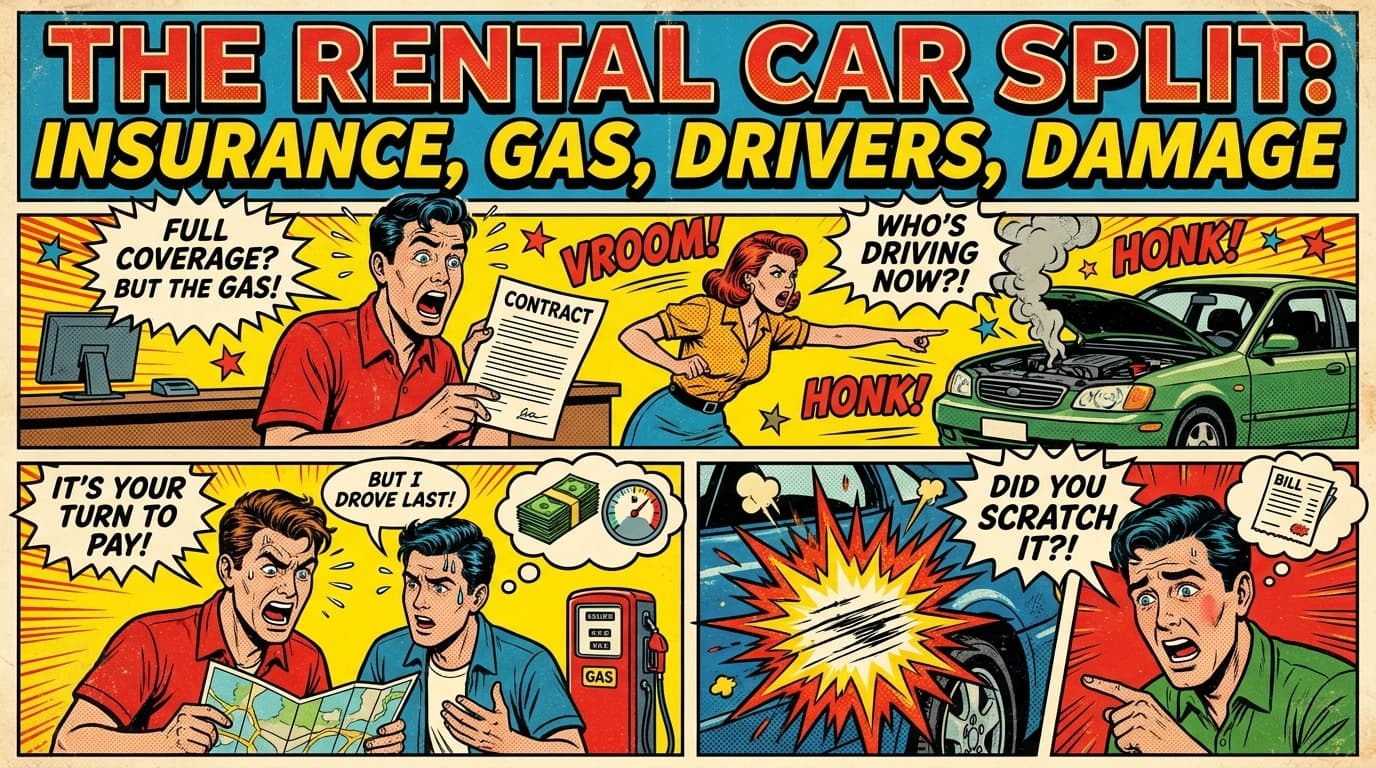
Renting a car for a group trip is one of those expenses that looks simple. "Let's just split it." Then the bill arrives and there are nine line items, half of which nobody saw coming.
Here's the breakdown of what's actually on a rental car bill, how to split each piece fairly, and what to do about additional drivers, gas, and the dent that nobody is admitting to.
What's actually on a rental car bill
A typical 7-day rental car charge breaks down roughly like this:
- Base rental rate: the per-day cost
- Taxes and government fees: city/state taxes, airport surcharges
- Insurance (optional, see below): several types
- Additional driver fees: $10-15/day per extra driver
- Underage driver fee: $20-30/day if under 25 (varies)
- Toll transponder: $5-10/day if you used it
- Refueling charge: if you didn't return the car full
- Late return fee: if applicable
- Damage charges: if applicable
The base rate is what people think about. The other fees together can equal or exceed the base rate.
For splits, treat each category differently based on who actually caused the cost.
How to split the base rental
Default: split equally among all car users.
When this works:
- All passengers were in the car a roughly equal amount.
- The car was the only transportation method.
- The group all benefited from the rental equally.
When to adjust:
- Some people only used the car part-time. If 4 friends rented a car for a week and 2 of them mostly walked, splitting by 4 isn't fair. Charge per car-day-used.
- One friend never drove or rode. If they didn't use the car at all, don't charge them.
For most trips, equal split is fine. Don't over-engineer.
How to split the gas
Gas should be tracked separately and split equally among car users.
The simple system:
- Each fill-up gets logged (amount, date)
- At trip end, total gas cost ÷ car users
- Settle as part of the trip's overall split
The wrong system:
- "Whoever's driving fills the tank and we'll even out" almost never evens out
- Trying to estimate fuel use by passenger weight or destination is way too much
- Letting one person buy gas every time "because they're driving" and never reimbursing
More on driver gas dynamics in our road trip gas split piece.
Insurance: the big rental car question
Rental car insurance is confusing on purpose. The rental company wants you to add it. Your existing coverage may already include it.
The four common types:
1. Loss Damage Waiver (LDW) or Collision Damage Waiver (CDW): covers damage to the rental car itself. Usually $20-40/day.
2. Supplemental Liability: covers damage you cause to other vehicles or property. Usually $10-15/day.
3. Personal Accident Insurance (PAI): covers medical expenses for you and your passengers. Usually $5-10/day.
4. Personal Effects Coverage (PEC): covers theft of personal items from the car. Usually $3-5/day.
Do you actually need each? Often no. Reasons:
- Your personal auto insurance often extends to rental cars (check your policy).
- Many credit cards (especially travel cards) include rental car CDW as a benefit when you pay with the card.
- Your health insurance typically covers medical expenses regardless of where the injury happened.
- Your renters or homeowners insurance typically covers theft of personal items, including from a rental car.
Before adding any rental insurance, check:
- Your personal auto policy
- The credit card you'd use to pay
- Your health insurance
- Your renters/homeowners policy
If those cover the bases, you can decline the rental company's insurance.
How to split insurance if you do buy it: equally among car users. It's a flat cost benefiting everyone in the car.
Additional driver fees
Most rental companies charge $10-15/day per additional driver named on the contract. Some exceptions: spouses are usually free, members of certain loyalty programs get free additional drivers.
Question: who pays the additional driver fee?
Approach A: Everyone splits equally. The argument: an additional driver benefits everyone (more rotation, more safety for long drives).
Approach B: The additional driver pays their own fee. The argument: their name being on the contract is what's being paid for.
Approach C: It's free if the renter has the right credit card or loyalty membership. Many travel cards (Hertz Gold, Avis Preferred) include free additional drivers as a benefit. The cardholder doesn't bear cost.
For most trips, Approach A is the easier default. The cost is small enough not to be worth a debate.
The underage driver fee
If you're under 25 (or in some markets, under 21), you pay a per-day surcharge. Often $20-30/day.
Who pays the underage fee?
The underage driver, full stop. They're the reason the fee exists. Don't ask the over-25 friends to subsidize someone else's age.
The exception: if a group of all-under-25 friends rents together, the fee is on whoever's name is on the contract (because they're the named driver). Other under-25 friends contribute as additional drivers, each with their own underage surcharge.
Tolls and parking
Tolls: if the rental car has a transponder, the rental company charges you per use. If you used the transponder, that's your cost. Whoever drove during the tolls pays, or split equally if everyone was in the car.
Parking: if you parked in a paid garage during the trip, split equally among occupants of the car at that time.
Both are small. Don't over-track. Use a single trip-expense category and split at end.
What about damage?
The scary line item. Three scenarios:
Scenario 1: Clear single-driver damage. One friend backed into a pole. They were driving. Damage cost is theirs.
Scenario 2: Damage that happened while a specific friend was driving. Same as #1, but maybe less obvious blame (a stone chip on the highway). Generally the driver covers it, since they were behind the wheel.
Scenario 3: Damage of unclear origin. A dent appears on the rental at return. Nobody knows when it happened. Split among the group.
This is where insurance matters. If you have CDW (rental company or credit card), most damage is covered.
Who deals with the rental company: the renter (name on the contract). They handle the claim, get reimbursed by the credit card or insurance, and recoup from the group if not covered.
The renter shouldn't carry damage cost alone if the damage was the group's. Settle it openly with the group.
The fuel return rule
Most rentals require you to return the car with the same fuel level you got it (usually full). If not, the rental company refuels at a per-gallon rate that's 2-3x the gas station price.
The fair rule: don't get stuck with the refueling penalty. Fill up before returning.
If you do get stuck, the cost is on whoever was responsible for returning the car. If "the group" was responsible, split it equally.
Some rental companies offer a "pre-paid fuel" option where you pay for a full tank upfront and return the car empty. Usually a bad deal unless you return on fumes.
Booking tips that save money
- Compare on Costco Travel, AutoSlash, and the rental company's own site. Prices vary wildly.
- Book early but stay flexible. Free cancellation gives you the option to rebook if prices drop.
- Check coupon codes (AAA, Costco, Amex, credit card benefits).
- Pick up at non-airport locations to skip the airport surcharge if possible.
- Use a credit card with rental insurance so you can decline the rental company's coverage.
Savings of 20-40% are real if you shop.
How to actually pay and split
For most group trips with a rental car:
- One person rents and pays (their name on the contract, their card).
- Group splits the total at end of trip based on use.
- Track in an expense app so all the rental-related charges (base, gas, tolls, parking) are visible to everyone.
- Damage and overages settle separately if they happen.
The renter takes on financial risk for the group. The group should pay back promptly.
TL;DR
- Base rental: split equally among car users for most trips.
- Gas: track and split all fill-ups equally.
- Insurance: usually skip the rental company's coverage if your credit card and auto policy cover the bases.
- Additional driver fee: split equally by default, simple and small.
- Underage fee: the underage driver pays it. Don't ask older friends to subsidize.
- Damage: covered by insurance ideally; otherwise paid by the driver responsible or split if no clear cause.
- Refuel before returning to avoid the rental company's penalty rate.
- The renter takes on financial risk. Group should pay back promptly.
Frequently asked questions
How do friends split the cost of a rental car?
Default to splitting the base rental equally among car users, with gas tracked separately and also split equally. Adjust if some people barely used the car or didn't ride at all. The renter (whose name is on the contract) takes financial risk for the group, so they should be paid back promptly after the trip.
Should I get the rental car insurance offered at the counter?
Usually no. Most personal auto insurance policies extend to rental cars, many travel credit cards include CDW when you pay with them, and your health and renters/homeowners insurance often cover the other categories. Check your existing coverage before paying $30+/day at the rental counter.
Who pays the additional driver fee on a rental car?
Usually split equally among the group, since additional drivers benefit everyone with more rotation. Some travel credit cards and rental loyalty programs waive additional driver fees entirely, the cardholder doesn't bear the cost in those cases. Whatever the math, split it openly so nobody is surprised.
What about the underage driver surcharge?
The underage driver pays it, not the group. Friends over 25 shouldn't subsidize someone else's age-based fee. If the whole group is under 25, the renter pays their own surcharge as part of being the named driver.
What happens if the rental car gets damaged?
Depends on the cause. Clear single-driver damage (backed into a pole) is the driver's cost. Damage of unclear origin (a mystery dent at return) usually gets split among the group. Insurance (rental company's, your credit card's, or your auto policy's) often covers most damage. The renter handles the claim and the group settles whatever isn't covered.