Heating Bill Wars: How to Split Gas When Someone Keeps It at 76°F
Gas heating bills can spike to $250 in a cold month. Here's how to split heating between roommates, what to do about the thermostat fights, and when to switch to budget billing.

Anna
Supasplit Team
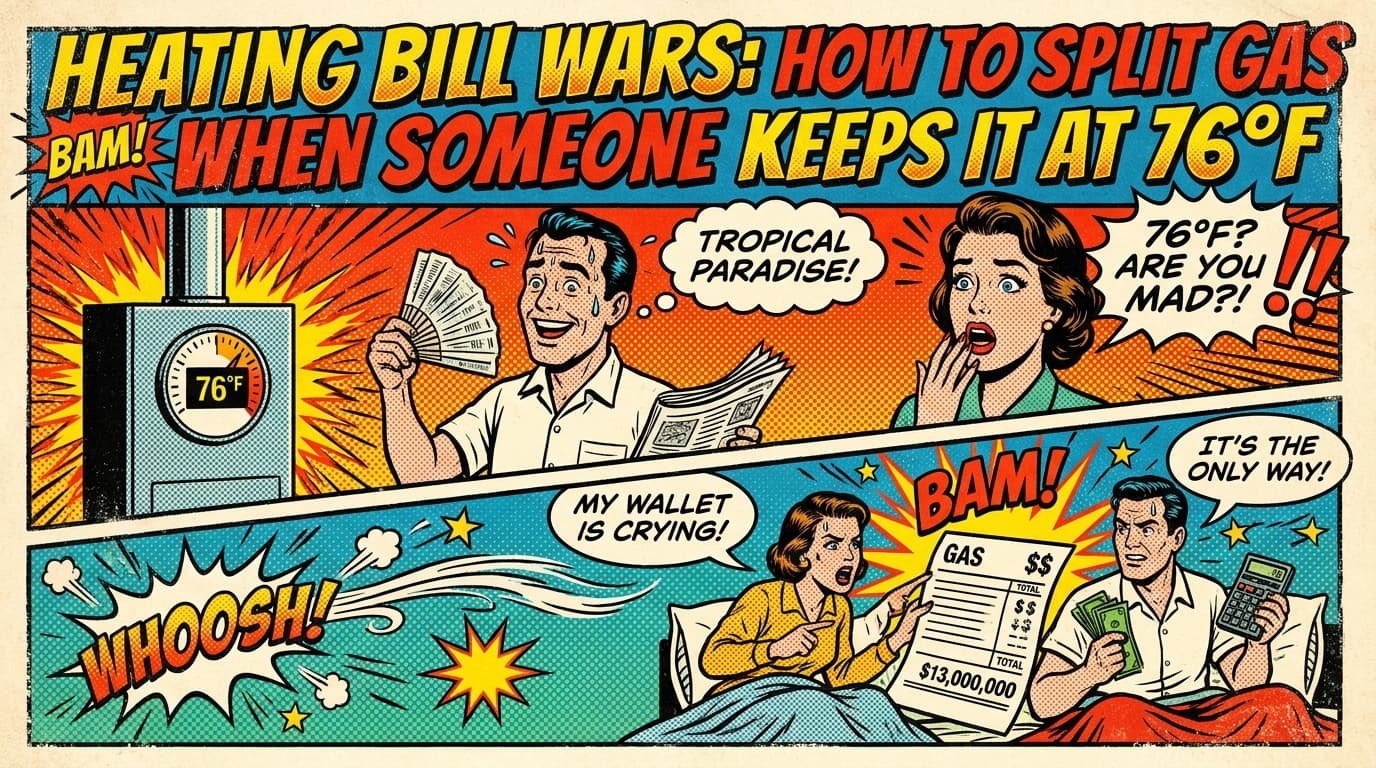
The gas bill is the one that quietly destroys roommate harmony every January. The kind where you open the email and audibly say "how much?"
Gas in colder months can hit $200-$300 a month in a four-bedroom house, then drop to $25 in May. And the usage isn't even because one roommate likes the place at 76°F and another would happily wear a sweater at 64°F.
Here's the playbook for splitting gas without it becoming a household cold war.
What gas usually covers in a roommate setup
Gas in a typical apartment or house heats one or more of:
- The furnace or boiler (space heating)
- The water heater (showers, dishes)
- The stove and oven
- Rarely, a fireplace
Most of the bill in winter is space heating. In summer, it's water heating and cooking, which is why summer bills drop so much.
Knowing the breakdown matters because heating is the variable, behavior-driven part. The rest is consistent.
The default: split equally
For most roommates, split gas equally. Reasons:
- Water heating and cooking benefit everyone roughly equally.
- Space heating affects the entire shared space, not individual rooms (in most setups).
- Tracking individual heat usage is impossible without separate zone controls.
If your annual gas bills total under $1,000-1,500 and everyone has similar habits, equal is fine.
Where it breaks: large seasonal swings combined with very different thermostat preferences.
When to deviate
Different thermostat preferences.
If one roommate would naturally keep the heat at 65°F and another wants 75°F, you're paying for the higher setting whether you like it or not. Options:
- Set a household thermostat range everyone agrees to (typically 67-70°F).
- The higher-preference roommate covers a larger share of winter months.
- Each bedroom uses its own space heater for personal preference, central heat stays at the household setting.
Option 1 is the cleanest, if everyone can actually live with it.
Rarely home / WFH split.
Same logic as electric. If one roommate is home 50 hours more per week, they consume more heat (because they're the one needing it on). 60/40 tilt is reasonable.
One roommate is gone for the winter.
If a roommate is gone the entire heating season (subletting, traveling, abroad), they reasonably owe a much smaller share for those months. Possible structure: they cover a portion equal to the summer gas bill (representing baseline water heater and stove), and pay nothing toward space heating.
Budget billing: the roommate hero
This is the single most useful tool for splitting gas. Most utilities offer a budget plan that averages your annual usage into 12 equal monthly payments.
Instead of $30 in July and $260 in January, you pay $115 every month.
Benefits for roommates:
- No "why is this month $260?" conversation
- Predictable monthly cost (easier to set up auto-payments)
- The high-thermostat roommate doesn't single-handedly cause a January spike
- Reduces resentment because the bill never shocks
Downsides:
- You might end up overpaying or underpaying for the year, with an adjustment in month 12
- If a roommate moves out mid-year, the settlement can be awkward (see below)
Enable it. Worth it.
What if a roommate moves out mid-budget-billing?
The gas company eventually trues up your account. If you've been underpaying (used more than the average), you'll owe a balance. If overpaying, you'll get credit.
If a roommate leaves before that true-up, they should be responsible for their share of any balance owed for months they were a part of the household. Calculate it pro-rata when they move out, settle it then, don't wait for the true-up.
Document this. A simple "on move-out, settle any open budget-billing balance based on months in residence" goes in your roommate agreement.
Thermostat rules that don't suck
Most roommate conflicts about heating come down to thermostat behavior, not the bill. Some rules that work:
- Set a daytime range: 67-70°F. Acceptable to most people.
- Lower it at night: 62-65°F. People sleep better cool, and overnight is a big chunk of heating cost.
- Lower it when no one is home: Programmable or smart thermostat handles this automatically.
- Individual blankets and space heaters for comfort: Personal preference, personal cost.
The smart thermostat thing is real. A $100 Nest or Ecobee pays back in a single winter if it shifts your average usage even slightly.
When one roommate uses way more hot water
Long daily showers, baths, lots of dish-washing by hand, frequent laundry on hot setting. All of this hits the gas bill (because the water heater is gas).
Usually, this is the same person who shows up in the water bill conversation. The fix can be the same: small tilt on the split, or behavior conversation.
For gas specifically, the dollar impact of long showers is bigger than for water (you're heating gallons, not just delivering them). A 15-minute hot shower daily versus a 5-minute one can mean $10-15/month difference in winter.
How to actually pay the gas bill
Gas accounts usually have one name. Setup options:
Option A: One roommate's name, others reimburse. Standard. Works fine if you communicate.
Option B: Shared bill-pay account. Everyone transfers their share to a household account, autopay handles the bill.
Option C: Distribute bills across roommates. A handles gas, B handles electric, C handles internet. Bills average out across the year.
For gas specifically, because the bill amount varies so much month-to-month, the shared account (Option B) tends to work best. It avoids one roommate fronting a $250 bill in January and chasing everyone else for two weeks.
When the bill is shocking
If your gas bill jumps 40%+ in a month, check before getting upset:
- Weather. A cold snap will spike usage 30-50%. Check the local weather for the billing period.
- Rate change. Gas prices can rise sharply when supply is tight. Look at the rate per therm against last month.
- Equipment issue. A poorly maintained furnace runs more to deliver the same heat. If you suspect this, get it serviced.
- Actual behavior change. Someone got a hot tub, started taking baths daily, etc.
Bring it up as a question, not an accusation: "Hey, did anyone notice the gas bill? It's way higher this month. Let's figure out why."
TL;DR
- Default: split equally. Most roommate setups make precise heat tracking impossible.
- Use budget billing to smooth out the $30-to-$260 winter shock.
- Set a household thermostat range rather than fighting month-to-month.
- Tilt 60/40 when one roommate works from home or is rarely there.
- A roommate gone for winter should pay only their share of baseline (summer-level) usage.
- A surprise spike is usually weather or a furnace issue. Diagnose before blaming.
Frequently asked questions
How do roommates split a gas heating bill?
Most roommates split gas equally because it's hard to separate space heating from water heating from cooking. Use budget billing to even out the seasonal swing. Tilt the split only when one roommate is rarely home, works from home, or has a strong thermostat preference that drives bigger bills.
What's budget billing and should we use it?
Budget billing averages your annual gas usage into 12 equal monthly payments. Instead of $30 in July and $260 in January, you pay around $115 every month. It's the single most useful tool for roommate gas splits because it removes the monthly surprise and the resentment that follows. Worth asking your gas company about.
What should we do about thermostat disagreements?
Set a household thermostat range that everyone agrees to upfront, typically 67-70°F daytime and 62-65°F overnight. If one roommate wants it warmer, they use a blanket or personal space heater in their own room. A smart thermostat pays for itself in one winter by automating night and away setbacks.
Our gas bill doubled this month, what should we do?
Check the weather first, a cold snap can spike usage 30-50%. Compare the rate per therm to last month, gas prices can rise too. If neither explains it, your furnace may need servicing. Bring it up to roommates as a question, not an accusation: 'Did anyone notice the gas bill is high, let's figure out why.'
What if one roommate is gone for the entire winter?
They should pay only for their share of baseline (summer-level) gas usage, basically the water heater and stove. They shouldn't pay for space heating they weren't here to use. Calculate roughly what the summer monthly bill is and have them cover that share for the months they're away.