The Electricity Bill Roommate Split: AC, Heat, and Phantom Loads
Electric bills swing wildly across seasons. Here's how to divide electricity between roommates fairly, whether you split equally, by room, or by hours at home.

Anna
Supasplit Team
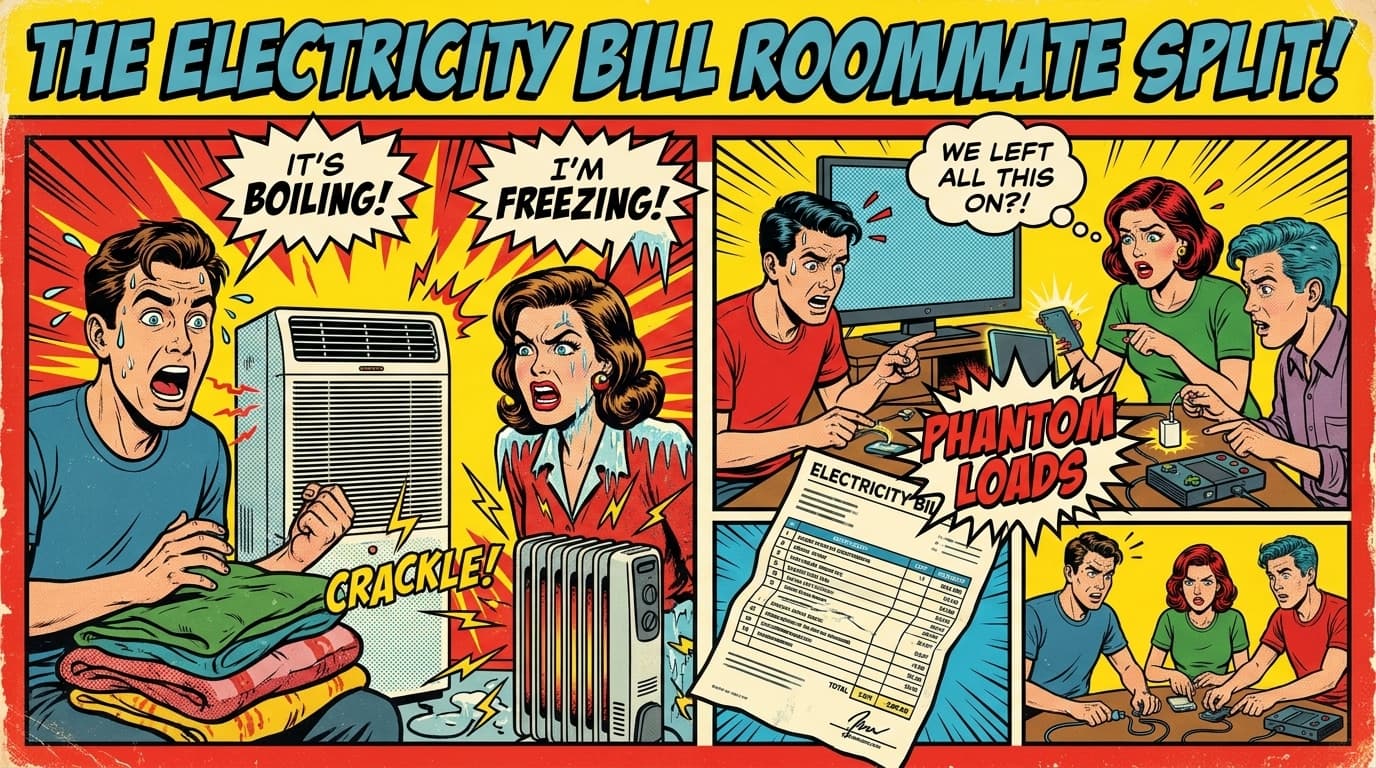
Electricity is the bill that tests roommate friendships. Unlike internet, the number actually moves with behavior. The summer AC bill in a four-roommate apartment can hit $400 in a hot month. In December, it might be $90. And one of you definitely runs the heater more than the rest.
Here's how to split electricity fairly, with options ranging from "don't overthink it" to "track everything."
The default: split equally
For most roommate setups, splitting electricity equally is the right call. Here's why:
- Tracking individual electricity use is essentially impossible without smart plugs on every device.
- The bill has a fixed delivery/service charge component that's the same regardless of use.
- Common-area lighting, the fridge, the dishwasher, water heating, all benefit everyone.
If your bills are reasonable ($60-$150 in a typical month) and nobody has wildly different habits, just split it equally and stop thinking about it.
Where this breaks down: when usage is very uneven, when one roommate is rarely home, or when seasonal spikes get extreme.
When to deviate from equal
Scenario 1: One roommate is rarely home.
If someone travels for work, spends most weekends at a partner's place, or is gone for the summer, splitting electric equally isn't fair. A 60/40 tilt or 70/30 tilt toward the home roommate is reasonable.
Don't try to count exact days. Set the tilt, agree on it, move on.
Scenario 2: WFH versus office workers.
If one of you is home 50 hours a week using AC, lighting, and laptops, and the other is in an office, the WFH person uses more electricity. A 60/40 tilt is the usual fix.
This is the same logic covered in our WFH utility guide. The fix isn't tracking. It's a fixed-ratio adjustment.
Scenario 3: One person runs a power-hungry setup.
Gaming rigs, mining setups, multi-monitor workstations, space heaters. If a roommate runs equipment that genuinely draws more power than a normal person uses, they should cover more.
Rough estimate: a high-end gaming PC running 8 hours a day adds $15-25 a month to the electric bill. They should cover that extra explicitly.
The room-size method
Some roommates split electric proportionally to room size, especially if one roommate has the master bedroom with its own AC unit. The logic: more square footage equals more lighting, more cooling, more heating.
This is a stretch for electricity because so much usage is shared (kitchen, living room, fridge). Better fit for splitting rent (see our bedroom size rent split piece).
If you do use room-size splits for electric, weight it lightly. 55/45 maximum.
Seasonal swings: the AC and heat problem
This is where electric bills get explosive. A four-bedroom with central AC in August can run $300+. The same place in October is $80. Two issues come up:
Issue 1: who controls the thermostat?
If one roommate runs the AC at 68°F in July and the others would have set it to 76°F, that's a behavior cost. Either:
- Set a household thermostat rule (typically 72-74°F in summer, 68-70°F in winter)
- Charge the chronic over-cooler more for those months
- Use individual room AC units (window units) where each person controls their own bedroom and pays accordingly
Issue 2: bill smoothing
Many utilities offer "budget billing" or "even pay plans" that average your annual usage across 12 months. Instead of $300 in August and $80 in October, you pay $150 every month.
For roommates, this is great. It removes the seasonal shock, keeps the budget predictable, and means the AC-loving roommate isn't suddenly footing a $300 bill alone. Ask your utility company about it.
What about phantom loads?
Phantom load (or "vampire power") is the electricity used by devices that are plugged in but off. Chargers, TVs, game consoles in standby. It adds up to maybe 5-10% of a household electric bill.
For a roommate split, this is not worth tracking. Just split it equally as part of the household base. The math isn't worth the time.
How to actually pay it
Electric usually has one name on the account. Setting up:
Option A: One roommate's name, others reimburse. Common but creates a recurring chase. Use only if you trust each other deeply.
Option B: Shared bill-pay system. Each roommate transfers their share to a joint account that autopays the bill. Cleanest long-term.
Option C: One bill per roommate. A handles electric, B handles internet, C handles water. Bills usually average out across the year. Less admin, slightly less fair month-to-month.
Option D: Expense-tracking app. Recurring split set up once, app tells everyone what they owe each month. Recommended for groups of 3+ where the math gets messy fast.
When the bill jumps unexpectedly
A sudden spike (50%+ increase month over month) usually means one of three things:
- Weather. Hot or cold snap drove HVAC use up. Just split equally and move on.
- Rate change. Some utilities adjust rates seasonally. Check the rate per kWh against last month.
- A new appliance or behavior. Someone got a space heater, started running the dryer daily, bought a second fridge. Worth discussing.
Don't immediately blame a roommate. Check the kWh usage on the bill, look at the weather for the period, and bring it up as a question, not an accusation.
The conversation to have before bills arrive
Before the first month's bill, decide:
- Are we splitting equally or with a tilt?
- Are we enrolling in budget billing?
- Who sets the thermostat (or what's the household range)?
- How do we handle spikes (just absorb, or revisit the split)?
If you skip this and the August bill arrives at $310, you're having this conversation while everyone is hot and grumpy. Bad time to negotiate.
TL;DR
- Default: split equally. Fixed delivery charges plus shared appliances make precise tracking pointless.
- Tilt 60/40 or 70/30 if one roommate is rarely home or WFH while others aren't.
- Special equipment (gaming rig, mining setup, space heater) is on that roommate to cover.
- Use budget billing to smooth seasonal AC and heating swings.
- Don't track phantom loads. Not worth the time.
- Have the conversation before the first bill, not after a $300 surprise.
Frequently asked questions
How do roommates split an electricity bill?
Most roommates split electric equally, which works fine when usage is roughly even. Tilt the split (60/40 or 70/30) if one roommate is rarely home, works from home while others don't, or runs power-hungry equipment like a gaming rig. Don't try to track individual usage, the admin isn't worth the accuracy.
Is it fair to split electricity equally if one roommate is rarely home?
No. If a roommate travels for work, spends weekends at a partner's place, or is gone for the summer, a 60/40 or 70/30 split toward the home roommate is more fair. Pick a fixed ratio rather than counting exact days, easier to maintain and avoids monthly negotiations.
How do you split an electricity bill with a roommate who works from home?
A 60/40 tilt toward the WFH roommate is the typical fix. They're home using AC, heat, lighting, and electronics for 50+ hours a week when office workers aren't. It's the same adjustment you'd make for any utility that scales with hours at home.
Should we use budget billing for our electric bill?
Yes, if your utility offers it. Budget billing smooths the bill into 12 equal payments instead of a $300 summer spike and an $80 winter low. It makes roommate splits predictable and removes the month-by-month surprise that often triggers conflicts.
What if one roommate keeps the AC running constantly?
Either set a household thermostat range that everyone agrees to (typically 72-74°F in summer), or have the AC-loving roommate cover a larger share of the summer months. Window units in each bedroom are the cleanest fix because each person pays for their own comfort.