Sharing a Car With Your Partner: Insurance, Gas, Repairs
The complete guide to sharing a car as a couple. Who pays for insurance, gas, repairs, and what happens to the car if you split up.

Anna
Supasplit Team
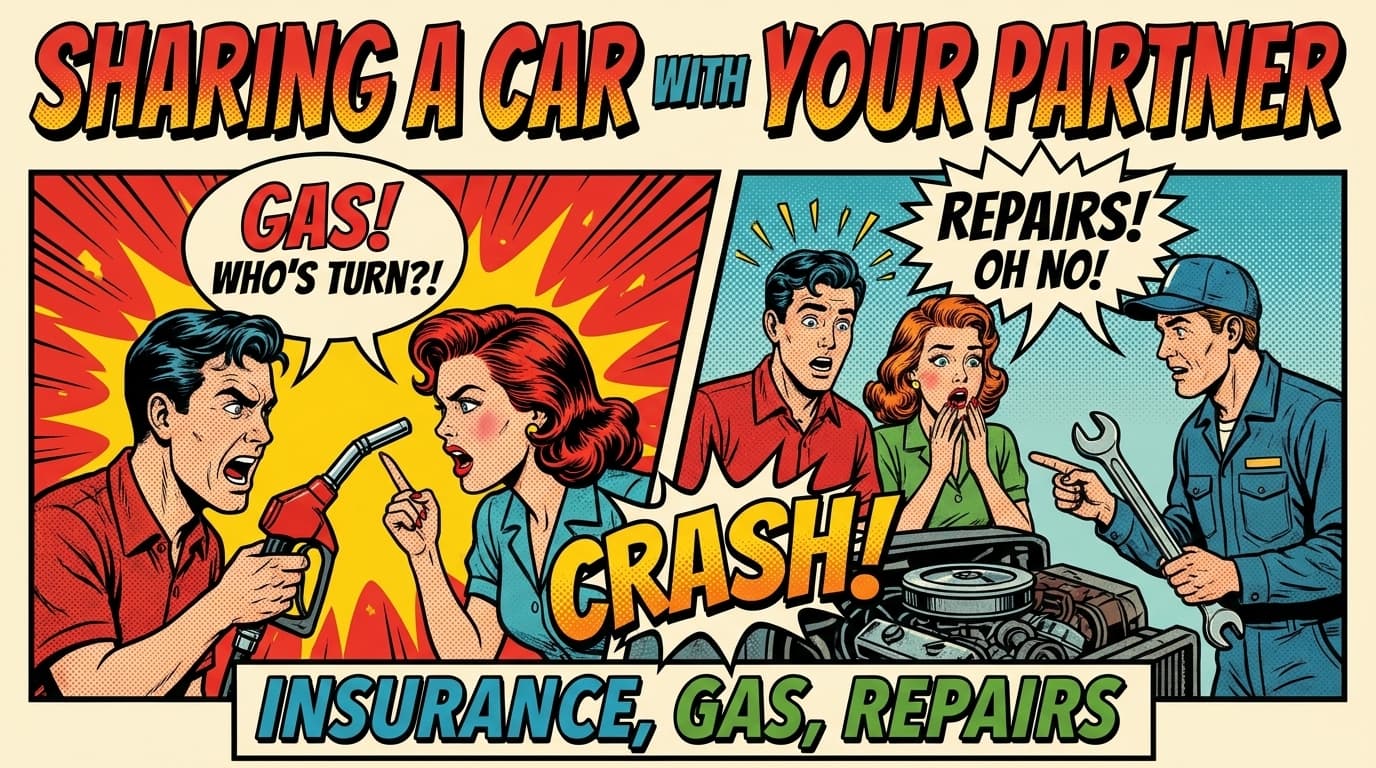
Going down to one car is one of the smartest financial moves a couple can make. It's also one of the easiest to mess up by not having a single clear conversation upfront.
Here's the full playbook: who pays for what, how to split insurance, how to handle gas and maintenance, and what happens to the car if the relationship ends. All the stuff you'll be glad you figured out before month three.
Why one car is such a good idea (financially)
The average US car costs about $12,000/year to own when you count payment, insurance, gas, maintenance, registration, and depreciation. Two cars is $24,000. Going to one saves a real chunk, sometimes the equivalent of a raise.
Plus:
- One insurance policy, not two
- One oil change schedule
- Half the depreciation
- Fewer parking headaches if you live somewhere tight
If your schedules mostly don't conflict, or you have decent public transit / rideshare options, one car is almost always the smart call.
The friction is logistical and financial. We're only covering the financial here.
Step 1: whose name is on the car
The first question is legal, not philosophical. Whose name is on the title?
- If one of you owned the car before the relationship: their name stays on it. Don't add the other partner to the title unless you're both clear on what that means.
- If you're buying the car together: you can put both names on the title, or just one. Check state-by-state rules because some states have specific "joint tenancy" rules for vehicles. Both names usually means both people have to sign to sell.
- If you're leasing: typically one name on the lease. Adding a second person is often more paperwork than it's worth.
The title matters because it determines who owns the asset. If you break up, the person on the title keeps the car. Not necessarily forever (see below), but on day one.
Step 2: insurance, the real cost driver
Insurance is almost always cheaper with both partners on one policy than with two separate policies. But the setup matters.
If both partners drive the shared car:
- Both should be named on the policy. Having one partner drive uninsured on the other's policy is a bad idea if something happens.
- Your rates are based on the combined risk profile. A spouse with a clean record often brings the rate down; a partner with tickets brings it up.
- Usually cheaper per person than two separate policies.
If only one partner drives:
- One-person policy, no issue.
- Make sure the other partner isn't accidentally listed or paying toward insurance they don't use.
If you're unmarried:
- Some insurers still happily put unmarried couples on the same policy. Some don't. Shop around.
- In some states, unmarried couples need to specifically declare their relationship to qualify for joint policy rates.
Split the insurance cost proportionally to use. If you both drive equally, 50/50. If one of you drives 80% of the time, roughly that split.
Step 3: gas and charging
The smallest expense that generates the most pettiness. Handle it with a system.
Options:
Option A: whoever fills, pays, and it evens out. Works if you use the car roughly equally and nobody keeps mental score. Breaks if one of you drives way more.
Option B: track fill-ups, split proportionally. Both partners log when they fill up, how much, and you split at month-end based on usage. More accurate, more admin.
Option C: shared gas fund. You each put $X per month into a joint account used only for gas and car-related expenses. Top up as needed. Clean once it's running.
Option D: whoever drives pays for that tank. If you mostly use the car in long stretches (road trips, commute weeks), whoever is driving during a fill-up covers it.
Most couples end up on Option A ("evens out") even when it doesn't actually even out. If you notice you're the one filling up 80% of the time, raise it before it becomes a thing.
Step 4: maintenance and repairs
Routine maintenance (oil, tires, brakes): split 50/50 or proportionally to use.
Unexpected repairs (alternator, transmission): same rule. Shared car, shared cost.
Damage from one partner's driving (fender bender): the at-fault partner absorbs the cost or at minimum the insurance deductible.
Pre-existing issues from before the car was shared: belongs to whoever owned it originally.
Keep receipts. Even rough tracking beats the eventual "wait, who paid for the tires in October?" conversation.
Step 5: the car payment question
If there's a loan or lease on the car, who pays the monthly?
If one partner owned the car pre-relationship: they keep paying it. The loan is in their name. The other partner can contribute if they're using the car, but it's not required.
If you bought the car together: split the monthly payment based on use or agreed-on ratio (usually matches your overall bill-split method).
If one of you is fronting and the other is "paying back": formalize it. A verbal "I'll Venmo you half each month" evaporates in about 6 months. Set up an automatic transfer or put the car in the yours-mine-ours shared expense category.
Step 6: parking, tolls, and the small stuff
- Monthly parking: shared, 50/50 or proportional.
- Tolls: whoever racks them up pays.
- Registration and yearly fees: shared.
- Car washes: shared if maintenance-level. Personal if it's aesthetic preference.
- Tickets: whoever got it pays. Non-negotiable.
What if one of you drives way more?
Two paths:
Path 1: split everything proportionally to use. If you drive 70% of the miles, you pay 70% of insurance, gas, and wear-and-tear.
Path 2: the higher-use partner absorbs more as a general rule, without tracking exact miles. Less admin, rougher fairness.
Either works. The worst option is 50/50 when one partner drives 90% of the time. That's quiet unfairness that shows up as a bigger fight later.
What happens if you break up
The car is usually the biggest physical asset a couple shares short of a house.
The title-holder keeps the car. That's the default.
The other partner gets bought out if they contributed meaningfully (down payment, loan payments, significant maintenance). Buy-out value = current used-market value times their contribution percentage. Not what they paid originally, current value.
If both are on the title: one buys the other out at half of current market value, or you sell and split.
If you're still paying on a loan: the title-holder keeps paying, and any buy-out accounts for what's still owed.
Insurance: the non-title partner comes off the policy immediately.
Do this in one documented conversation, not three months of text messages. See the shared bills after a breakup guide for the broader playbook.
TL;DR
- One car saves around $12,000/year. It's one of the best couple financial moves.
- Title ownership matters. Whoever's on the title owns the car.
- Insurance: both drivers on one policy. Never drive a car you're not insured on.
- Gas, maintenance, shared costs: split proportionally to use (or 50/50 if you use it roughly equally).
- Damage from one partner's driving is usually that partner's cost.
- On breakup: title-holder keeps the car, other partner gets bought out at current market value if they contributed.
Frequently asked questions
How should couples split car expenses?
Split proportionally to use. If you drive the car equally, 50/50 on insurance, gas, and maintenance. If one partner drives significantly more, that partner absorbs more of the costs. The worst setup is splitting 50/50 when one partner drives 90% of the miles, that imbalance shows up as resentment eventually.
Should couples share a car insurance policy?
Usually yes, if both drive the shared car. One joint policy is almost always cheaper than two separate policies, and both partners get proper coverage. Never let a partner drive a car they're not named on the policy for, your insurer may refuse the claim or drop you.
Who pays for car repairs when couples share a car?
Routine maintenance and unexpected repairs: shared, 50/50 or proportional to use. Damage caused by one partner's driving: that partner covers the deductible or repair cost. Pre-existing issues from before the car was shared belong to the original owner. Keep receipts for everything, memory fails on car expenses.
What happens to a shared car if couples break up?
Whoever's on the title keeps the car as the default. The other partner gets bought out if they contributed meaningfully (down payment, loan payments, major maintenance). Buy-out value is based on the car's current market value times their contribution percentage, not what was paid originally. Non-title partner comes off insurance immediately.
Is it a good idea to put both names on a car title?
Only if you're both clear on what it means: both partners own the car jointly, both usually need to sign to sell, and both have equal claim if the relationship ends. If one of you owned the car before the relationship, don't casually add the other partner to the title, that's a significant ownership transfer.