How to Divide Shared Bills After a Breakup (Without Drama)
A clean playbook for untangling shared bills, leases, subscriptions, and furniture after a breakup. The goal: end the financial entanglement before the emotional one gets harder.

Anna
Supasplit Team
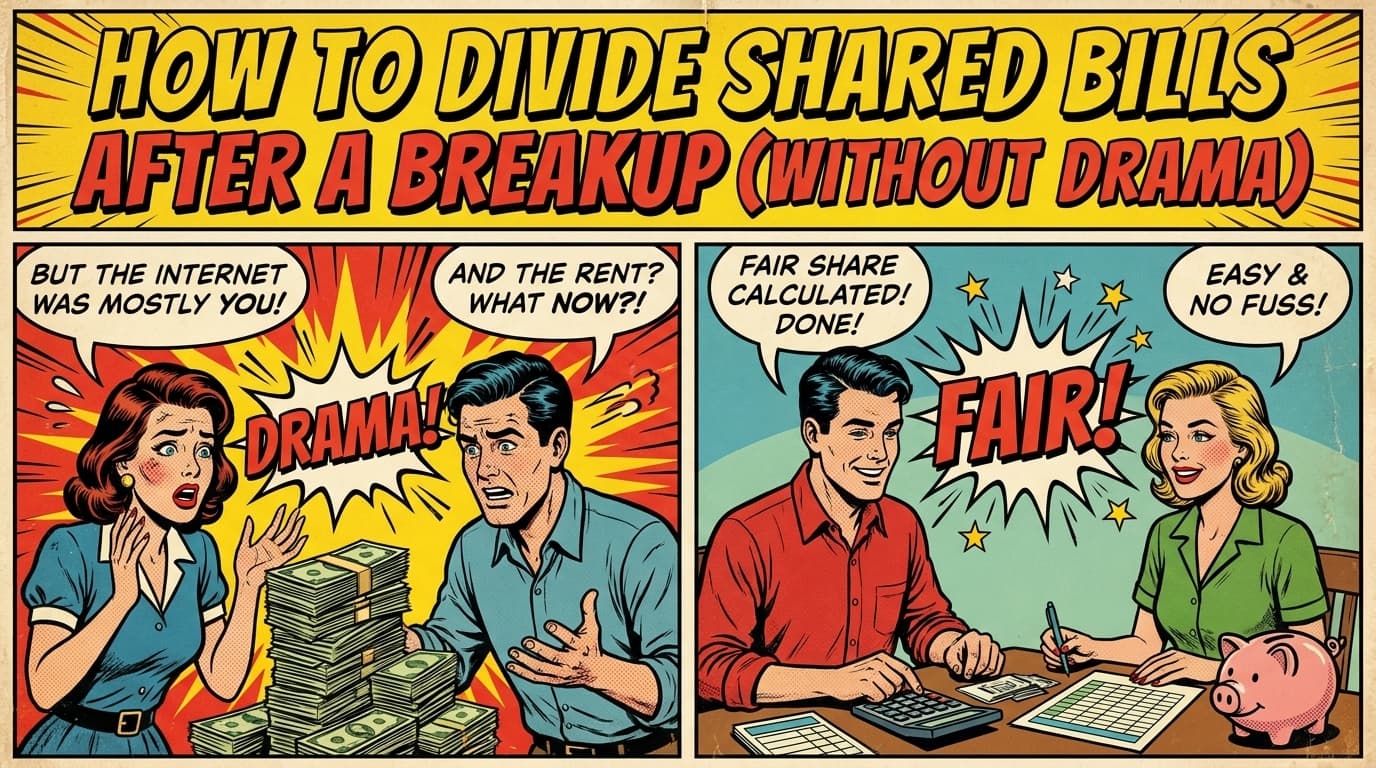
Breakups are hard enough without also having to figure out whose name is on the gas bill and who gets the couch.
This is the practical, unromantic guide to untangling shared money after a split. The goal isn't fairness in some deep cosmic sense, it's to end the financial entanglement cleanly so both of you can move on.
Rule 1: Deal with this faster than feels comfortable
Shared bills are one of the top reasons exes stay in touch when neither of them wants to. Every month that rent, utilities, and subscriptions are tangled is another month of contact.
Set a target: fully disentangled within 60 days of the breakup. Faster if one of you has already moved out.
Rule 2: Separate emotional accounting from financial accounting
You might be owed things emotionally. That's a separate conversation. The financial reconciliation is: who paid what, who owes what, and how do we split stuff we bought together.
Don't let "but they cheated" or "but I was always the one cooking" into the math. Those are real things, but they're not line items.
The checklist
1. The lease
If you're both on the lease:
- Talk to the landlord about removing one name. Most leases allow replacement but require approval.
- If you're staying, find a new roommate to replace the leaving partner.
- If you're both leaving, give notice.
- Until one of you is off the lease, you're both still on the hook for rent. Make sure rent gets paid on time regardless of relationship status.
If only one of you is on the lease:
- The on-lease person stays by default.
- The off-lease person moves on their preferred timeline.
- No drama with the landlord.
2. The security deposit
Whoever paid it in initially gets it back at the end of the lease. If you both paid, it splits back proportionally to how you paid in.
If the leaving person moves out mid-lease and is replaced, the replacement roommate reimburses the leaving person's share of the deposit. The staying person doesn't pay it back out of pocket.
3. Utilities and accounts
For every shared utility:
- If it's in the leaving person's name: transfer to the staying person.
- If it's in the staying person's name: no change, but clarify final-month splits.
- If it's a joint account: close it at the end of the current month, staying person opens a new one.
Don't leave shared accounts "for now." It's one more tie and the incentive to pay on time goes down when you're no longer together.
4. Shared subscriptions
- Who's keeping each one? Decide item by item.
- Password-shared streaming: change the passwords, remove old devices.
- Family plans (Apple One, Spotify Duo, phone plans): whoever's the account holder keeps it and boots the ex off. The ex signs up for their own.
- Any paid subscription the two of you split: whoever wants to keep it pays going forward.
5. Joint accounts
Joint checking or savings:
- Close it as soon as pending transactions clear.
- Split the balance based on what's in there (usually proportional to what each contributed, or 50/50 if truly merged).
- Open separate accounts if you haven't already.
Joint credit cards:
- Call the issuer to close or remove an authorized user.
- Pay off the current balance before closing.
- Who pays for what on the final statement gets split by purchaser (you get a full statement showing who charged what, mostly).
6. The shared stuff
Furniture, kitchenware, the TV, the dog:
- Paid entirely by one person: belongs to them.
- Chipped in by both: whoever keeps it buys out the other at current used-market value, not what you paid originally.
- Gifts to each other: belong to the receiver, full stop.
- Gifts from family ("our" wedding registry): complicated. Usually defaults to whoever has the closer tie to the gift-giver.
- The dog: genuinely hard. Don't pretend it's like a couch. Talk it out separately.
Write down the split. Sign it if you want, even informally. Memory is unreliable and gets worse when things are emotional.
7. Outstanding shared debts
If one of you was fronting a lot of stuff the other owed for (trip costs, rent months, shared dinners), use a bill-splitting app to pull the total. Pay it off in one transaction if possible.
Don't carry shared debt past the formal separation. It's another tie, and it accumulates weirdness.
8. Shared things you forgot about
A non-exhaustive list of things people forget:
- That one savings account for "the house down payment"
- The magazine subscription one of you started
- The gym membership with shared billing
- The pet deposit on the apartment
- Loans within the couple ("I lent you $400 for your bike")
- Costco membership
- The storage unit
- Shared loyalty accounts (hotel points, airlines)
Go through finances from the last 12 months. Anything recurring that still has the ex's name on it or money tied up in it, resolve.
The script for the financial conversation
"I want to figure out the money stuff cleanly. Can we sit down for an hour, go through everything shared, and make a list of what's what?"
"Cleanly" is the key word. It signals you're trying to be fair, not trying to extract anything.
Bring:
- A list of shared accounts, bills, subscriptions, and possessions
- A note of what each of you paid into shared stuff recently
- An empty column for "what we're agreeing to"
Go through it. Write down agreements. Both take a photo of the list.
What if they're being unreasonable?
If the ex is refusing to split fairly or is being vindictive:
- For joint lease issues: talk to the landlord directly, they often have experience with this.
- For joint accounts: many banks have processes for one party to close a joint account with just their signature.
- For large disputes ($1,000+): small claims court is an option.
- For smaller amounts: sometimes eating it is worth the clean break. Calculate the emotional cost of another month of fighting.
The long view
A clean financial break isn't about "winning." It's about getting to a place where neither of you has a reason to keep contacting the other about utility bills. Six months from now, you want to have forgotten who paid what in March.
TL;DR
- Target 60 days to fully untangle shared finances.
- Separate emotional from financial accounting. Don't let the relationship drama into the math.
- Work through the checklist: lease, deposit, utilities, subscriptions, joint accounts, shared stuff, outstanding debts.
- Do it in one meeting if you can, not spread over weeks.
- Write down agreements and both keep a copy. Memory gets worse when you're emotional.
Frequently asked questions
How do you split shared bills after a breakup?
Work through the categories: lease (remove one name or end it), security deposit (refunded proportional to contribution), utilities (transfer to staying person or close), subscriptions (whoever keeps each one pays), joint accounts (close and split balance), shared stuff (current used-value buyout). Aim for full disentanglement within 60 days.
Who pays the rent after a breakup if both names are on the lease?
Both of you are legally still on the hook until one name is removed. Practically, whoever is staying covers going forward, but the leaving person may owe pro-rated rent for the current month and should help find a replacement if the lease can't just be transferred.
How do you split furniture and shared stuff after a breakup?
Whoever paid entirely for something keeps it. Items you both chipped in on, whoever keeps it buys out the other at current used-market value, not original price. Gifts to each other belong to the receiver. Pets aren't possessions, talk it out separately.
What happens to a joint bank account after a breakup?
Close it as soon as pending transactions clear. Split the balance based on contribution (usually proportional, sometimes 50/50 if it was fully merged). Open your own separate account before closing the joint one so your direct deposits don't bounce.
How long should it take to fully separate finances after a breakup?
Target 60 days. Longer than that and you're maintaining a financial tie that usually becomes emotional friction. Faster is better. The exceptions are lease terms you can't break without significant cost, those might legitimately take longer.