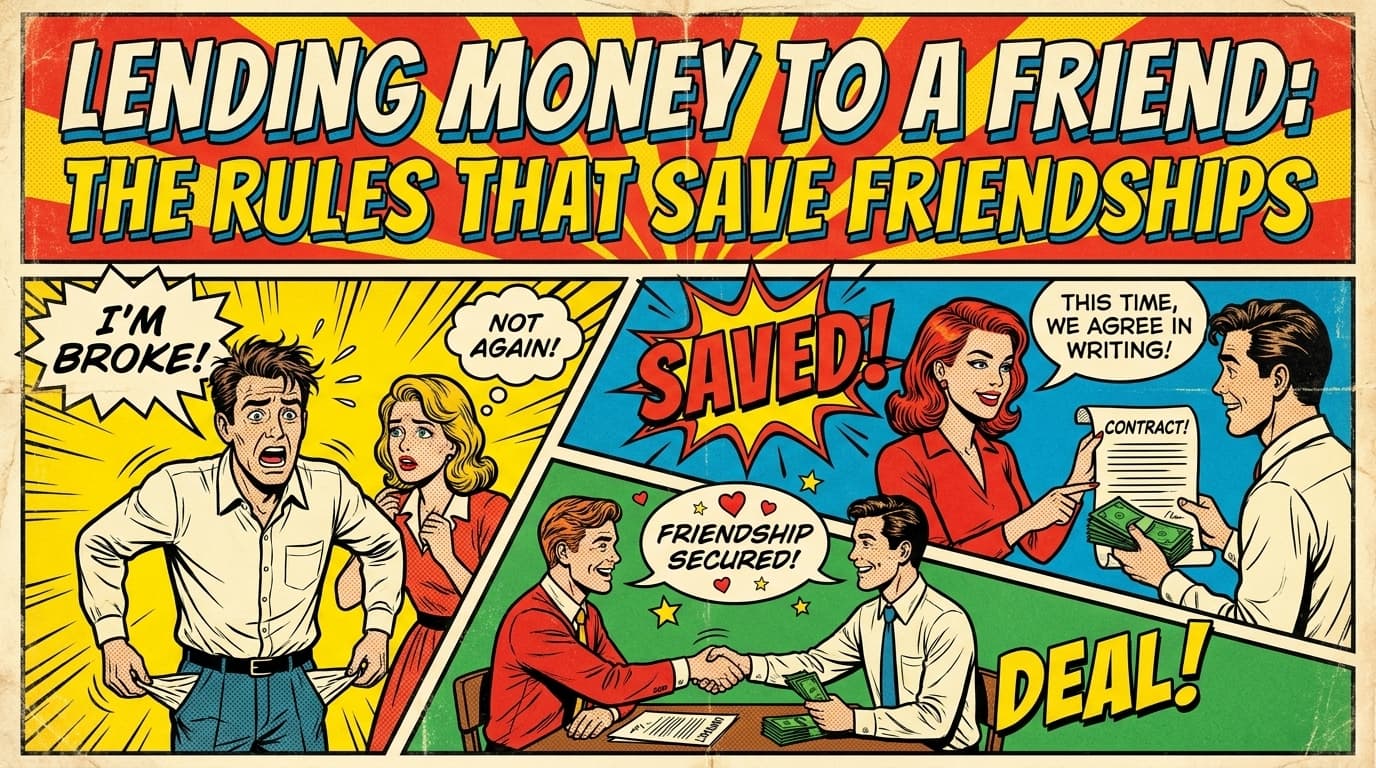
Lending Money to a Friend: The Rules That Save Friendships
A friend asks to borrow $500. Or $2,000. Here are the rules that let you lend to friends without blowing up the friendship, and how to know when to say no.

Anna
Supasplit Team
The message that changes the friendship
It comes in as a text. "Hey, would it be weird to ask for a loan? I need like $800 for car repairs, I can pay you back in 2 months."
Suddenly you're making a decision that isn't just about money. It's about the friendship. How you respond, how much you lend, how you track it, whether you follow up when they're late. Every step has a right move and a wrong move, and the wrong moves can permanently shift the relationship.
Lending money to friends doesn't have to end badly. Lots of people do it successfully. But it requires rules, the kind most people figure out only after one bad loan. Here are those rules, so you can skip the learning-the-hard-way version.
Rule 0: Only lend what you can afford to never get back
This is the foundation. Everything else only works if you follow this one.
Assume the worst case before lending: the money is gone, and you and this friend drift apart. Is the amount you're considering small enough that you'd survive both outcomes?
If yes, lending is a reasonable call. If no, don't lend it, period. Most loans between friends get paid back, but some don't, and you don't know in advance which is which. Lending more than you can afford to lose is how perfectly stable people end up in bitter feuds.
Rule 1: Say no is always on the table
You can say no to a loan request. You don't owe your friends access to your bank account. "No" is a complete sentence.
The softer version if you want one:
"I can't swing a loan right now, but I can help you think through options if that's useful."
This declines the loan without declining the friend. You're still there, you're just not the bank.
Most friends understand no. The ones who escalate ("come on, it's just $500, I know you have it") are giving you information about them, not about your generosity.
Rule 2: Name terms, write them down
If you say yes, do not do it vaguely. Before money changes hands, three things are clear:
- The exact amount.
- The repayment date. Not "soon." Not "when I can." A date.
- The payment method. Venmo? Check? Cash? Pick one.
Put it in a text message. Both of you have a record. You haven't done anything formal, you've just made the expectation concrete.
Example message:
"Cool, sending you $800 Venmo now. Plan is you pay back $400 on June 1 and $400 on July 1, sound good?"
They reply "yes/cool/appreciate it." Now you both have written terms. No future confusion about what was agreed.
Rule 3: Split the loan into installments for anything over $200
For amounts above a couple hundred, set up installments rather than one big repayment.
Installments are easier for the friend (smaller amounts are less intimidating) and clearer for you (you can spot a missed payment fast). For $800: four $200 payments over four months. For $2,000: four $500 payments. Installments beat lump sums for friend-lending hygiene, every time.
Rule 4: Don't charge interest (unless it's a business loan)
Personal loans between friends shouldn't have interest. The moment you introduce interest, the transaction stops being a friendship gesture and becomes a financial product, and the friendship gets weird.
Exceptions exist if the loan is for a business or investment and you've explicitly agreed it's a business-like arrangement with paperwork. That's rare and typically not what people mean when they say "lend me some money."
For normal life stuff (car repairs, rent gap, medical bill), lend the amount and get back the amount. Clean.
Rule 5: One gentle follow-up when they're late
If a payment date passes without payment, send one gentle message:
"Hey, just wanted to check in on the June payment. If this month is tight, let me know, we can figure it out."
Notice what this doesn't do:
- Accuse
- Demand
- Guilt-trip
- Pretend you forgot
What it does:
- Name the thing (June payment)
- Open a door ("if this month is tight")
- Propose a path ("we can figure it out")
Most friends respond within the day, either with payment or with an honest "ugh sorry, can I push it two weeks?" Either is fine. Communication is the win.
Rule 6: If they ghost the follow-up, one direct conversation
If the gentle follow-up gets ignored for a week+, don't keep sending polite nudges forever. One direct message:
"Hey, I haven't heard back on the loan payment. Want to hop on a quick call or talk about where things are at?"
You're requesting a real conversation, not another text exchange. This forces the issue onto a real surface, which is uncomfortable but effective.
If they avoid the conversation, you've learned something hard but real: they are choosing to avoid addressing it. That's the information you needed.
Rule 7: Never lend to the same friend twice until the first loan is squared
A friend with an outstanding loan asks for another one. The answer is no, or "once the first one is paid, happy to talk."
Lending to someone who hasn't paid back the first loan is not generosity, it's enabling. You're signaling that payback is optional. Worse, you're doubling your exposure with someone who's already shown they can't or won't pay on time.
Sticking to this rule is kinder than bending it, because it forces the conversation that's been avoided.
Rule 8: Some amounts should just be gifts
For small amounts ($50-200) lent to a good friend in a tough moment, consider making it a gift instead of a loan. Say so explicitly:
"Don't worry about paying it back, consider it a gift."
This is cleaner than pretending it's a loan and then silently not expecting repayment. Gifts are declared, loans are structured. Don't blur the two.
The scenario where you should say no immediately
A few situations where the answer is always no, even if you could technically afford it:
- A new friend, under a year of friendship. You don't have enough data yet.
- A friend currently in a crisis that's not stabilizing (active gambling problem, ongoing eviction cycle, serial borrower). Lending pushes the problem down the line.
- A friend whose previous loan from someone else you know isn't paid back.
- An amount larger than you'd comfortably gift them.
In these cases, the most helpful response isn't a loan. It's "no, but I care about you. Let's talk about what's actually going on."
TL;DR
- Only lend what you can afford to never get back. Everything else rests on this.
- Name terms in writing before any money moves. Amount, date, method.
- Installments beat lump sums for anything over $200.
- One gentle follow-up, then one direct conversation if they're late.
- Never lend to the same friend twice until the first loan is squared. Passive aggression is the worst option.
Frequently asked questions
Should I lend money to a friend in need?
Only if you can afford to never get it back and still be okay both financially and emotionally. If the worst-case scenario is survivable, lending can be a genuine kindness. If losing the money would cause you real hardship or permanent resentment toward the friendship, don't lend it. Say no kindly and offer other kinds of help.
How do I ask a friend to pay back money they owe me?
Start with a gentle text that names the thing and opens a door: 'hey, wanted to check in on the June payment, if this month is tight let me know we can figure it out.' If that's ignored, escalate to asking for a direct conversation, not another text thread. Avoid passive aggression at all costs, it ruins friendships faster than unpaid loans.
Should I charge interest on a loan to a friend?
No, for normal personal loans. The moment interest enters the picture, the loan stops being a friendship gesture and becomes a financial product, which changes the relationship. The exception is a formal business loan with written paperwork where you've explicitly agreed it's a business-like arrangement, and that's rare in practice.
What do I do if a friend asks to borrow money and I don't want to lend it?
Say no. You don't owe friends access to your bank account. The softer version is 'I can't swing a loan right now, but I can help you think through options.' This declines the loan without declining the friendship. Most friends understand. The ones who escalate or guilt-trip are telling you something important about them.
Should I keep lending money to a friend who hasn't paid back the first loan?
No. The answer is 'once the first one is paid, happy to talk.' Lending to someone with an outstanding loan doubles your exposure to someone who's already shown they can't or won't repay on time. Sticking to this rule is kinder than bending it, because it forces the conversation that's being avoided.