Friend Owes You $20, Let It Go or Chase It? A Decision Tree
A practical decision tree for when a friend owes you a small amount. When to let it go, when to send the request, and when to say something.

Anna
Supasplit Team
The $20 that's been on your mind for a week
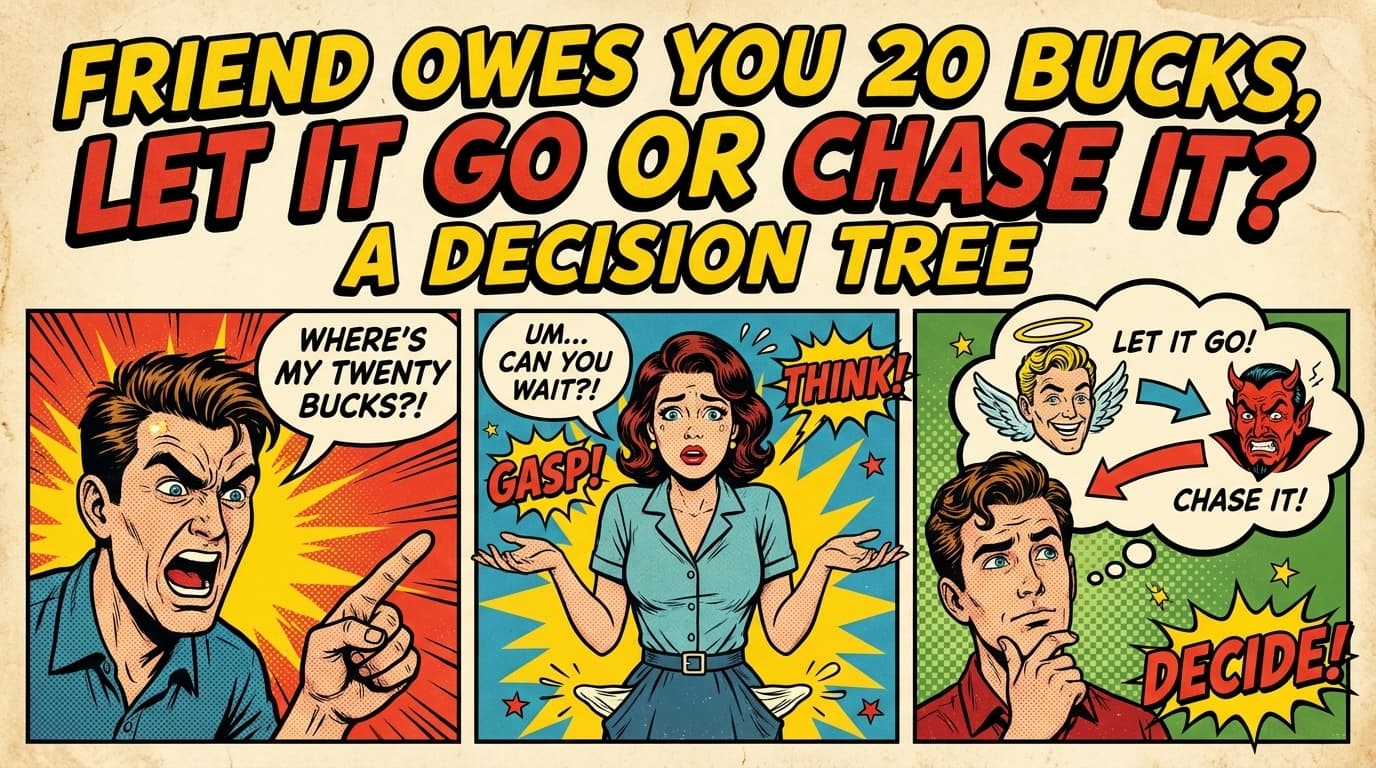
It's $20. They owe you $20. You've had $20 in your own wallet this whole time. And yet, somewhere in the back of your head, $20 is doing its little dance.
Should you ask? Is it petty to ask? Is it petty to not ask and then be quietly annoyed about it? Is $20 a little or a lot? Is the answer different for a close friend vs. an acquaintance? Why is this the thing consuming five minutes of your day?
Small-amount decisions are strangely high-friction, because the amount is too low to feel comfortable chasing but too noticeable to just forget. Here's a decision tree that'll get you to an answer in about 45 seconds, and then you can move on with your life.
The tree, top to bottom
Start with the first question. Follow the branches until you hit an answer.
Question 1: Has it been more than a month?
No, it's recent (under a month): Go to Question 2. You're in "low awkwardness" territory. Normal to follow up.
Yes, 1-3 months: Go to Question 3. The request feels weirder the longer it sits, but it's still fine.
Yes, 3+ months: Go to Question 4. You're in "probably let it go or have a real conversation" territory.
Question 2: Recent debt, under a month
Just send the Venmo request with a clear memo. Don't overthink. This is the cheapest possible fix.
Message template if you prefer messaging first:
"Hey, $20 for the Uber last Friday, whenever's good!"
Tone-light, amount named, context given. Close to 100% of friends respond within a day.
This is not petty. $20 is $20. If you'd pay them back on $20, it's reasonable to want $20 back.
Question 3: It's been 1-3 months
Now it's a little weirder but still fine. The move: lead with "I forgot to follow up."
"Hey, totally forgot to follow up, you're $20 for the pizza from my birthday. Want to just send it over?"
You put the delay on yourself, which takes the gotcha energy out. Most friends respond with an immediate forehead-smack and send.
If they don't respond within 4-5 days, one gentle nudge, then let the request do the work.
Question 4: It's been 3+ months
This is where the tree gets interesting. Go to Question 5 and Question 6.
Question 5: Is the friendship currently active and warm?
Yes, we still hang out weekly: The relationship is alive, so chasing is fine. Use the "I forgot to follow up" approach.
Meh, we see each other occasionally: Consider if the $20 is worth the potential vibe hit. Usually it is, because $20 is enough that forgetting it silently feels bad too.
No, we haven't really talked in months: You're in "probably let it go" territory. Chasing $20 isn't going to fix the drift, and sending a Venmo request out of the blue 4 months later reads as the only reason you're reaching out. It kills a flickering friendship for $20. Not worth it.
Question 6: Is this a pattern or a one-off?
One-off: Just let it go. You're forgiving a friend a small debt. That's fine. Relationships have a tolerance budget for this stuff.
Pattern (they've done this 3+ times): You're not forgiving $20. You're accepting a pattern. That's worth a different conversation, one about how you two handle money together, not about this specific $20.
Translating the tree into action
Based on the branches, here's what you do:
Under a month, any friend: Send the request. Low friction, low awkwardness.
1-3 months, active friend: Send the message ("I forgot to follow up") + request.
3+ months, active friend: Decide if you want the money or the peace. If money, same message approach. If peace, forgive it silently and stop thinking about it.
3+ months, drifted friend: Forgive it. Don't reach out just to ask for $20. You'll feel worse.
Pattern friend: Stop fronting their share. Split at the table, don't cover their stuff. The $20 is a symptom.
The hidden cost of the middle option
A lot of people default to the middle: they don't ask, but they also don't mentally let it go. Every time they see the friend, a little voice says $20. Every time the friend posts something on social, the voice shows up. Every dinner, every coffee, every group text.
Over the course of six months, this mental overhead probably "costs" you more than $20 worth of emotional bandwidth. You're paying the price of the money you didn't get, plus the price of carrying the thought.
The asymmetry is wild: asking costs 30 seconds and an awkward message. Not asking costs five minutes a week for half a year. Do the math.
When $20 is actually $200
Sometimes what you think is a small-amount decision is actually about a bigger pattern. If you find yourself asking this decision tree about the same friend four times a year, the $20 isn't the issue. The issue is that they consistently owe you small amounts and you consistently let it slide.
The fix isn't to chase the $20. It's to structurally stop being their default lender. Split at the restaurant (two tabs, not one). Have them pay the concert organizer directly. Don't front their share of the Uber.
The Venmo-request psychology
For people who hate sending Venmo requests at any amount, a reframe: a request is not an accusation. It's the app's native mechanism for settling shared expenses. You're not "calling them out" when you send one. You're using the tool for its literal purpose.
That said, memos matter. A good memo on a $20 request:
- "Uber Sat night"
- "pizza at my bday"
- "concert ticket"
A bad memo:
- No memo
- "🙄" or emoji-only
- "the thing you forgot"
- "finally lol"
Keep memos specific and neutral. The request is business, the memo shouldn't be editorialized.
The "it's really bugging me" test
Ultimate tiebreaker: how much is this actually affecting your head?
If you've thought about it more than twice in a week, ask. The cost of thinking about it is higher than the cost of asking.
If you forgot about it for two weeks and only remembered because you saw this article, forgive it. It clearly doesn't matter.
TL;DR
- Under a month: just send the request. This isn't petty, it's normal.
- 1-3 months: lead with "I forgot to follow up" to remove the gotcha energy.
- 3+ months, active friendship: still fine to ask. Warm friends can handle an old follow-up.
- 3+ months, drifted friendship: forgive it. Chasing $20 won't revive a flickering connection.
- Pattern-owing: the $20 isn't the issue. Stop structurally fronting their share.
Frequently asked questions
Is it petty to ask a friend to pay back $20?
No. $20 is $20. If you'd pay them back on $20, it's fair to expect the same. The perception of pettiness usually comes from how you ask, not whether you ask. A casual 'hey, $20 for the Uber, whenever's good' lands totally fine with almost any friend.
How long should I wait to ask a friend to pay back a small amount?
Don't wait. Send the request or message within 24-48 hours of the expense. Same-day or next-day is the least awkward window for any size amount, including small ones. After a month it becomes slightly weirder to bring up, after three months it becomes a real decision about whether it's worth it.
When should I just forgive a small debt instead of chasing it?
Forgive it when the friendship has drifted and you haven't talked in months, because reaching out just to ask for $20 reads badly. Also forgive it if you genuinely won't notice the $20 is gone and the friend is in a tight spot. But actually forgive it, don't silently resent them while pretending to forget.
What if the same friend keeps forgetting to pay me back small amounts?
The $20 isn't the real problem. The pattern is. Stop structurally fronting their share. Split at the restaurant so their card goes in, have them pay the organizer directly for group events, don't cover their Uber. You're not punishing them, you're removing yourself as the default lender.
How do I send a Venmo request without feeling awkward about it?
Reframe the request. It's the app's built-in mechanism for settling shared expenses, not an accusation. Keep the memo specific and neutral, 'Uber Sat night' or 'pizza at bday.' Don't editorialize with emojis or sarcasm. A request sent within 24 hours almost never feels weird. Delayed requests feel weirder the longer you wait.