Tipping Uber Eats, DoorDash, and Grubhub: What's Actually Expected in 2026
Delivery tipping has its own etiquette. Here's what's actually expected for Uber Eats, DoorDash, Grubhub, and other delivery apps in 2026.

Anna
Supasplit Team
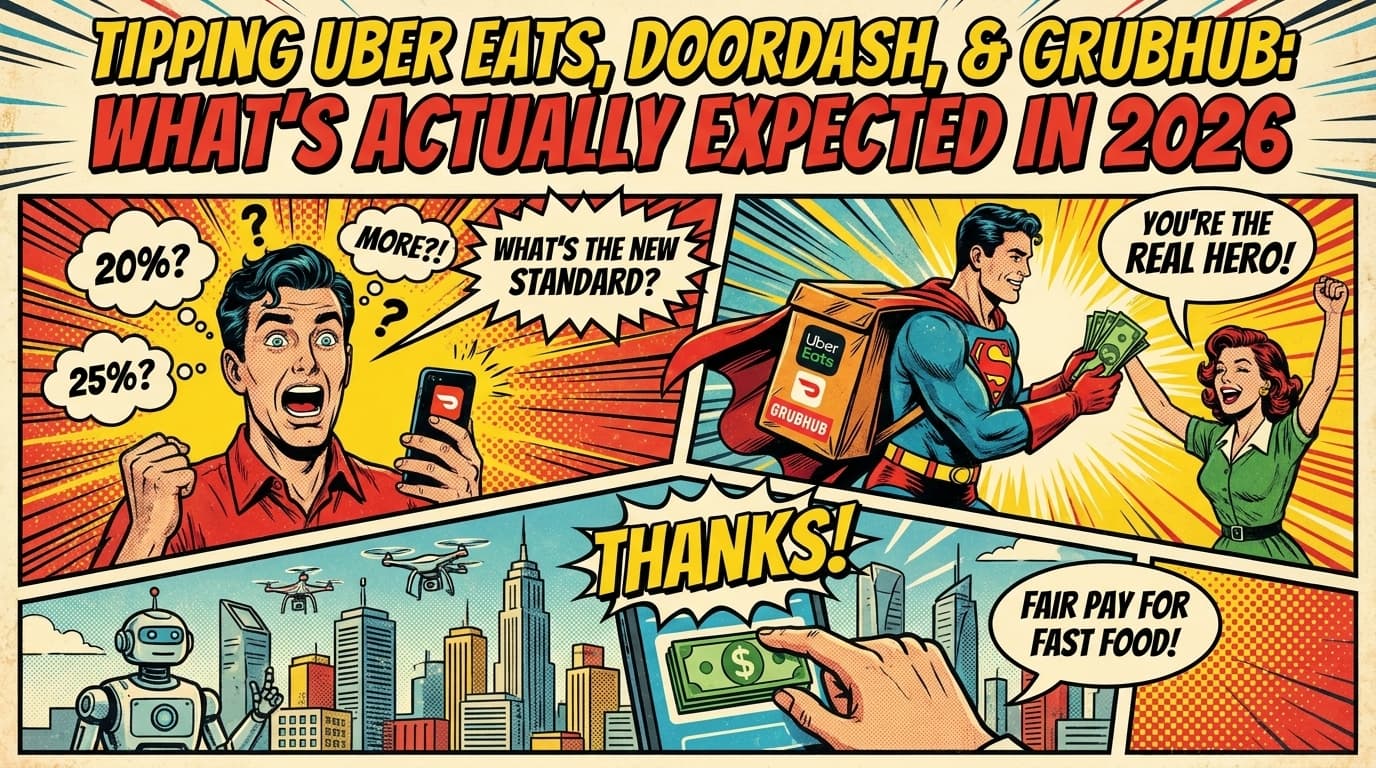
Food delivery is its own tipping universe. The drivers earn differently from rideshare. The platforms work differently. The customer-facing prompts are different. The result: a lot of people are quietly tipping wrong, either way more than necessary or way less than fair.
Here's what's actually expected for Uber Eats, DoorDash, Grubhub, and other food-delivery apps in 2026. Plus when to pre-tip, when to adjust after, and how to think about the math.
The standard: 15-20% of the food total
The base norm is 15-20% of the food cost (before fees and delivery charges).
Not the total of the order with fees included. The actual food price.
Example: you order $40 of food. Delivery fee is $5, service fee is $4, fees plus food = $49 before tip. The standard tip is 15-20% of the $40, not the $49.
So: $6-8 tip on a $40 food order.
Why not on the total? Because the fees go to the platform, not to the driver. Tipping on the platform's cut doesn't help the driver.
Why delivery tips matter more than rideshare
Delivery driver pay structure:
- A delivery driver's base pay per order is often very low ($2-5 in some markets).
- They drive to the restaurant, wait for the food, then drive to you.
- They cover their own gas, car maintenance, insurance.
- The platform takes a cut.
- The tip is often a meaningful fraction of total compensation.
For a $4 base pay + $7 tip = $11 total order, the tip is 64% of the driver's income on that order.
This is a big reason driver communities care a lot about tipping. The tip isn't a bonus, it's a substantial part of the income.
When to tip more
Situations that push you toward 20-25%:
Bad weather. Driving in heavy rain, snow, or extreme heat to deliver food is genuinely hard. Tip up.
Long distances. A delivery from a restaurant 20 minutes away that came on time is more work than one from down the block. Tip higher.
Walk-up apartments or hard-to-find addresses. The driver carried your food up four flights or hunted for your building. Add a few dollars.
Late-night orders. Drivers covering late shifts deserve more.
Large or heavy orders. Catering, multiple bags, large drinks. Tip up.
The driver dealt with something extra. Followed special instructions, waited for a long restaurant wait, helped carry into the apartment.
The upper end (25%+) is for exceptional or particularly difficult deliveries.
When you can tip less
Few situations:
Pickup orders. If you went to the restaurant yourself, no driver to tip.
The order was wrong or the driver was rude. Tip lower (or use the app's adjustment to fix after).
Very small orders. A $5 coffee delivery, a $1 tip is realistic, but consider whether ordering delivery for that price makes sense at all.
The food was an hour late and the restaurant (not the driver) was at fault. Still tip the driver. The driver didn't make the food.
Notice what's not on the list: "the app prompted me to tip too much." That's a UI complaint, not a tipping rule.
Pre-tipping is the standard now
For delivery apps, you typically tip when you place the order, before the driver has picked up the food.
Why this matters:
- Drivers see the tip when deciding whether to accept the order.
- Low or no-tip orders get accepted last, often by less-experienced drivers, often slower.
- High-tip orders get picked up fast by good drivers.
If you pre-tip $1 on a $40 order, the algorithm flags it as a low-priority order. Drivers may pass on it. The order goes to whoever is willing to accept.
If you pre-tip $7-10, your order gets picked up fast and probably delivered well.
The pre-tip is part of the order economics. Skipping it (or low-balling) is taking a gamble on delivery quality.
Adjusting the tip after delivery
Most apps let you adjust the tip after delivery, usually within 24 hours.
Reasons to adjust UP:
- The driver was unusually helpful or fast.
- The conditions were bad (weather, late hour) and the driver made it work.
- You realize you pre-tipped low and want to correct.
Reasons to adjust DOWN:
- The food arrived hours late due to the driver (not the restaurant).
- The driver was rude or unsafe.
- The order was wrong because of the driver's mistake (not the restaurant's).
Don't adjust down for things outside the driver's control. Restaurant errors aren't the driver's fault.
The platform-specific differences
In practice, the tipping math is the same across DoorDash, Uber Eats, Grubhub, and most other US delivery apps. But the dynamics vary:
DoorDash:
- Tip is visible to drivers at order acceptance time.
- Drivers can decline low-tip orders.
- DoorDash markets a "guaranteed minimum" but the tip is critical.
Uber Eats:
- Similar to DoorDash. Tip visible at acceptance.
- Driver and rider apps are integrated.
Grubhub:
- Tip visible at acceptance.
- Some markets have unionized or guaranteed-wage drivers.
Postmates (now part of Uber):
- Merged with Uber Eats functionality.
Instacart, Shipt (grocery):
- Different dynamics: shoppers do more work (selecting items, communicating substitutions). Tip 15-20% of the grocery cost, considering the labor.
What about subscription services like DashPass or Uber One?
Subscriptions that waive delivery fees still require tipping. The tip is for the driver, not for the platform.
Don't "skip the tip because I'm paying for DashPass." The driver gets neither the delivery fee nor the subscription benefit. Tip normally.
Tipping on Instacart and grocery delivery
Grocery delivery is more labor-intensive than restaurant delivery. The shopper:
- Reads your list
- Selects each item
- Handles substitutions with you
- Bags and transports
- Delivers to your door
For that work, 15-20% of the grocery total is fair. For large or complex orders, 20-25% is more appropriate.
Same logic as restaurant delivery: the tip is on the items, not the fees.
Big group orders for office or party
When ordering catering or a large group order:
- 20% is the standard floor (not 15%).
- Reason: large orders are heavier, more bags, more complex.
- Pre-tip generously, the driver will take more care.
- If you split the cost among the group, include the tip in the split.
Don't make the orderer absorb the tip while everyone else pays only for the food.
What if you didn't get the food?
If the delivery never arrived (driver delivered to wrong address, food lost):
- Contact the platform for a refund.
- Most platforms will refund the order including the tip if the food never made it.
- If the driver was clearly responsible, the tip should be refunded too.
- If the driver did try and something went wrong outside their control, consider keeping the tip.
Good faith effort by the driver deserves the tip, even when the outcome wasn't great.
Cash tipping is not the norm for delivery
Unlike rideshare or in-restaurant service, cash tipping for delivery is unusual. Most customers don't have cash anyway, and drivers expect in-app tips.
If you want to give cash as well, fine. But the in-app tip should still be at the standard rate.
Don't "tip a dollar in cash" while pre-tipping zero in the app. The driver doesn't know about your cash plan and won't have accepted the order under those terms.
TL;DR
- Standard delivery tip: 15-20% of the food cost, not the total with fees.
- Pre-tipping is the norm. Low or no-tip orders get picked up last (or not at all).
- Tip higher for bad weather, long distance, large orders, late nights, walk-up apartments.
- Adjust the tip up to 24 hours after for service that was notably different from expected.
- Subscriptions like DashPass waive delivery fees, not tips. Tip normally.
- Grocery delivery (Instacart, Shipt) deserves 15-20% on the grocery total for more labor-intensive work.
- Big group orders: 20% floor, include in the group split.
Frequently asked questions
How much should I tip Uber Eats or DoorDash?
15-20% of the food cost, not the total order with fees. So on a $40 food order with $9 in fees, tip is $6-8 (15-20% of $40). The fees go to the platform, the tip goes to the driver. Pre-tipping at this rate is the standard practice in 2026.
Why should I pre-tip on delivery apps?
Drivers see the tip when deciding whether to accept your order. Low or no-tip orders get picked up last, often by less-experienced drivers, often slower. A standard pre-tip ensures your order gets picked up quickly by a good driver. Pre-tipping is part of the order economics.
Do I need to tip on delivery if I'm using DashPass or Uber One?
Yes. The subscription waives delivery fees, but those fees go to the platform, not the driver. The tip is the driver's actual income from your order. Tip normally regardless of whether you have a subscription.
Should I tip more for Instacart and grocery delivery?
Tip 15-20% of the grocery total, with 20-25% appropriate for large or complex orders. Grocery shoppers do more work than restaurant delivery drivers, they select each item, handle substitutions, and bag everything. The labor justifies a fuller tip.
Can I adjust my delivery tip after the order arrives?
Yes, most apps let you adjust within 24 hours. Adjust up for unusually helpful service or bad conditions handled well. Adjust down only for issues that were actually the driver's responsibility, restaurant errors aren't the driver's fault.