Should Chores Count as Rent? The Honest Answer
When one roommate does most of the cleaning, should they pay less rent? The honest answer, plus the fair way to handle uneven chore distribution.

Anna
Supasplit Team
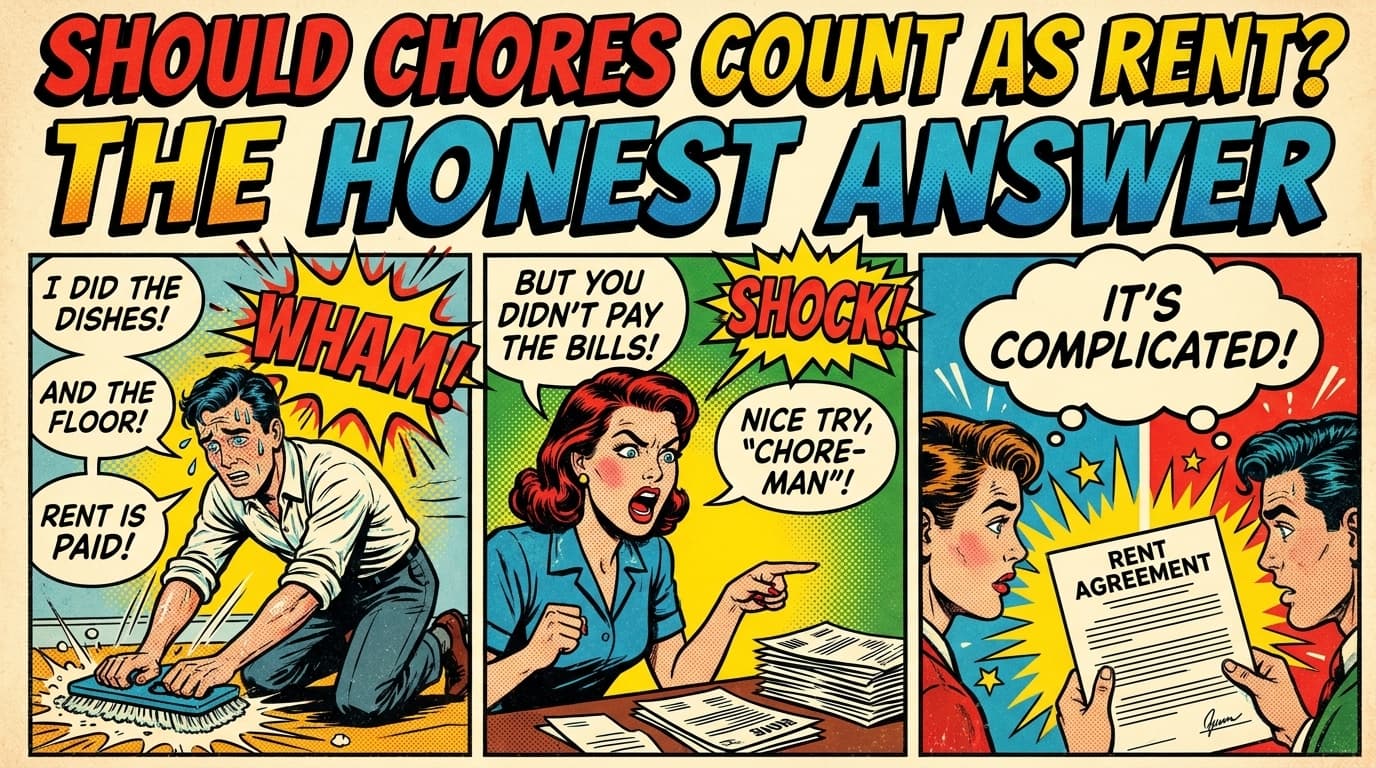
Your roommate hasn't cleaned the bathroom in four months. You've been doing it. Plus the kitchen. Plus taking out the trash. Plus managing the bills.
Somewhere in month three, you started thinking: if I'm doing 80% of the housework, should I be paying 80% of the rent?
It's a fair question. Also a dangerous one, because the answer most roommates want to hear ("yes, charge them for it") isn't the one that actually works in practice.
Here's the honest take: chores should not replace rent. But the imbalance is real, and there are better ways to fix it.
Why "chores as rent" sounds good but fails
The instinct is understandable. You're doing labor. Labor has value. Shouldn't the person doing less labor compensate the person doing more?
In theory, sure. In practice, turning chores into a rent discount creates three new problems that are worse than the original one.
Problem 1: It puts a price on invisible work. Once cleaning the kitchen is "worth $100 off rent," every chore becomes a negotiation. "I took out the trash, that's $5 off this month." You've just turned your home into a gig economy.
Problem 2: It lets the slacker opt out. If chores are monetized, the roommate who hates cleaning now has an easy escape: "Fine, I'll just pay the full rent, you clean." Congrats, you are now the maid.
Problem 3: It doesn't actually fix the resentment. The bathroom still needs cleaning. You still have to do it. You get $60 off rent but spend three hours scrubbing tile. Is that a win? Probably not.
The real problem isn't that chores aren't valued. It's that chores aren't getting done fairly. Those are different fixes.
What actually works: system, not discount
The fair answer is a chore system where labor is distributed more evenly, not monetized.
Three systems that actually work:
1. Fixed rotation. Each week or two, a specific person owns a specific chore. Bathroom is yours one week, theirs the next. Kitchen alternates. Trash rotates. Write it down, stick it on the fridge or in a shared note.
2. Ownership by chore. One person owns dishes forever. The other owns bathrooms forever. Pick what you each tolerate better, and commit. No rotation, no confusion.
3. Hire a cleaner. For the big stuff (bathroom, floors, kitchen deep clean), bi-weekly cleaner at $80-120 a pop, split 50/50. That's $40-60 per person per month to not fight about mold in the grout. Often worth it.
Most pairs land on a mix: cleaner for the big jobs, rotation or ownership for daily stuff.
When the imbalance is really extreme
Some situations are so lopsided that "fair system" feels like it skips the actual problem. If your roommate does literally nothing, month after month, no amount of reshuffled rotation is going to fix that.
In those cases, you're not actually in a chore problem. You're in a roommate problem. And the fix isn't a rent discount, it's a conversation about whether this roommate situation is working at all.
Scripts for the escalation:
"We've talked about this a few times and nothing's changed. I don't want to keep bringing it up. Either we hire a cleaner and split it, or we need to have a bigger conversation about how we're living together."
Notice what this doesn't say: "you owe me money for all the cleaning I did." That framing almost always loses. The "either we fix this together or we acknowledge we have a bigger problem" framing doesn't.
The exception: when it's actually rent, not chores
There are a few rare setups where chores-as-rent is the whole deal from day one, and those are fine because both people went in eyes open.
Au pair / nanny situation. Someone lives in the house rent-free in exchange for childcare. That's a real, explicit labor exchange. Written up front.
Property management exchange. One roommate handles maintenance, repairs, dealing with the landlord, in exchange for reduced rent. Usually because they're a contractor, plumber, or handyperson. Defined scope.
Family arrangement. A parent, sibling, or family friend staying temporarily and "paying" in cooking or childcare instead of money. Works because expectations are set.
The common thread: everyone agreed on the trade in advance, in writing, with specific tasks defined. That is not the same as one roommate silently resenting another's messiness and wanting a retroactive rent cut.
The actual fair conversation
If you're in the "I do more than them" spiral, here's the conversation that actually works. It has nothing to do with rent.
"Hey, can we talk about chores? I've been doing most of the cleaning and it's starting to bug me. Can we figure out a system that splits it more evenly? I'm thinking [rotation / ownership / cleaner]."
Three moves:
- Name the imbalance directly. No passive-aggressive sighing.
- Lead with a solution. Don't just complain.
- Keep the language about the chores, not about their character.
The goal is more cleaning getting done by them, not less money from them.
What if they just literally won't
You had the talk. They agreed. Three weeks later, dishes are piled up again.
At this point, your options are:
- Accept it, lower your standards, stop doing more than your share. The house gets messier. You stop resenting because you're not overperforming.
- Pay for a cleaner, split it, reclaim your time. If they refuse to split the cleaner cost, cover it yourself and drop the chore rotation entirely. Your sanity is worth $60 a month.
- Start planning an exit when the lease ends. Some roommate dynamics don't get fixed, they just get outlasted.
None of these involve charging them rent for chores. All of them involve stepping out of the do-everything-and-stew pattern.
TL;DR
- Don't swap chores for rent. It monetizes invisible work, lets slackers opt out, and doesn't fix the underlying resentment.
- Build a chore system instead: rotation, ownership by chore, or a shared cleaner. Systems beat tallies.
- A bi-weekly cleaner split 50/50 is often the cheapest peace you can buy.
- Name the imbalance directly and lead with a solution, not a grievance.
- If nothing changes, lower your own output or plan an exit. Don't keep doing 80% and stewing about it.
Frequently asked questions
Should chores count as rent if one roommate does more cleaning?
Generally no. Monetizing chores creates more problems than it solves, it lets the less-involved roommate opt out of chores by just paying, and it doesn't actually reduce the work. A chore system (rotation, ownership, or hired cleaner) fixes the underlying imbalance better than a rent discount.
What's the fair way to split chores between roommates?
Pick one of three systems: weekly rotation of specific chores, permanent ownership of specific chores, or a bi-weekly cleaner split 50/50. Write it down. Avoid ad-hoc arrangements, they drift.
Is it fair to ask for lower rent if I do all the cleaning?
Usually not the right move. Asking for a better chore split is fairer and more likely to actually change the situation. Money discounts don't reduce the labor, they just transfer a small amount of cash while the resentment continues.
When does chores-as-rent actually make sense?
Only in explicit, pre-agreed arrangements like au pair situations, handyperson roommates, or family members staying short-term in exchange for specific tasks. Defined scope, written agreement, not retroactive after months of silent resentment.
What if my roommate refuses to do chores even after we've talked?
Either hire a cleaner and split the cost, cover the cleaner yourself and stop doing the chores personally, or plan an exit at lease end. Don't keep overperforming and hoping they'll change, that pattern never breaks on its own.