When a Friend Rolls In an Hour Late: How to Handle the Bill
The friend who shows up 90 minutes into dinner, orders one drink, and expects to split equally. Here's how to handle it without ruining the night.

Anna
Supasplit Team
Reservation was 7. By 7
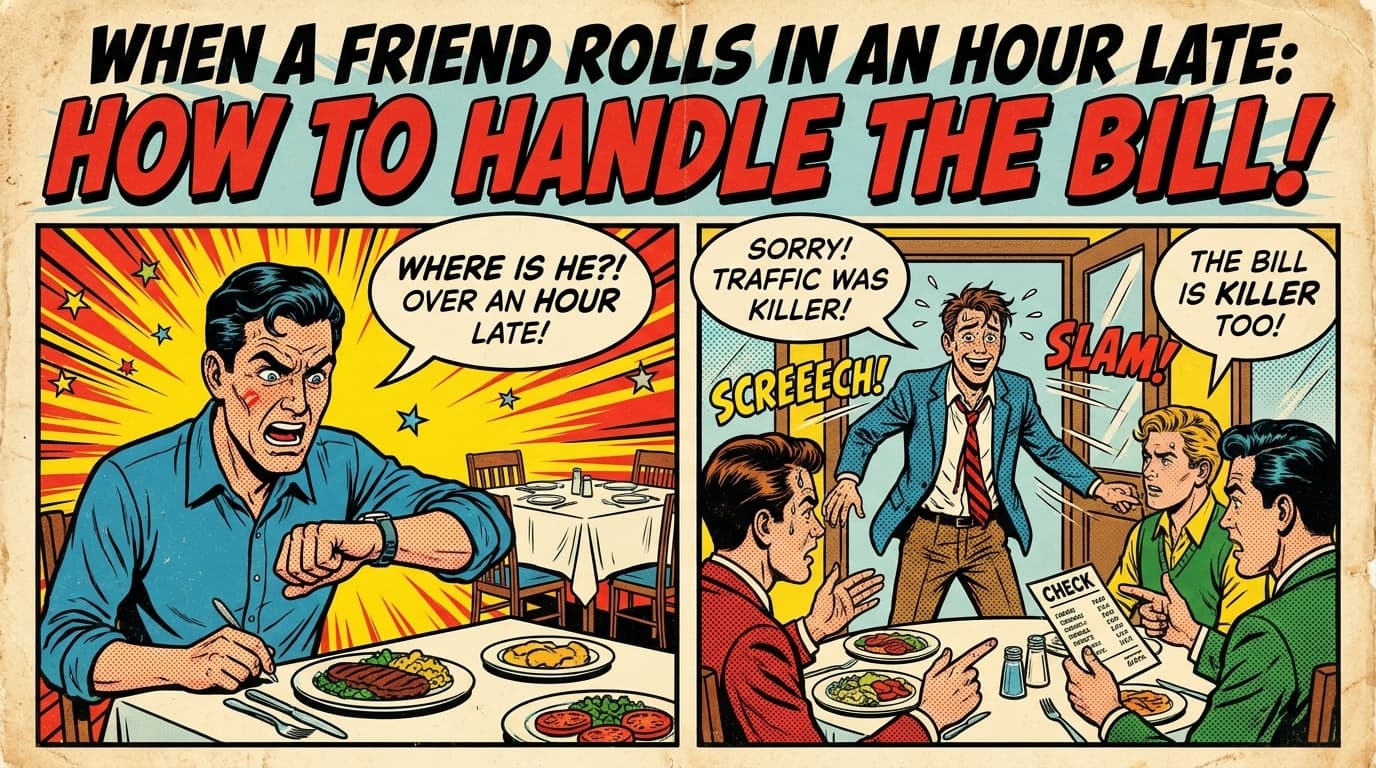
your group ordered drinks and an app. By 8 you ordered mains. At 8, one friend texts: "On my way!" At 8 they walk in. Everyone's halfway through their entree.The late friend orders a quick drink and a salad. Forty minutes later the bill arrives, and they say: "Let's just split it."
The rest of the group has been there for 90 minutes. They've each had a $40 entree, a $14 cocktail, and probably some shared apps. Their share is around $80 a head. The late friend's actual food + drink: $30.
Does the late friend split equally with everyone else? Pay only for what they got? Something in between?
Here's how to handle it without anyone feeling cheap or cheated.
The non-negotiable: pay for what you ate
The core principle: people pay for the food and drinks they actually consumed.
The late friend ordered a $30 dinner. They pay for $30 plus their share of any shared items they ate, plus their share of tax and tip on that.
The on-time friends, who collectively ate more, pay accordingly.
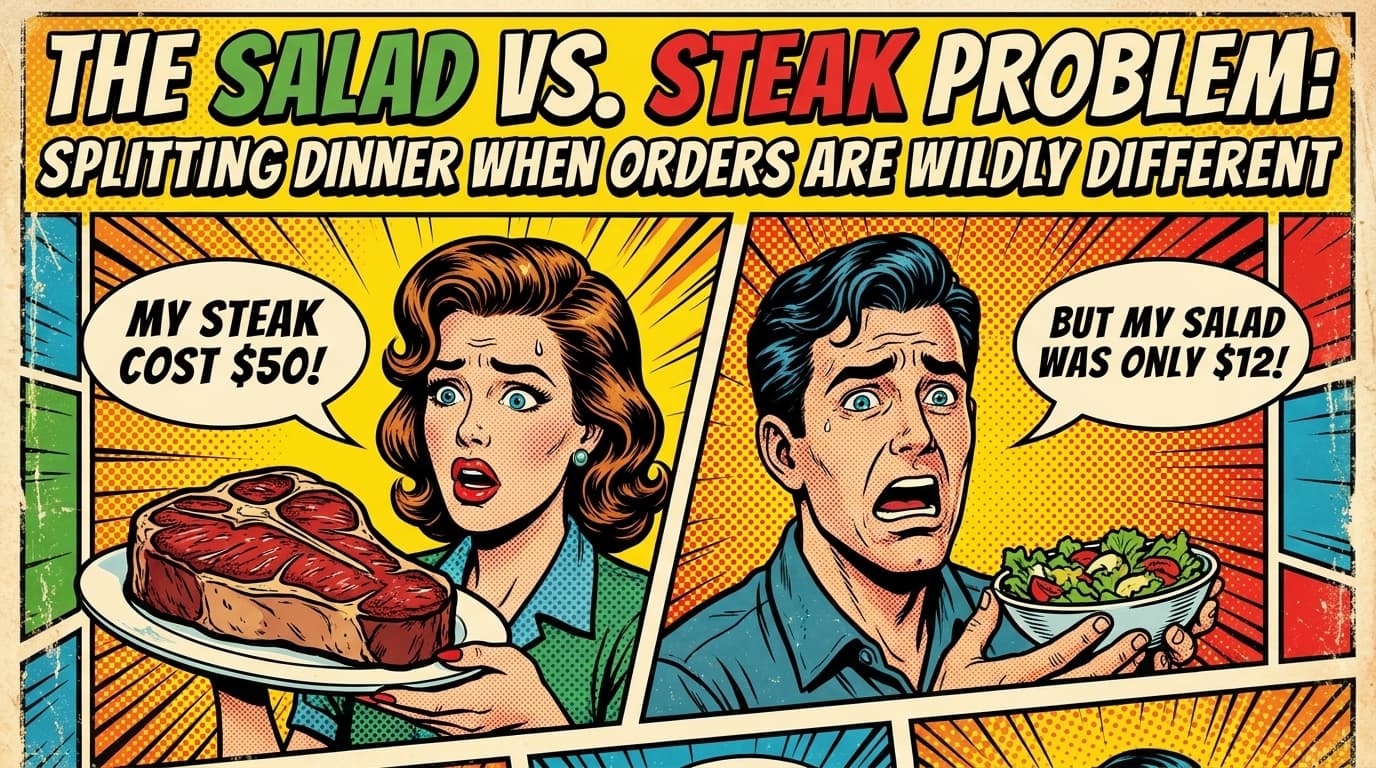
This is the same principle from our salad vs steak guide about ordering unevenly. Lateness is just another version of "you ate less, you pay less."
Why "let's just split it" is unfair here
When the late friend says "let's just split it," they're proposing a system where their lateness costs them less.
The rest of the group:
- Sat through the whole meal, ordered the whole menu.
- Paid for time, attention, and money.
- Would have ordered the same regardless of who was there.
If the bill splits evenly, the late friend is effectively subsidized by the on-time group.
The occasional generous gesture (you all chip in when a friend can't afford it) is different. The structural "I came late, I pay less by averaging it out" is a pattern that erodes goodwill.
How to handle it in the moment
The rest of the group should split their bill by what they ate. The late friend pays separately for what they got.
Logistics:
Option 1: Ask for separate checks.
"Could we get separate checks please?" Most servers will do this if asked, especially if it's clear there's a logistical reason.
The on-time group splits their bill among themselves. The late friend gets their own.
Option 2: Itemize at the table.
The on-time group splits their portion by averaging or by item. The late friend covers their specific items, taxes, and tip.
Use a calculator. Show the math. Don't be passive about it.
Option 3: The late friend pays what they ate, the on-time group splits the rest.
The late friend says "my share is around $35 with tip." They Venmo or hand cash to whoever's covering the bill. The rest of the group splits the remaining total.
Clean, kind, doesn't require restaurant logistics.
The thoughtful late friend
The best move (if you're the late friend): pre-empt the conversation.
When you arrive: "Hey sorry I'm late. Definitely just put me on a separate tab or I'll Venmo for my share, no need to split mine in."
This removes all the awkward math from the group. You came in late, you handle it gracefully.
If you don't pre-empt, expect the group to bring it up at billing time. Don't be defensive.
When equal split actually does work
Situations where averaging the bill is fine even with one late friend:
The late friend was only 15 minutes late. They got food, they got drinks, they participated in most of the meal. Splitting equally is fine.
The group's order was very even (everyone got similar prices). Even with a 30-minute lateness, the average works out close to actual costs.
The late friend ordered the full menu rapidly to catch up and ended up eating roughly what everyone else ate.
The group decided in advance the bill would be split equally regardless of attendance. (This is a real choice some groups make for simplicity.)
When those conditions don't apply, the fair-math approach is the move.
When the lateness was their fault vs. not
Does it matter why they were late?
If they were stuck in traffic or had a work emergency: the math is the same (pay for what you ate), but the group's grace level might be higher about not making it awkward.
If they were just casual about being on time: the math is the same, but the conversation might be more pointed if it's a pattern.
Reasons for lateness aren't the issue. The bill math is the same. The social tone differs.
What about the friend who didn't order anything?
More extreme case: the late friend orders a sparkling water, no food. Then the bill arrives.
The right answer: they pay for their water plus a small share of tip on whatever shared items they had. Probably $4-6 total.
They shouldn't pay any share of the on-time group's food. Their presence at the table doesn't entitle them to a share of others' meals.
If the rest of the group invited them or insisted they come, that goodwill doesn't change the math. Their presence is welcome, their meal is what it is.
What if the late friend offers to pay equally anyway?
This happens. The late friend is socially aware enough to know they're behind, and offers to pay equally as a gesture of "I'm sorry, I'm covering it."
Response: graciously accept, but acknowledge it.
"Thanks, that's really nice. Honestly, just covering your share is plenty, but if you want to split equally we appreciate it."
Don't let them quietly absorb the math while everyone else thinks it was fair. Let them know you noticed and appreciated.
How to set group norms for this in advance
For groups that eat together regularly, having a baseline norm helps:
Norm 1: Each person pays for what they ordered.
Default for most modern friend groups. Simple, fair, scales.
Norm 2: Split equally, but only if everyone's there for the same time and ordering similar amounts.
Works for tight groups with similar habits. Gets weird if conditions change.
Norm 3: One person pays, rotation across meals.
Works for very tight groups (close friends, small groups). Hard to apply at scale.
Most regular groups settle on Norm 1 implicitly. Stating it explicitly once removes the per-meal negotiation.
The bigger pattern: when the late friend is always the bargain
If a specific friend is consistently late to group meals and consistently benefits from equal-split math, eventually the rest of the group notices.
Ways to handle:
- Switch to per-item splitting at every meal (removes the benefit).
- Casually mention it: "You're getting a deal with our split tonight!" Not accusatory, but visible.
- Have a private conversation with the friend if the pattern persists.
- Stop including them in meal plans where the math will be unfair.
The pattern, more than any single instance, is the issue. One late dinner is forgivable. Six in a row is a pattern.
When you're the one who's late
If you're the late friend:
- Don't say "let's just split it." Say "I'll just pay for mine."
- Take responsibility for the math. Don't make the group do it.
- Tip on the actual amount you owe, including a share of shared items.
- Apologize once for being late. Move on.
The rest of the night is much better when you handle the bill gracefully. The lateness gets forgiven; the awkward billing doesn't.
TL;DR
- Pay for what you ate. Late friend covers their items and a share of shared things they participated in.
- Equal split is unfair when one person ate significantly less. Don't accept "let's just split it" by default.
- Ask for separate checks or itemize at the table. The math is doable.
- The thoughtful late friend pre-empts by offering to pay their share or take a separate tab.
- For chronic patterns of late + equal-split, address it privately or change your group norms.
- If you're the late friend, default to fairness, not convenience.
Frequently asked questions
Should a friend who's late to dinner pay an equal share of the bill?
Not usually. If a friend arrives an hour late, eats less, and orders less, splitting equally means everyone else is subsidizing their late arrival. The fair approach is for the late friend to pay for what they actually ordered plus their share of any shared items they ate, plus tax and tip on that amount.
How do I bring up bill fairness with a late friend without being awkward?
The cleanest move is to ask the server for separate checks before the bill arrives. If that's not possible, address the math openly when the bill comes: 'Should we just split among those of us who were here for the whole meal, and you cover yours separately?' Direct, kind, removes the awkward dance.
What if the late friend offers to pay equally anyway?
Graciously accept and acknowledge it. Don't let them quietly absorb the math while everyone pretends it was fair. A simple 'thanks, that's really nice, just your share is plenty if that's easier' lets them choose without pressure either way.
What if I'm the one who's late?
Pre-empt the bill conversation. When you arrive, mention casually that you'll just cover your share or take a separate tab. Take responsibility for the math, don't make the group do it. Apologize once for being late, handle the bill cleanly, move on with the evening.
What if a friend is always late and always benefits from equal splits?
Patterns deserve direct conversations. Either change the group norm to per-item splits at every meal (removes the benefit), or have a private chat with the friend. One instance is forgivable, six in a row is a pattern worth addressing. Stewing in silence usually ends up worse than the awkward conversation.