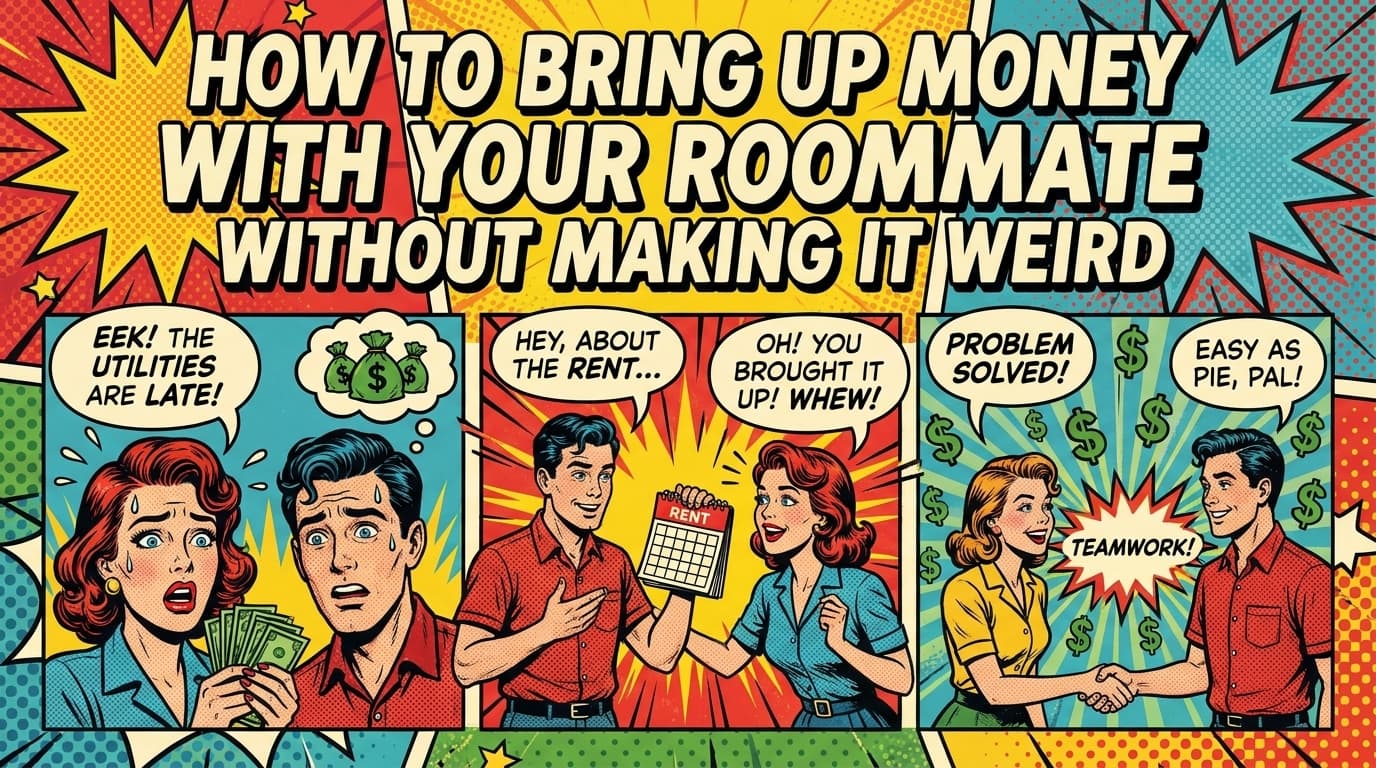
How to Bring Up Money With Your Roommate Without Making It Weird
Most roommate money problems are really communication problems. Here are the exact scripts and timing for bringing up money without the awkward silence.

Anna
Supasplit Team
Your roommate has owed you $140 for three weeks. Every time you see them, you consider bringing it up. You rehearse the line. You land on the couch. They ask how your day was.
You don't mention the $140.
This is the core roommate money problem, not that it's hard to split costs, but that it's hard to talk about it. Most roommate financial fights are actually communication fights that went unaddressed for too long.
Here's how to bring up money with a roommate so it doesn't land like a confrontation.
Why money talk feels weirder than it should
Three things happen at once when you need to bring up money:
- It feels transactional in a relationship that's supposed to be casual.
- It implies distrust, like you're keeping score.
- It's about actual money, which is culturally taboo to discuss directly.
All three are real. None of them are reasons to not have the conversation. The longer you avoid it, the weirder it gets, because the vibe stays tense while the topic stays unsaid.
The trick isn't to pretend money isn't awkward. It's to have the conversation before awkward turns into resentment.
The timing rule
The worst time to bring up money is when you're angry. The second worst time is when either of you is hungry, tired, or doing something else.
The best time: a neutral moment when you're both relaxed and the stakes are low. Ideally before a bill is due, not after a bill is three weeks overdue.
Concrete examples of good moments:
- Saturday morning coffee
- Walking somewhere together
- After dinner, before anyone's on their phone
- When you're both already talking about logistics
Bad moments:
- Right after they've walked in from a bad day at work
- Late at night
- During a fight about something else
- In passing as you leave for work
The three-part script
Most money conversations with roommates follow a pattern. Use this template and adapt:
1. Name the topic. Short, casual, specific. "Hey, can we talk about the electric bill for a sec?" Not: "We need to talk." That phrasing makes everyone brace.
2. State the concrete thing. No vague framing. "The last two months, we've been splitting 50/50 but you've been home a lot more and I'm noticing the bill is higher than usual."
3. Offer a proposed fix. Don't leave it open-ended. "Want to try 60/40 starting next month? I think that'd match better."
The reason this works: it names what's bothering you, gives the other person evidence rather than feelings, and gives them a specific thing to react to. "Do you feel like the split is fair?" is a trap question. "Want to try 60/40?" is a proposal they can yes/no.
Scripts for the common scenarios
When they owe you money and haven't paid:
"Hey, totally no stress, but can you Venmo me for the grocery run from last week? It was $42. I don't want it to slip my mind."
Notice: no accusation, no "I've been waiting," no sigh. Low-stakes reminder. 90% of the time they just forgot.
If they don't pay after the reminder, wait 4-5 days, then ask again, firmer:
"Hey, following up, can you send the $42 when you get a sec?"
When you want to change how you split something:
"I've been thinking about how we split [rent/utilities/groceries]. With the way things have shifted, 50/50 isn't quite matching up anymore. Want to try [proposal] for a month and see how it feels?"
The "for a month and see how it feels" phrasing lowers stakes. You're not asking them to commit forever. It's a trial.
When you can't afford something this month:
"Quick heads up, I'm going to be tight on rent this month by a few days, not because of anything weird, just timing. I'll have it by [specific date]. Wanted to tell you before the 1st so you're not wondering."
Proactive, specific, with a date. This is infinitely better than silence followed by late rent.
When they can't afford something and you're worried:
"Hey, I noticed things seem tight for you lately. I'm not trying to pry, but I wanted to check in. Do we need to rework any of the splits, or is this a temporary thing?"
This works when it's genuinely from a place of "are you okay" not "are you about to miss rent." Read the situation.
The stuff you shouldn't say
Some phrases that keep sneaking in and making things worse:
- "We need to talk." Makes people brace. Almost never a good opener.
- "I feel like" followed by a vague complaint. Use specific numbers or observations, not feelings about feelings.
- "You always..." / "You never..." Almost always not true, and invites the other person to argue about the wording instead of the topic.
- "It's fine." When it's not fine. This is the one that turns small problems into resentment.
- Joking-but-not-really. "Haha, you know you owe me like $200, right?" is worse than just asking. The joke gives them an out to laugh and move on.
The one question that saves a lot of grief
Early in a roommate relationship, ask this once, directly:
"How do you like to handle money stuff? Do you want reminders when bills come in, do you want to set up auto-pay, do you want a weekly check-in?"
This sounds intense but it's actually easy because it's not tied to a current problem. You're just figuring out their preferences before anything has gone wrong.
Some people want constant communication. Some people want Venmo requests they can ignore until Sunday. Some people want the whole thing on auto-pilot. Knowing which category your roommate is in means 90% of your future money conversations happen through the preferred channel, not through a tense kitchen sit-down.
When it escalates
If you've tried the scripts and they're not working, something bigger is going on. Either:
- Your roommate is genuinely struggling and needs help, not a nudge.
- Your roommate doesn't care, and no conversation is going to fix that.
In both cases, the right move is to stop trying to fix it with better phrasing and have the bigger conversation: is this working? Do we need to rethink how we're living together?
That's a harder talk than "can you Venmo me $42." But if the small talks keep failing, the big one is the one that actually matters.
TL;DR
- Bring up money before it becomes resentment. Small, early conversations prevent big, late ones.
- Use a three-part script: name the topic, state the concrete issue, propose a fix.
- Pick a neutral moment. Not right after work, not during a fight, not at midnight.
- Avoid "we need to talk," "you always," and joking-but-not-really. All three make things worse.
- Ask early how they like to handle money. It's the single most useful question you'll ask a new roommate.
Frequently asked questions
How do I bring up money with my roommate without making it awkward?
Pick a neutral low-stakes moment, use a three-part script (name the topic, state the concrete issue, propose a fix), and always bring a specific number. Vague openers like 'we need to talk' make things worse, specific openers like 'can we chat about the electric bill for a sec' don't.
When should I remind my roommate to pay me back?
Sooner than you think. Wait a week to a week and a half, then send a casual low-stakes reminder with the specific amount. Most delays are accidental, not deliberate. If they don't respond, follow up firmly 4-5 days later.
How do I ask my roommate to change how we split bills?
Propose a specific alternative, not an open question. 'Want to try 60/40 on utilities for a month?' works better than 'do you feel like our split is fair?' Frame it as a trial so they're not committing forever.
What if my roommate gets defensive when I talk about money?
Defensiveness usually means they feel accused. Restate with no accusation, focus on the math not the character, and remind them you're proposing a fix not assigning blame. If it keeps happening, the issue is likely bigger than the current bill.
Should I tell my roommate if I can't afford something this month?
Yes, and proactively. Tell them before the due date, give a specific date you'll have the money, and skip the over-explaining. Silence followed by a late payment is way worse than a short heads-up a few days early.