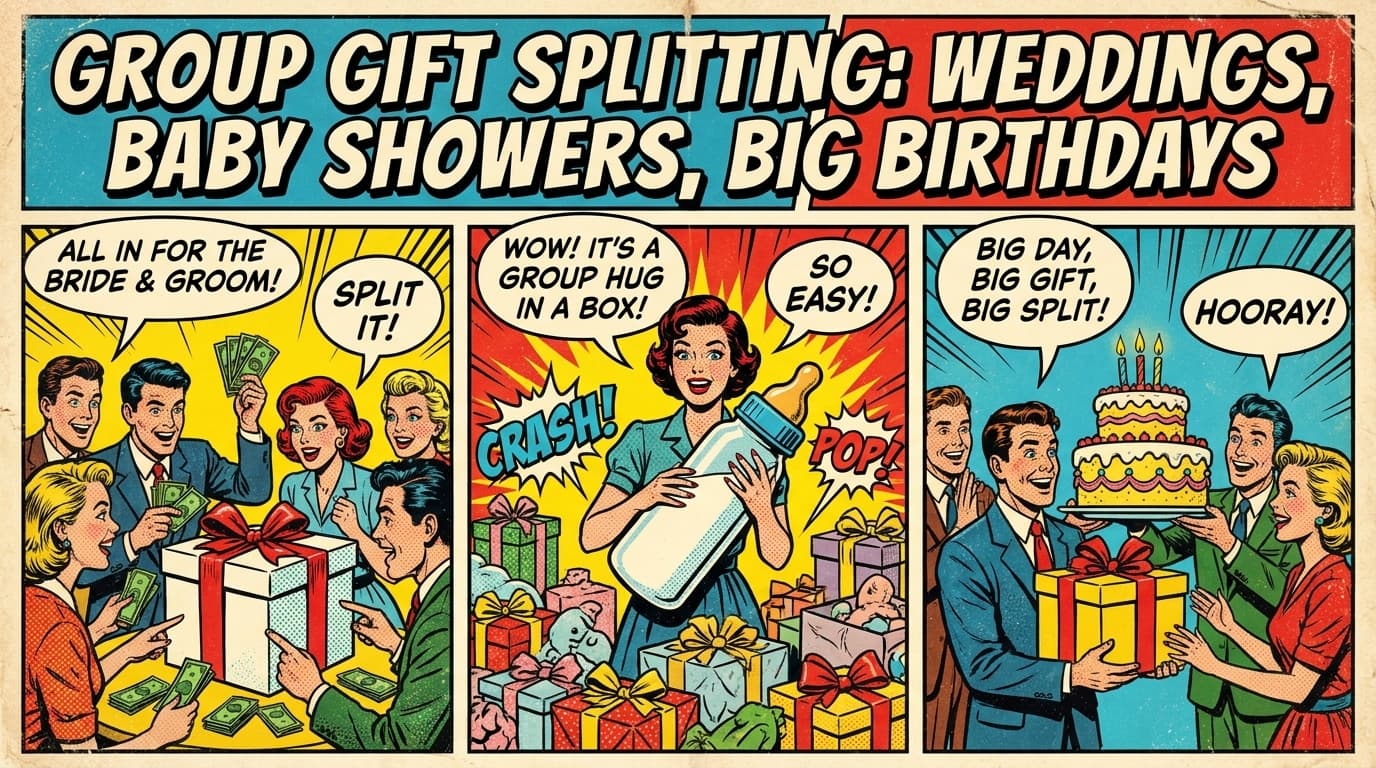
Group Gift Splitting: Weddings, Baby Showers, Big Birthdays
The complete guide to splitting group gifts for weddings, baby showers, and milestone birthdays. How to collect, how much to suggest, and how to avoid the awkward.

Anna
Supasplit Team
Someone in your group chat just typed "hey what if we all chip in for something bigger?" and now you're the one organizing it.
Group gifts are a better idea than a pile of individual ones, but only if somebody runs them well. Here's the full playbook: how to pick the gift, how much to suggest, how to collect cleanly, and how to avoid the specific kinds of awkwardness that group gifting generates.
When a group gift is actually the right move
Group gifts work best when:
- The recipient is getting something expensive (honeymoon fund, nursery furniture, a big-ticket item on a registry)
- The group is 4-10 people. Smaller feels thin. Bigger gets chaotic.
- Everyone in the group actually knows each other enough to be comfortable sharing a Venmo thread
- The occasion is big (wedding, milestone birthday, major baby shower item, retirement)
They don't work as well for:
- Small, casual gifts where individual gifts feel more thoughtful
- Groups where one person is much closer to the recipient than the others (the gift becomes a social math problem)
- Situations where some people can't afford the tier and will feel pressured
Who runs point
One person has to organize. Pick someone who:
- Is comfortable collecting money
- Is close enough to the recipient to know what they'd actually want
- Will remember to follow up on the people who haven't paid in
- Doesn't mind being a light pest about it for two weeks
If nobody in the group fits all four, pair two people: a taste-maker and a collector. The taste-maker picks the gift. The collector chases the money.
Setting the amount per person
This is the single most important decision and the one most likely to blow up.
Pick a target number for the gift, then divide by the realistic number of contributors. That gives you a per-person contribution. The question is: is that number comfortable for the least-flush person in the group?
A few guidelines:
- Wedding group gifts: $50-$150 per person is the common range. $200+ is a "we're all close family friends and this is significant" tier.
- Baby showers: $40-$100 per person for a group gift on a bigger registry item.
- Milestone birthdays (30, 40, 50, 60): $30-$75 per person for a typical friend group gift.
- Retirement gifts at work: $20-$50 per person, often on the lower end to include the most people.
When you're unsure, pick a number slightly lower than you'd personally contribute. The worst-case scenario isn't that the gift is too small, it's that half the group feels financially uncomfortable. Small and uncomfortable-free beats big and awkward.
Messaging the group (the actual script)
In a group chat:
"Hey everyone, for [Person]'s [occasion], I was thinking we could do a group gift. My idea: [specific thing] from their registry, total around $[total]. That'd be about $[per-person] each if we all pitch in, but absolutely no pressure and anyone who'd rather do their own thing should. Let me know by [date] if you're in and I'll send Venmo info."
Four things this does:
- Names the gift specifically so people can opt in knowing what they're paying for
- Names the amount so nobody's surprised
- Explicitly creates a no-pressure out for anyone who wants to bow out
- Sets a deadline so it doesn't die in silence
Do not send a vague "hey let's do a group gift, I'll figure out details later!" That message will cost you a week and two people will still be confused.
How to collect the money
Three options, in order of preference:
1. A split-tracking app
Everyone sees the total, the per-person amount, and who has paid. You don't have to chase individually because the app shows it. Pay-in is one tap. This is the cleanest option for groups of 5+.
2. One Venmo recipient (you)
You collect, you buy the gift, you follow up with the stragglers. Works for smaller groups. Just know you're the hub: if someone doesn't pay, you'll be fronting it or awkwardly asking.
3. Direct contributions to a registry that supports it
Some registries let multiple people contribute toward one item (honeymoon funds, baby registries with cash funds). In that case, you don't collect money at all, you just tell everyone which item to contribute to.
What doesn't work: "we'll figure out money after the gift arrives." Collect before you buy.
The awkward stuff, addressed
People who don't pay up. Send one group reminder, then one DM to stragglers after 48 hours. After that, either eat it or send one final gentle reminder. Don't turn it into a cold war.
People who want to contribute less. "That's totally fine, happy to have you in at whatever works." Don't make them explain.
People who want to contribute more. Let them. Don't make it a thing.
Someone who doesn't contribute but wants their name on the card. Most functional groups just put them on. Nobody loses social capital over a $40 gift. If it becomes a pattern, different problem.
The plus-one question. If the group is couples, one contribution per household is the norm, slightly higher than a solo contribution. Don't ask each spouse separately.
After the gift is given
Two things:
- Tell the recipient who contributed. A group card with all the names. Not because the recipient needs to know who gave what, but because the group effort is part of the gift.
- Give a "thank you to the contributors" update. "Hey everyone, thanks for chipping in, they loved it, here's a pic they sent." This closes the loop and makes people feel good about participating.
This tiny step makes people way more likely to join the next group gift you organize.
When the group gift is for family, not friends
Family dynamics are different. A few tweaks:
- Siblings buying a gift for parents: often uneven contributions based on incomes, and that's fine as long as it's explicit. Don't force equal when it doesn't fit.
- Extended family gifts: usually one person in each branch of the family coordinates their branch's contribution. Don't try to run a 25-person group chat.
- Gifts for grandchildren from multiple aunts and uncles: often one family elder runs point and asks each household for a number.
Family group gifts usually have softer edges than friend group gifts. The rule of "no pressure, no awkward" applies even more.
TL;DR
- Pick the gift and the per-person number first, message the group second.
- Frame the amount as a ceiling, not a floor. Protect the tighter budgets.
- Collect before you buy. Never front and chase.
- Use a split-tracking app for groups of 5+. It removes the social chasing step.
- Close the loop with a group thank-you update after the gift is given.
Frequently asked questions
How much should each person contribute to a group gift?
Common ranges: wedding group gifts $50-$150 per person, baby showers $40-$100, milestone birthdays $30-$75, office retirement gifts $20-$50. Pick a target gift amount, divide by realistic contributors, and err slightly lower to include everyone comfortably. Always frame the per-person amount as a ceiling, not a minimum.
Who should organize a group gift?
Someone close enough to the recipient to know what they'd want, comfortable collecting money, willing to nudge stragglers, and okay being the hub for two weeks. If one person can't do all four, split the role between a taste-maker and a collector.
What if someone doesn't pay their share of a group gift?
Send one group-chat reminder, then one direct message to anyone still outstanding after 48 hours. After that, either absorb it (with a mental note for next time) or send a final gentle reminder. Don't escalate. The relationship usually matters more than the $40.
Should you collect money before or after buying a group gift?
Before. Always. Organizers who front the gift and chase reimbursements usually end up eating a few no-pays every time. Collect first, buy second, and use a split-tracking app or shared Venmo request so people can see who's paid in.
Is it okay to contribute less to a group gift if money is tight?
Yes, and any good organizer will welcome it. The framing 'happy to have you in at whatever works' should come from the organizer, but if it doesn't, you can say it yourself. The gift still goes through. What matters is that you're in, not the exact amount.