Should You Split the Engagement Ring Cost? The 2026 Honest Answer
Engagement rings used to be one partner's expense. Modern couples are rethinking that. Here's what's normal in 2026 and how to actually split it.

Anna
Supasplit Team
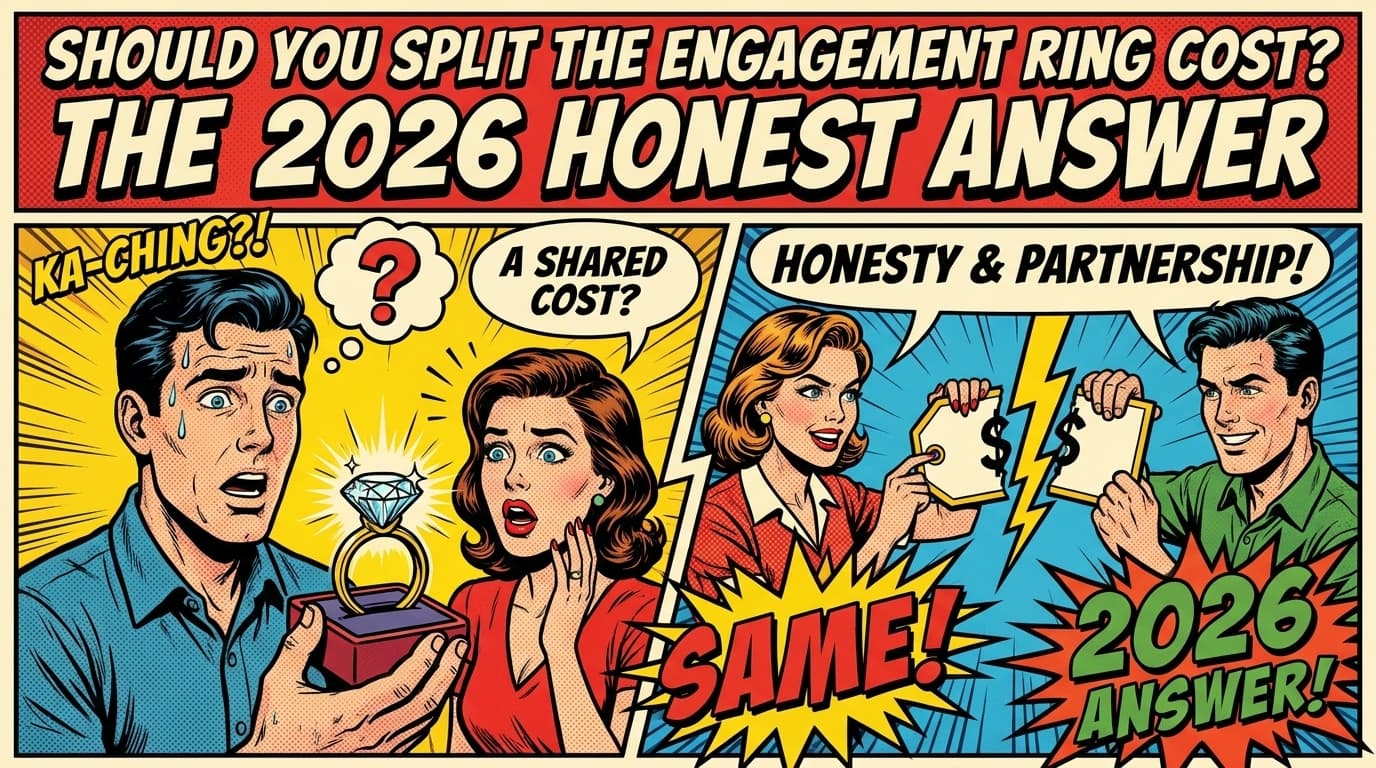
The traditional convention: one partner pays for the engagement ring, full stop. Often it's a substantial sum, sometimes 1-3 months of salary by the old rule that nobody quotes anymore. Sometimes financed. Sometimes secret.
In 2026, more couples are rethinking the whole setup. Some split it. Some replace it. Some redirect the budget. Here's what's normal now, what's actually fair, and how to handle the ring conversation without it becoming weird.
What rings actually cost
For context (US 2026 averages):
- Average engagement ring spend: $5,000-7,000. Down from the $8,000 peak of a few years ago, partly due to lab-grown diamonds.
- Lab-grown vs. natural diamonds: lab-grown costs about 50-70% less for visually equivalent stones.
- Wedding band cost: $500-2,000 per band (so $1,000-4,000 for two).
- Custom or vintage: widely variable, often comparable or cheaper than retail new.
Most couples don't spend the average. A growing number spend significantly less, intentionally redirecting the budget elsewhere (down payment, honeymoon, just saving it).
The traditional setup, and why it's being rethought
Traditional: proposer (often the man in opposite-sex couples) pays for the engagement ring, recipient (often the woman) doesn't contribute. Often a surprise.
Why this is shifting:
- Income equity. Many couples have closer-to-equal incomes, making one partner solo-bearing a 5-figure expense feel disproportionate.
- Joint finances. Couples who already share money find it weird to pretend the ring is one person's solo expense when it comes from the joint budget anyway.
- Same-sex and non-traditional couples. The traditional setup doesn't map cleanly; couples make their own rules.
- Cost transparency. Some couples find the secret-purchase aspect uncomfortable. They want to talk about the cost together.
- Value redirection. Couples increasingly redirect ring budget toward other priorities (a home, a trip, a kid).
None of this means the traditional setup is wrong. It just isn't the only setup anymore.
Three modern ring-cost approaches
Approach 1: One partner pays, traditional style.
One partner buys the ring as a gift. Often still common, especially when the proposer wants the surprise to be part of the moment.
Works when:
- The proposer has the financial means without strain
- The recipient is genuinely surprised by the ring (style, timing, both)
- The couple's financial dynamics support one partner solo-spending this amount
Watch out for:
- Financing a ring (going into debt) when the recipient would have preferred a smaller one
- Spending way beyond means to hit a perceived norm
- Surprise rings that don't match the recipient's actual taste
Approach 2: Both partners contribute.
The couple discusses budget, the ring is selected together (or one partner picks within an agreed budget), both contribute to the purchase.
Common variations:
- 50/50 contribution from each partner's personal funds
- Proportional to income (higher earner covers more)
- One partner buys the engagement ring, the other buys the wedding band, evening out the total spend
- Both partners pick a ring together, joint funds pay
Works when:
- The couple already has open money conversations
- The recipient wants input on a piece of jewelry they'll wear forever
- The financial reality is too significant for one person to handle solo
Approach 3: Skip or replace the engagement ring.
Some couples opt out entirely. Reasons:
- They don't value the symbol
- They'd rather use the budget for a house, trip, or other priority
- Lab-grown stone or simple band instead of a traditional diamond
- A non-ring symbol (a tattoo, a watch, a piece of art)
This is more common than the wedding industry advertises. If neither partner cares about the ring tradition, skipping it is fine.
How to talk about the budget
The most useful conversation is the budget conversation, not the who-pays conversation.
Questions to actually answer together:
- What's a reasonable amount for our financial situation?
- Are we doing a separate engagement ring and wedding bands, or one combined symbol?
- Lab-grown or natural diamond? Or no diamond?
- Custom or retail?
- Vintage or new?
Once the budget is set, the "who pays" conversation becomes simpler.
What about the surprise element?
A real tension: if both partners discuss the ring together, the surprise factor goes way down.
Ways to keep some surprise while collaborating:
- The recipient picks the style category (gold vs. platinum, solitaire vs. halo) but the proposer picks the specific ring.
- The recipient sends inspiration photos but doesn't know the final selection.
- The recipient is involved in the ring shop visit but the proposal is unannounced.
- The proposal itself is the surprise, regardless of how the ring was picked.
Most couples land on one of these. Pure surprise is hard to combine with significant collaboration on the purchase.
Splitting the ring vs. splitting the wedding
The ring is one purchase. The wedding is many. The split conversation for each is separate.
For the wedding overall, see our wedding cost splitting guide. The classic "bride's family pays" tradition has shifted dramatically in modern weddings.
For the ring specifically, it can be:
- Outside the wedding budget (one partner's solo expense)
- Inside the joint wedding budget (couple pays, parents contribute or not)
- Outside any budget (gifted by family member, heirloom, etc.)
Decide as a couple what bucket the ring lives in.
Heirlooms and family rings
If one partner has a family ring that's being passed down (grandmother's, aunt's, etc.), the financial conversation is different.
Questions:
- Is the heirloom going to be re-set or worn as-is?
- Is there cost to reset, appraise, or insure it?
- Are both partners genuinely OK with using the heirloom, or is one partner being polite?
- If reset, who pays for the work?
Heirlooms can be sentimentally beautiful or quietly resented. The conversation needs to be honest.
Many couples use an heirloom stone in a new setting, splitting the cost of the new setting. Others save it for a different occasion. Both are valid.
Financing rings: usually don't
Ring financing is widely available. Most jewelers offer 12-36 month plans, sometimes interest-free, often at high APR after the promotional period.
Reasons to avoid:
- Starting a marriage with consumer debt
- The interest rate after promo periods is usually 18-30%
- A ring that exceeds your means strains the rest of the wedding budget
- Late payments hurt the buying partner's credit going into joint applications
If you can't pay for the ring out of savings or current cash flow, the ring is too expensive for your situation. The conversation isn't "how do I finance this" but "what budget actually fits."
When the ring needs to be returned
The awkward but important question: if the engagement ends before the wedding, who keeps the ring?
Legal default in most US states: the ring is a conditional gift, conditional on the wedding happening. If the wedding doesn't happen, the ring goes back to the giver, regardless of who broke off the engagement.
Some states (Montana for example) treat the ring as an unconditional gift and the recipient keeps it.
If the ring was a joint purchase, the joint purchase price is split per the contribution.
Unpleasant to think about. The point of even raising it: don't enter the engagement with assumptions that don't match the legal reality of where you live.
TL;DR
- Average US engagement ring cost is $5,000-7,000, down from the $8,000 peak as lab-grown diamonds become normal.
- Three common modern approaches: one partner pays traditionally, both partners contribute, or skip the ring entirely.
- Have the budget conversation together, even if you still want some surprise in the actual selection.
- Don't finance an engagement ring. If it's not in cash, the budget is wrong.
- Heirlooms require honest conversations, not just sentiment-driven assumptions.
- In most US states, the ring is a conditional gift. If the engagement breaks off, it goes back to the giver.
Frequently asked questions
Should couples split the cost of the engagement ring?
Increasingly common in 2026. Modern approaches range from traditional (one partner pays solo) to fully collaborative (both partners contribute and pick the ring together). There's no single right answer. The conversation that matters is the budget conversation, which should happen together regardless of who ultimately pays.
How much should we spend on an engagement ring?
Whatever doesn't compromise other priorities. US averages are $5,000-7,000, but plenty of couples spend significantly less or skip rings entirely. If the ring delays your down payment, honeymoon, or other goals you care about, that tradeoff should be conscious, not accidental. Lab-grown diamonds cost 50-70% less than natural for visually equivalent stones.
Is it weird to talk about the ring budget together?
Not anymore. Many couples in 2026 discuss the ring openly, especially when the budget is significant relative to their financial situation. You can still preserve some surprise (recipient picks the style, proposer picks the specific ring) while making the budget a shared decision.
What happens to the engagement ring if the wedding doesn't happen?
In most US states, the engagement ring is legally a conditional gift, conditional on the wedding occurring. If the engagement breaks off, the ring typically goes back to the giver, regardless of who ended the engagement. A few states (like Montana) treat it as an unconditional gift. Worth knowing the laws in your state.
Should I finance an engagement ring?
Generally no. Most jewelers offer financing, often at 18-30% APR after promotional periods. Starting a marriage with consumer debt on a piece of jewelry is rough. If you can't pay for the ring with savings or current cash flow, the budget is too high, pick a smaller ring or wait. The meaning is in the commitment, not the price.