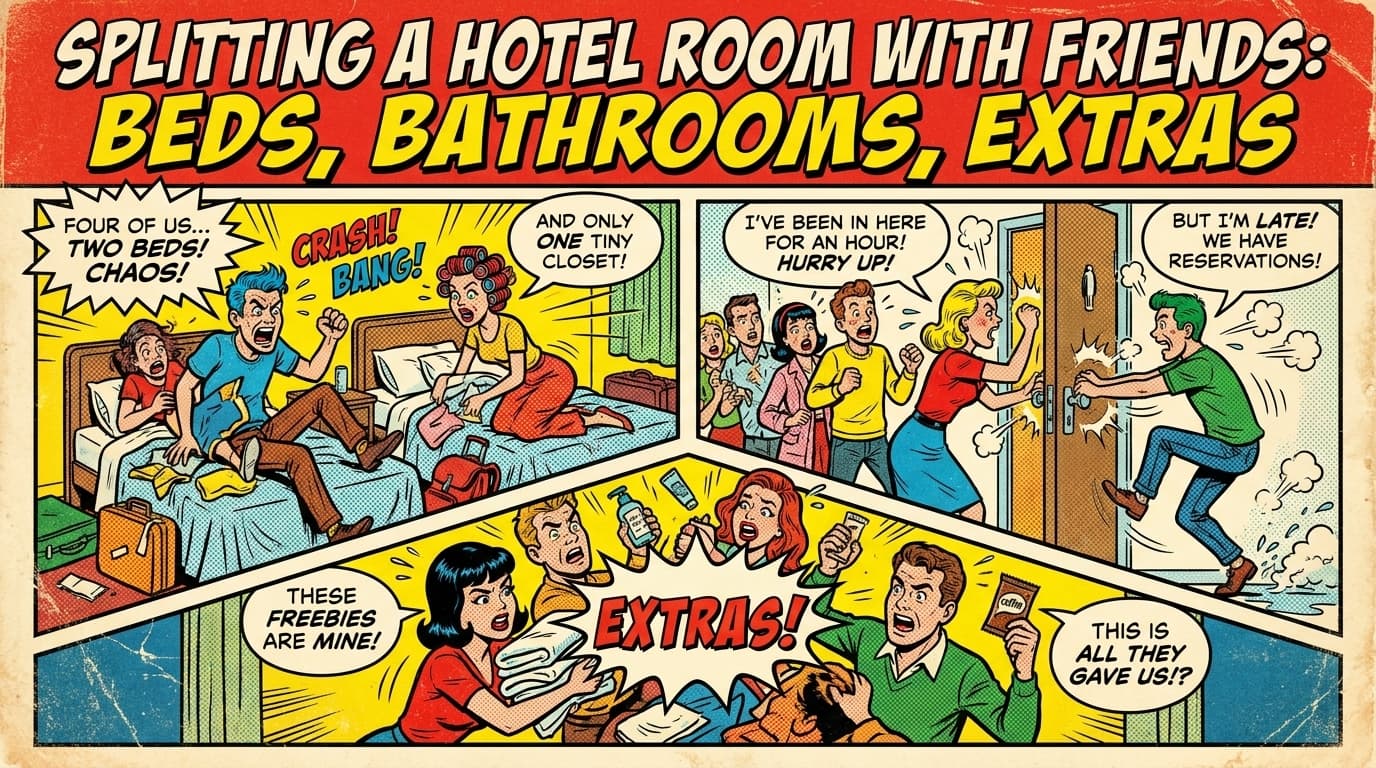
Splitting a Hotel Room With Friends: Beds, Bathrooms, Extras
Sharing a hotel room with friends saves money but creates new questions. Here's how to fairly split the cost, the beds, and the extras.

Anna
Supasplit Team
Hotel splits sound simple. Two beds, two friends, divide by two. Done.
Then reality intrudes. One bed is bigger. One friend snores. The room has a fee for the third person. You used the minibar. The hotel's parking is $40/night. The taxes are 16%. And one friend booked the room six months ago at a different rate than what's showing now.
Here's how to actually split a hotel room with friends, including the parts most groups don't think about until check-out.
The base hotel cost
Start simple: total room cost (room rate × nights) ÷ number of occupants.
That's the fair starting point for a hotel where everyone has roughly equivalent setups.
Example: $200/night × 3 nights = $600 total. Two friends sharing = $300 each. Add taxes and fees proportionally.
Not complicated. Most splits start here.
Where it gets interesting:
When beds aren't equal
If the room has one king and one twin, or one queen and a pull-out couch, the beds aren't equivalent.
Options:
Option A: Equal split, beds randomized or chosen first-come.
Everyone pays the same. Whoever wants the king picks first (rock-paper-scissors, dibs, whatever). Whoever takes the worse bed gets it next time.
Option B: Adjusted split based on bed quality.
The king sleeper pays a bit more (55/45 or 60/40 typical). Couch/pull-out sleeper pays less.
Option C: Splitting in nights.
For longer stays (4+ nights), alternate beds. Each person spends some nights in the king, some in the lesser bed. Equal split.
Most groups end up on Option A for short stays and consider Option C for longer ones. Don't agonize over the math for one or two nights, it's small money.
Three or more people in one room
Most hotels allow up to 4 people in a room with two beds. Some have a per-person fee for the 3rd or 4th.
If the 3rd person fee is $20/night, who pays it?
Approach A: The 3rd person. They're the extra. They cover the surcharge.
Approach B: Split equally. Their presence benefits everyone (more people means more cost-splitting on the base rate). The surcharge is a household cost.
Approach C: Hybrid. The 3rd person pays the surcharge plus their share of the base rate.
For most fair-feeling splits, the 3rd person paying the surcharge plus an equal share of the rest works. They added the cost, they cover the increment.
The cot or rollaway bed
Some hotels charge $20-40/night for a rollaway. Whoever uses it usually pays.
If there's no rollaway and one person is sleeping on the floor or a chair, that person should pay less (or the group should rethink the room).
The single sleeper in a double room
Reverse problem. One friend isn't there at all, but the room was booked as a double. The friend who's actually there is paying for two-person occupancy when they're alone.
If the friend who didn't show is bailing: they cover their share (they committed to the booking).
If the room was always for one person: don't book it as a double. Most hotels charge less for single occupancy.
If you're upgrading to a single because your friend dropped out: communicate with the hotel about a single rate, then settle whatever shortfall exists.
Hotel taxes, resort fees, and extras
The stuff on the bill that nobody talks about until they see it.
Taxes: typically 10-20% on top of the room rate. Split with the base.
Resort fees: $30-50/night in many places, supposedly covering pool/wifi/gym. Mandatory in many hotels. Split with the base.
City taxes: in some markets (NYC, San Francisco, Vegas), per-night tourism taxes. Split with the base.
Parking: $30-50/night for self-parking, more for valet. Whoever parked, paid (if only one car). Split if multiple cars or shared use.
Wifi: sometimes free, sometimes a daily fee. Split equally.
Minibar: whoever consumed, paid. Specifically itemized at checkout.
In-room movies, on-demand: whoever watched, paid.
Room service: whoever ordered.
The principle: shared/mandatory fees split with the base. Individual usage is individual cost.
Loyalty points and rewards
If one friend booked the room using points or rewards:
Don't include the points cost in the split if the other friends benefit. The point-using friend already paid for points (either with travel or money). They're contributing value.
Reasonable arrangement:
- Points-booker covers the room (with points)
- Other friends cover taxes, fees, and any cash supplements
- Or, the friends split the cash value of the room (what it would have cost) and the points-booker keeps that money
Don't ask the point-booker to absorb the cost "because they got it free." They didn't, the points took effort to accumulate.
For loyalty-status benefits (free breakfast, late checkout), enjoy the perks and don't argue about them.
The mid-trip price drop
Real scenario: one friend booked the room six months ago at $180/night. Today the room shows $140/night.
Who takes the loss?
Standard answer: the price they booked at is the price you split. They booked at $180, you split $180.
The booking friend isn't entitled to a refund-by-friendship for what is essentially their booking decision. They could've held out, or rebooked when prices dropped.
Optional: if the price drop is dramatic (50%+), the booking friend might rebook themselves at the lower rate. Some hotels honor lower rates on existing reservations if you call.
What about damage to the room?
If the room gets damaged:
- Clearly one person's responsibility: they pay. They broke the lamp.
- Group-caused (party, spill): split equally.
- Unclear origin: typically, the person on the credit card eats the cost first, then the group settles.
The person whose card is on the room is the one the hotel pursues. Make sure the group settles fairly even if the hotel's process is just billing one person.
Splitting via Venmo, Zelle, or an app
For most 2-3 person hotel splits:
- One person books and pays
- Calculate each person's share including taxes and fees
- Settle via Venmo or Zelle by check-out or before
For larger groups or longer stays:
- Use an expense-tracking app
- Add the hotel as a single expense
- Add minibar, parking, room service separately
- Settle at trip end
The trick: split the room cost as one expense, individual extras as separate expenses. Don't try to bake everything into one number.
Cancellation policies
Hotel cancellation policies range from "cancel anytime" to "non-refundable."
If the trip gets canceled:
- Refundable booking: cancel, no cost.
- Non-refundable: the booking friend takes the hit unless the group agreed to share risk.
Decide upfront if the booking is shared risk or solo risk. "I'll book it on my card and trust everyone shows up" is solo risk if it's non-refundable.
For shared risk: discuss before booking, and confirm everyone agrees to absorb a share if the trip falls through.
Two rooms vs. one room
For groups of 4+, the question is often: one big room or two regular rooms?
One room considerations:
- Cheaper total cost usually
- More cramped
- Less privacy for couples
- Per-person surcharges can add up
Two rooms:
- More privacy
- Better for couples who want their own space
- More expensive total
- Sometimes lets you split between morning people and night owls
The right answer depends on the group's preferences. For trips longer than 2 nights, two rooms is often worth it. For one-night layovers, one room is fine.
Tipping the housekeeping staff
Underlooked but important. $2-5 per night per room is the US standard.
Who tips? Typically the room occupants split equally. Left in cash on the pillow or a clearly marked spot.
Don't skip this. The housekeeper does real work, especially when groups are loud or messy.
TL;DR
- Base split: total room cost ÷ occupants. Includes taxes and mandatory fees.
- Different beds: adjust slightly (60/40) or alternate for longer stays.
- 3rd person fees: that person covers it, plus equal share of the rest.
- Parking, minibar, room service: individual use, individual cost.
- Loyalty points booker contributes value; don't ask them to absorb the room cost.
- Cancellation risk: discuss upfront whether it's shared or solo.
- Tip housekeeping $2-5/night/room. Split among occupants.
- Track in an app for groups of 3+. Itemize what's shared vs. individual.
Frequently asked questions
How do you fairly split a hotel room with friends?
Start with the base split: total room cost (including taxes and mandatory resort fees) divided by the number of occupants. Then handle individual use separately, minibar, parking, room service belong to whoever used them. The base is the shared cost, individual use is per-person.
What if the beds in our hotel room aren't equal?
Options: equal split with bed assignments by negotiation, slight adjustment (60/40) for the better bed, or alternate beds on longer stays for an equal final split. Most groups don't agonize over this for one or two nights, the math is small. For longer stays, alternating works well.
Who pays for the extra-person fee in a hotel room?
Usually the third or fourth person pays the surcharge themselves, plus an equal share of the base room rate. They added the cost, they cover the increment. Some groups split the surcharge equally as a group cost, both can be fair depending on how the group prefers to handle it.
What if one friend booked the hotel at a higher rate than today's price?
The price they booked at is the price you split. The booker isn't entitled to a friendship-refund for what was their booking decision. If the price drop is dramatic, the booker might call the hotel and ask for a rate adjustment, some hotels honor lower rates on existing bookings.
Should we tip housekeeping when splitting a hotel room?
Yes, $2-5 per night per room is the US standard. Split among the occupants of the room, leave cash on the pillow or in a clearly marked spot. The hotel doesn't take care of this through the room rate or resort fees. Different staff may clean different days, so leaving a tip daily is better than only at checkout.