Splitting a Ski Trip: Lifts, Cabins, Après, Everything
Ski trips have more line items than any other group trip. Here's how to split the cabin, lift tickets, rentals, and the surprise $340 dinner without killing the vibe.

Anna
Supasplit Team
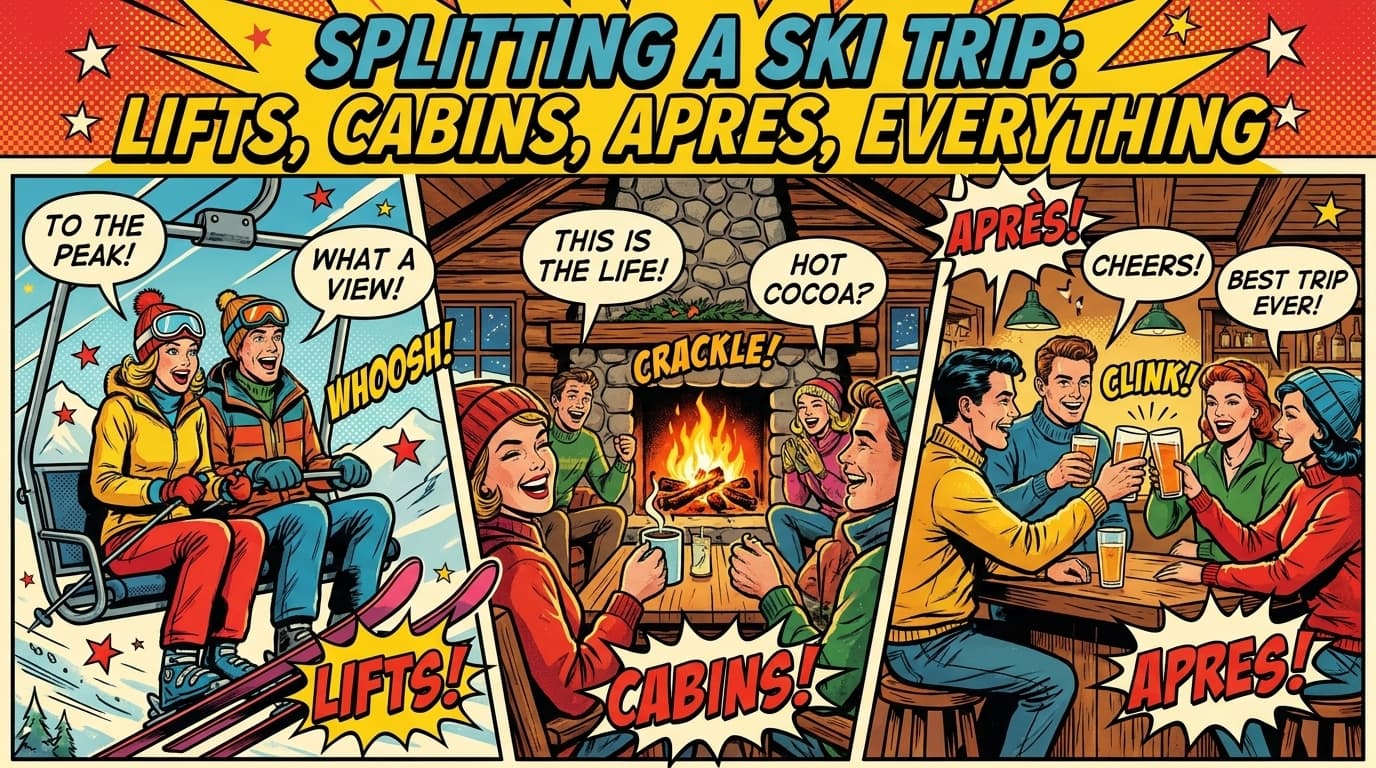
Seven of you rented a cabin in Park City. Four are skiing all four days, two are skiing twice, and one doesn't ski at all, they're just there for hot tub and après. Total trip cost so far: $4,800, and that's before anyone buys a single lift ticket.
Ski trips are the single most itemized group trip that exists. Here's the system that keeps them from imploding.
Why ski trips are different
Most group trips have one big shared cost (the rental) and a lot of small stuff. Ski trips have three or four huge line items that different people use differently:
- Lodging (everyone shares)
- Lift tickets (only skiers)
- Rentals and gear (only skiers, and only if they don't own)
- Lessons (only the learners)
- Food, drinks, après (everyone, but wildly uneven)
- Transportation (flights, shuttles, rental car)
If you throw everything into one pot and split equally, the non-skier pays for four days of lift tickets they never used. If you itemize badly, your group chat turns into a CPA exam.
The fix: bucket by who actually used what.
The four-bucket model
Bucket 1: The cabin (split by room). Same rules as any Airbnb split. Couples in a private bedroom pay more per person than bridesmaids in bunks. See the Airbnb split guide for the math. The non-skier who's there the whole time still pays a full room share, they're using the cabin like everyone else.
Bucket 2: Skiing costs (split among skiers only). Lift tickets, rentals, lessons, ski-in-ski-out parking. Only skiers pay. If one person skis 2 days and another skis 4, they pay in proportion to days skied, not equally.
Bucket 3: Food and drinks (split by who ate). Groceries for the cabin go per-person who's there for that meal. Restaurants get split on the night by who was there and what they ordered (more on this below).
Bucket 4: Transportation (pay your own unless it's shared). Flights, your own rental car, your own gas: yours. Shared rental car or shuttle from the airport: split among the people in that car.
Lift tickets, the hidden minefield
Multi-day lift tickets are cheaper per day than single-day. So if someone buys a 4-day pass but only skis 3 days, they still paid for 4. Someone else buys a day ticket on day 2 for $180 because they couldn't commit in advance.
Three ways to handle it:
- Everyone buys their own. Cleanest. No one owes anyone for lifts. Works if people skiing different amounts.
- Group pass, split by days. If 5 of you are skiing all 4 days, buy a group Ikon or Epic deal if eligible. Split the total equally among the 5, since you're all using it equally.
- Hybrid. The 4-day skiers buy a multi-day pass together. The 2-day skiers buy their own day tickets. Don't try to merge these.
The non-skier problem
Someone came to the cabin but isn't skiing. They're snowshoeing, reading, cooking, being content. How do you avoid making them feel like a mooch or a martyr?
- They pay full lodging share. They're using the cabin.
- They pay zero for lift tickets, rentals, or lessons.
- They pay their share of group food and drinks.
- If the group books a dinner that costs $120 per person, they join and pay their share like anyone else. If they'd rather eat something cheap at the cabin, that's fine too, just say so.
Don't overcompensate by insisting they 'don't have to pay much.' That makes them feel like a charity case. Treat them like a full member of the trip minus the stuff they didn't use.
Après and dinner, where the real damage lives
The $18 beer at the bottom of the mountain. The $340 dinner at the one 'fancy' place. The post-ski tequila round someone ordered for the table.
Après is where ski trip expenses balloon, and it's also where people feel weirdest about asking for a split. Two rules:
- Open one tab, close it together. If five of you are at the bar, open one tab and split it at the end. Don't play the 'oh, I'll get this round' game across four bars. Someone always ends up ahead by $80.
- Decide before the dinner reservation. If the fancy dinner is $150 per head, say so in the group chat: 'Friday dinner looks like $150 a head with drinks, cool for everyone?' People who can't afford it can skip or order smaller. No surprises.
Gear, the quiet cost
Someone didn't bring goggles. Someone else needs to rent boots. Someone bought hand warmers at the base for $20. Treat gear as personal unless it's genuinely shared (a roof box rental, a group snow chain purchase).
If one person covers all the small misc stuff, log each item so they get reimbursed. $20 here, $40 there, it's real money by the end of the week.
The daily reconciliation
Evening ritual: open the split app, log what you spent today that was shared. Takes a minute. By the end of the trip, the math is mostly done.
This is especially important on ski trips because days blur together. Tuesday's dinner and Thursday's dinner look identical three months later when someone's asking what that $94 charge was.
TL;DR
- Bucket the costs: cabin by room, lifts by skier-day, food by who ate, transport is your own.
- Non-skier pays full lodging, zero for lifts, normal share for food. No pity discounts.
- Buy lift tickets by how much each person is actually skiing. Don't force everyone onto the same pass.
- Open one tab per bar and close together. Don't do rolling rounds across four spots.
- Log everything each evening. Ski days blur, so does the math if you wait.
Frequently asked questions
How do you split costs on a ski trip fairly?
Bucket the expenses by who actually used them. Lodging gets split by room among everyone. Lift tickets, rentals, and lessons only go to skiers, in proportion to days skied. Food and drinks are split among the people at each meal. Transportation is personal unless you're sharing a shuttle or car.
Should non-skiers pay less for a ski trip cabin?
No. If they're sleeping in the cabin and using it like everyone else, they pay their full lodging share. They just don't pay for lift tickets, rentals, or lessons. Treating them as a half-person feels generous but usually makes them feel like a charity case.
How do we handle lift tickets when people ski different numbers of days?
Simplest option: everyone buys their own. If most of the group is skiing the same days, a group multi-day pass can be cheaper, but split it only among the people on it. Don't try to average across a 4-day skier and a 1-day skier on the same pass.
How do you split restaurant and bar bills on a ski trip?
Open one tab per place, close it together. For normal meals where everyone ate similar, split equally. For fancy dinners where orders vary a lot, log who ordered what and itemize. Decide on expected dinner prices before booking reservations so nobody gets surprised.
What's the biggest mistake groups make on ski trip expenses?
Waiting until they get home to reconcile. Ski days blur together, receipts get lost, and nobody remembers what that $94 Tuesday charge was. Log every shared expense the same evening it happens and settle within a few days of getting home.