The "I'll Venmo You Later" Friend on Vacation: A Survival Guide
That one friend who gets home from the trip and never sends their share of the Airbnb. Here's how to prevent it on the next trip and collect on the current one.

Anna
Supasplit Team
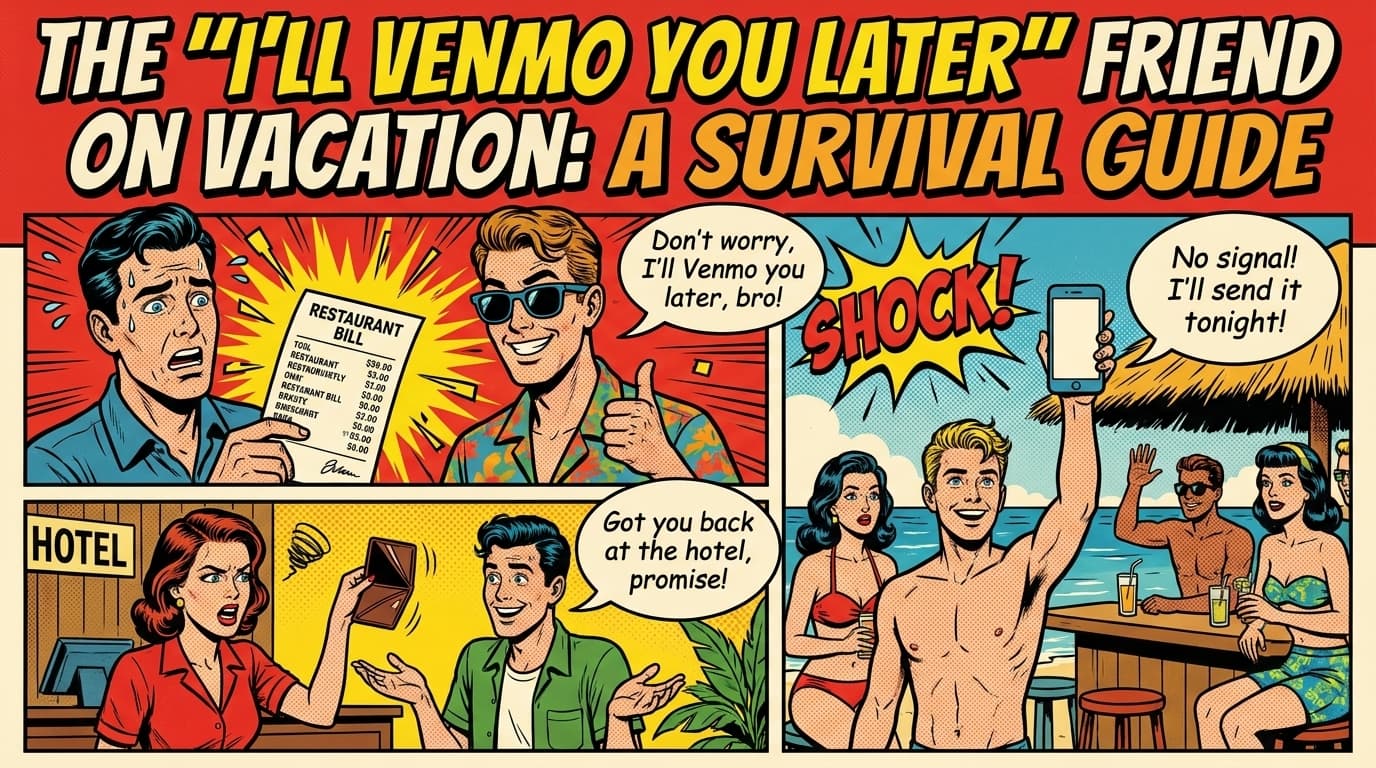
Trip's over. You're home. You fronted $380 for the Airbnb deposit, $220 for the rental car, $140 for the group dinner. Your friend has been posting Instagram stories for eleven days. They have not Venmoed you.
This is a universal friendship experience. Here's the practical playbook: preventing it next time, and collecting this time.
Why this happens
It's rarely malice. Usually it's one or a mix of:
- They lost track. They genuinely don't know how much they owe.
- They're overwhelmed. Coming home from a trip is chaos. Money admin is the last thing they open.
- They're bad at money. Fronting large amounts via Venmo stresses them out and they freeze.
- They're banking on you forgetting. Rare. Usually obvious.
Your response changes based on which type you're dealing with. Most of the time it's 1 or 2. Sometimes it's 3. Occasionally it's 4.
The prevention layer (for next trip)
These are the moves that make collection unnecessary because there's nothing to collect.
1. Use a bill-splitting app from day 1
The single biggest prevention tool. Every shared expense goes in the app as it happens. Everyone can see the running tally. When the trip ends, there's one tap to see who owes who what.
This beats every other system. The app is a neutral third party. Your friend isn't being nudged by you, they're being nudged by software.
2. Settle up before the last day
On the morning of the last day, open the app, everyone looks at their tally, and people pay on the spot. Some will pay cash, some will Venmo right there. This is the "shared ritual" version of settling up, it's normal, it's expected, nobody feels ambushed.
This beats "we'll figure it out when we get home" every single time.
3. Split in real time, not in bulk
If you front $400 for the rental car on day 1, request reimbursement within the next day, not at the end of the trip. Not as a nag, as normal. Most people pay within 24 hours when the memory of the expense is fresh.
4. Don't over-front
If you know a friend has trouble paying back, don't volunteer to cover their share of the Airbnb. Let someone else front, or pay your share directly and let them handle theirs. Protect your own exposure.
The collection layer (for this trip)
You're reading this because you already have an outstanding debt. Here's the ladder.
Level 1: The neutral reminder (Day 3-5 after the trip)
"Hey, got you down for $380 from the trip. Venmo or Cash App whenever."
That's it. Short, specific, no emotion. Most people pay within 24 hours of this. They'd just forgotten.
Level 2: The follow-up with context (Day 7-10)
No response or a "yeah I'll send it soon" that didn't happen.
"Heyy, circling back on the trip stuff. Can you send the $380 by end of week? Covering the Airbnb put me pretty out of pocket."
Adds a small reason ("out of pocket") without being dramatic. Gives a specific deadline.
Level 3: The direct ask (Week 2+)
Still nothing.
"Hey, the $380 is overdue. Can you let me know when you're sending it? If there's a problem on your end, happy to work out a payment plan."
This names the issue and opens the door if they're actually broke. You're not attacking, you're giving them an easy way to tell you the truth.
Level 4: The honest conversation (Week 3+)
If they're dodging or the amount is significant:
Call, don't text. 5 minutes.
"I've sent a couple messages about the trip money and I haven't gotten a clear answer. What's going on?"
Then shut up and let them talk. You'll learn which of the 4 categories they're in. From there:
- If they lost track: send them the breakdown, agree on a payment date.
- If they're overwhelmed: break it into smaller payments. $100 now, $140 in two weeks, $140 after that.
- If they're broke: forgive part of it, set up a payment plan for the rest, or accept that you're eating it and adjust your future behavior.
- If they're dodging on purpose: the friendship has a new shape now. Decide what you want to do with that information.
Level 5: The friendship decision (Month 2+)
If someone has ghosted a significant trip debt for a month or more, you have real information about the friendship. You can:
- Eat it and never front them again. Protects the friendship at your expense. Valid if the amount is small and the person matters to you.
- Have the direct conversation about the pattern. Not just this trip, the bigger issue. Uncomfortable but sometimes productive.
- Small claims court for amounts above $500-$1,000. The bar to file is low, the bar to collect is higher, and it usually ends the friendship. Rarely worth it under $1,000.
The nuclear option: the "never again" rule
Some people quietly add a friend to the "I front nothing for them" list. They're still friends, they still hang out, they just never again cover their Airbnb share or put their rental car on their own card.
This is not petty. It's prudent. You've learned something about how this friend operates with money. Act on it.
TL;DR
- Prevention beats collection. Use a bill-splitting app, settle up before the last day, split in real time.
- Don't over-front for known flakers. Protect yourself.
- Escalate cleanly: neutral reminder, then follow-up with context, then direct ask, then honest conversation.
- Call, don't text, once the situation's real.
- After a month of silence on a significant debt, you have information about the friendship. Act on it.
Frequently asked questions
What do I do when a friend won't pay their share after a trip?
Start with a neutral reminder within a week. If there's no response, follow up with a specific deadline. After two weeks, call rather than text and ask directly what's going on, most people owe less to malice than to overwhelm or disorganization. Escalate from there based on their response.
How do you prevent one friend from flaking on trip expenses?
Use a bill-splitting app from day one so everyone sees the running tally. Settle up before the last day of the trip as a shared ritual. Split in real time, not in bulk. And don't over-front for friends you already know have trouble paying back.
Is it rude to Venmo-request a friend for trip costs they owe?
Not rude. Trip costs are the textbook case for Venmo requests, structural debt you fronted that they explicitly owe. Send the request within a day or two of getting home while the memory is fresh.
Should you take a friend to small claims court over unpaid trip expenses?
Only for amounts above $500-$1,000, and only if you're okay with effectively ending the friendship. The bar to file is low but the bar to collect on a judgment is higher. For smaller amounts, most people eat it and stop fronting money for that person in the future.
How long should I wait before asking a friend to pay me back from a trip?
Within a day or two of getting home. The longer you wait, the weirder it gets to bring up. A timely specific request ('got you down for $380') lands as admin, not confrontation.