The Friend Who Always Orders the Most Expensive Thing (And What to Do)
Every group has one: the friend who orders the steak, the bottle, and the dessert while expecting an equal split. Here's how to handle it without blowing up the friendship.

Anna
Supasplit Team
The pattern you've noticed for years
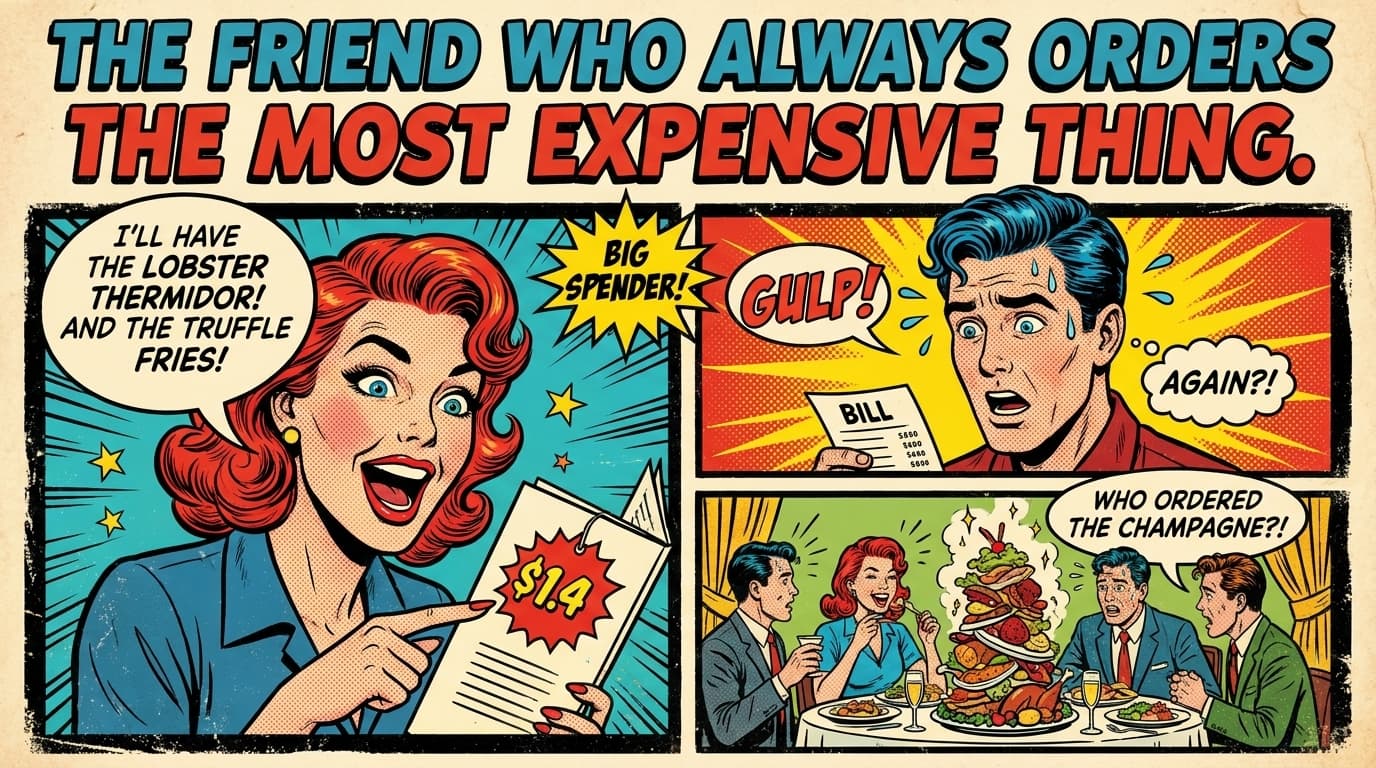
Every group has one. The friend who orders the ribeye, the $22 cocktail, and the dessert, every single time. And if you suggest splitting equally, they say yes immediately. If you suggest itemizing, there's a subtle vibe shift.
One dinner, it's whatever. Two dinners, you notice. By the tenth dinner, you're doing quiet math under the table while they order an after-dinner amaro.
You're not being petty. You're observing a pattern. Patterns cost money over time, and this specific pattern, one friend consistently ordering way up while expecting equal splits, is one of the most common reasons friendships quietly cool off.
Here's how to handle it.
First, check yourself
Before assuming bad intent, it's worth checking a few things:
Can they actually afford it? Some friends genuinely have different income levels and ordering steak feels normal to them. This isn't a strategy, it's just their life. If they earn 3x what you do, equal-splitting is fine for them and crushing for you, and they might not have clocked that.
Are you the outlier, not them? Maybe four people at the table ordered entrées around $40-50 and you ordered a salad. In that case, you might be reading a normal group dinner as "everyone orders big and I'm subsidizing them," when really you're the light-eater and the split is actually fine if you look at it honestly.
Has it been two dinners or ten? Two might be coincidence. Ten is a pattern. Don't confront a friend over a pattern you've only seen twice.
If you've done this honest check and it's still a real pattern, here's the playbook.
The first fix: itemize, permanently
The cleanest solution is to stop equal-splitting whenever this friend is at the table. Not as a callout, not as a moment, just as the default.
When the group sits down, you (or anyone) says:
"Let's do itemized tonight."
Done. Said before ordering, it's a non-event. The heavy-ordering friend will either say "cool" or get visibly mildly weird, which tells you everything.
If they push back ("just split it, it's easier"), you hold:
"Nah, I'm keeping it light, simpler if we itemize."
Once you've itemized twice in a row with this group, it becomes the norm. No more conversations. The problem is solved structurally.
The second fix: stop eating out with them 1-on-1
At a table of six, the expensive orderer costs you $15 a dinner. At a table of two, they cost you $40. The math scales with group size against you.
If you find this friend doing this specifically at 1-on-1 dinners with you, that's a stronger signal. It means you're specifically absorbing their premium order choices. The move: shift the hangouts.
- Meet for coffee ($5 each, no asymmetry possible)
- Grab a drink (cheap, and easy to pay separately)
- Hang at one of your places (zero bill)
- Do an activity (mini golf, movie, walk, whatever)
You don't have to announce you're avoiding restaurants. You just stop suggesting them, and start suggesting other things. In six months, the ratio of dinners to non-dinners has shifted, and you're saving a meaningful amount without any conversation.
The third fix: the direct conversation
If you've tried itemizing and the friend keeps pushing equal splits, or keeps ordering way up knowing they'll get covered, at some point you have to say something directly.
The script:
"Hey, can we talk quickly about bill-splitting when we go out? I've noticed we often end up with really different tabs and equal splitting is getting hard on my end. Can we itemize going forward?"
Why this works:
- It's a conversation, not an attack. You're not accusing them of anything, you're describing a pattern you've noticed.
- You put yourself in it ("it's getting hard on my end") rather than making it about their behavior.
- You propose a solution (itemize going forward) so it ends on action, not complaint.
Do this in DMs, not in person. It gives them time to process without having to react live. Most friends respond with "yeah totally, sorry I didn't realize." Some get defensive, which also tells you what you need to know.
The fourth fix: accept it and price it in
Some friendships are just expensive. The person might genuinely not register bill-fairness as a thing. They might come from money. They might be on a different planet financially and never realized.
If you love them and they're not otherwise an issue, you might decide: I'm going to see them twice a year, it'll cost me an extra $60 over equal-splitting, and I accept that as the cost of this friendship.
That's a valid answer. What's not valid is pretending to accept it while quietly building resentment. Either you're actually at peace with the extra cost, or you should do one of the fixes above.
The thing that signals a deeper problem
Some version of this pattern is a normal group dynamic issue that gets handled with itemizing. But there's a darker version that warrants more attention:
- They order up specifically when you're paying or covering, but order down when paying themselves
- They suggest expensive places specifically when not paying
- They get visibly annoyed when itemized splitting is proposed
- They have done this for years despite feedback
That pattern isn't just someone with a big appetite. It's someone who's either consciously or unconsciously running a ledger in their favor. That's a friendship-level problem, not a bill-splitting problem, and no app is going to fix it. Itemize permanently, limit restaurant hangouts, and pay attention to whether the friendship holds up once the financial asymmetry is removed.
Sometimes it does. Sometimes it doesn't, and that's useful information.
The structural fix for group settings
If this is happening in a group of 5-6 friends where one person is the consistent over-orderer, the group move (not just yours) is to make itemized splitting the default.
Someone, not the person being subsidized, says in the group chat before the next dinner:
"Let's make itemized the default going forward, it's easier for everyone and removes the 'who ordered what' guessing."
Framed as a group efficiency move, not a targeted callout. Everyone agrees because it actually is easier. And quietly, the big-orderer now either pays their full share or has to notice their own pattern for the first time.
This one conversation in the group chat fixes years of quiet resentment.
TL;DR
- Check yourself first. Pattern of 2 = coincidence. Pattern of 10 = real.
- Itemize as the default whenever this friend is at the table. Announce before ordering.
- Shift the activities. Coffee, drinks, activities, home hangs. Restaurants aren't the only option.
- If it persists, have the calm direct conversation. In DMs, not at the table.
- Some friendships are just expensive. Decide if you accept the cost, and then actually accept it. No quiet resentment.
Frequently asked questions
What do I do about a friend who always orders the most expensive thing?
Make itemized splitting the default whenever they're at the table. Announce it before anyone orders: 'let's itemize tonight.' Said at the start, it's a non-event. Said at the bill, it becomes a targeted callout. Two itemized dinners in a row and it becomes the norm, no conversation required.
Is it rude to ask to itemize when one friend always orders expensive stuff?
No. What's actually rude is expecting others to equal-split your $60 entrée when they ordered $20 pasta. Itemized splitting is the most equitable default for any dinner where orders vary meaningfully. If someone pushes back, that tells you more about them than about itemizing.
How do I bring up the over-ordering pattern with a close friend?
Do it in DMs, not in person, and not while you're still annoyed from the last dinner. Use 'I've noticed we often end up with really different tabs and equal splitting is getting hard on my end. Can we itemize going forward?' You're describing the pattern, owning your side, proposing a fix. Avoid attacking their character.
Should I stop going to restaurants with a friend who over-orders?
Shift activities more than outright stop. Meet for coffee, drinks, or at home instead of pricey dinners. You're not ending the friendship, you're changing the format. In six months the ratio of restaurant hangs to other hangs will have shifted, and you'll be saving money without ever having the awkward conversation.
What if my friend earns way more than me and doesn't realize equal-splitting is unfair?
High-income friends often genuinely don't clock this. Tell them directly: 'I love hanging but equal-splits are getting tight for me, can we itemize?' Most will say 'yeah totally, sorry I didn't think about it.' Some will even insist on covering more, which is fine to accept occasionally but not a replacement for itemizing long-term.