When the Birthday Person Pays (and When They Absolutely Shouldn't)
Who picks up the tab at a birthday dinner? The answer depends on who organized, who invited, and what the group agreed to before anyone sat down.

Anna
Supasplit Team
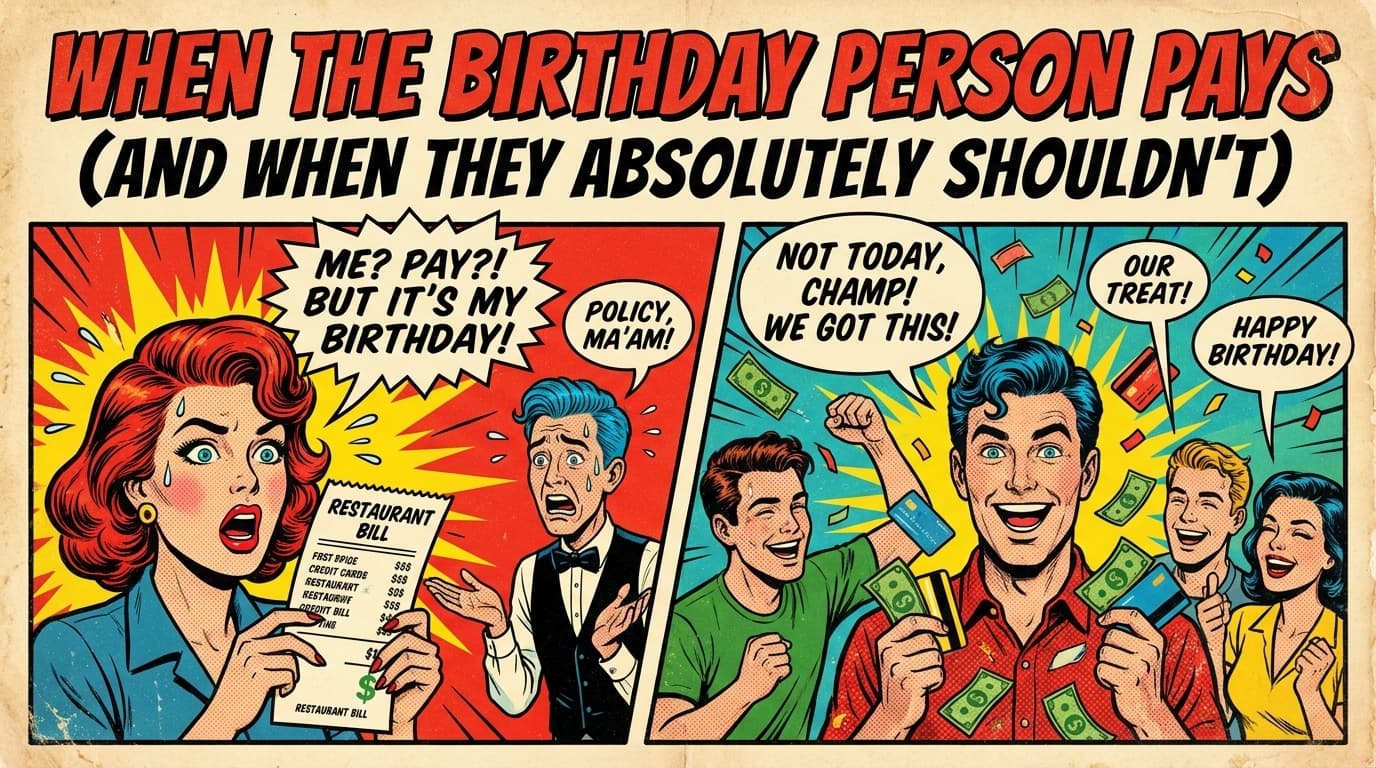
The moment everyone pretends not to notice the bill
It's your friend's birthday. Twelve people around a long table. Two bottles of wine, a round of shots, a shared dessert with a candle. The server drops the check in the middle of the table like a grenade nobody wants to touch.
Somebody laughs and says, "Well, it's their birthday, so I guess we got them?" Everyone nods. Nobody pulls out a card. The birthday person looks vaguely panicked.
Who actually pays here? Depends entirely on who set up the dinner and what was said before anyone walked in. Let me break it down.
The one question that decides everything
Before you get into etiquette, ask: who invited whom?
- The birthday person invited everyone to a restaurant they picked. They're the host. They pay, or at least signaled they'd handle it.
- Friends organized the dinner for the birthday person. The group pays. The birthday person's meal gets covered by everyone else.
- Nobody organized anything and it just happened. Split the bill like any other dinner, and someone can offer to cover the birthday person's share as a gift.
That's the whole framework. Everything below is how to apply it without awkwardness.
Scenario 1: The birthday person picked the spot and invited everyone
In older etiquette books, when you invite people to a meal, you pay. That rule still mostly holds for formal invitations.
But modern birthday culture is messier. Most "come to my birthday dinner" invites are casual, nobody assumes the birthday person is treating 12 people to a $90-per-head tasting menu. The default in 2026 is: everyone pays their own way, and the group collectively covers the birthday person.
The critical move here is being clear on the invite. If you're the birthday person, drop a line in the group chat:
"Dinner Saturday at 7. FYI, split the bill, I'm just excited to see everyone."
Or:
"My treat tonight, just come hungry."
Never leave it vague. Vague invites are how one person ends up with a $600 surprise bill and a lingering resentment.
Scenario 2: A friend organized the dinner for the birthday person
This is the cleanest case. One or two friends booked the reservation, wrangled everyone, and it's understood the birthday person is the guest.
Here, the rule is:
- Birthday person eats free. Their share is covered.
- Everyone else splits their own share plus an even cut of the birthday person's share.
- The organizer often fronts the whole bill and collects from everyone after.
If the birthday person's share was $80, and there are 10 other people, each contributes $8 extra on top of their own meal. Painless.
The script to run in the group chat beforehand:
"Dinner's at Luca. Let's all chip in to cover Sarah's meal, looks like it'll be around $15 extra per person."
Naming the number early means nobody's surprised. Nobody gets quietly elected as the finance committee.
Scenario 3: The casual birthday dinner
This is the most common version. No formal organizer. The birthday person texted "going to this place tonight, come if you want" and six people showed up.
Default: everyone pays their own way. If someone wants to cover the birthday person's drink or dessert as a gift, they do. If the group feels like collectively covering the birthday person, great, but it's not assumed.
The bad outcome is when half the table thought it was a "we're treating the birthday person" dinner and the other half thought it was a regular group dinner. The birthday person ends up split on who pays. Avoid this by having somebody, anybody, name the plan out loud before the bill arrives.
When the birthday person absolutely should not pay
There are a few situations where the birthday person footing their own bill is genuinely bad energy:
- A surprise party dinner. If friends sprung this on you, you are not paying. You're the reason everyone's here.
- A dinner where the organizer explicitly said "we're taking you out." That's a promise. Honor it.
- Someone ordered bottle service or a fancy round specifically "for the birthday." Whoever suggested the upgrade is paying for the upgrade. The birthday person shouldn't be stuck with a champagne tower they didn't ask for.
When the birthday person should absolutely pay (their own share)
Flip side. These are the cases where insisting on free birthday meals crosses into entitled:
- You picked a $200-per-head restaurant and 15 people came. You cannot reasonably expect the group to cover a $3,000 bill for your birthday.
- The group collectively covered a gift already. A group gift plus a free meal plus free drinks is a lot to ask.
- You've been the birthday person at four group dinners this year and never reciprocate. Birthday culture is a rotation. If you're always the receiver and never the cover-for-someone-else, the group notices.
The "who pays for the cake / bottles / shots" question
Side-purchases at birthday dinners get weird. The easy rule:
- Whoever ordered the extra thing is responsible for it, unless the table agreed first.
- Group-voted splurges (a bottle of champagne for a toast, a shared dessert with a candle) get split among the people who voted yes.
- A gift from the waitstaff or restaurant (free dessert for the birthday person) is free for everyone.
Do not let one person order a $180 bottle of Pinot for the table without asking if everyone wants in. That's a fast way to leave dinner mad.
How to settle it without killing the vibe
Before the dinner, one person, usually the organizer, says clearly in the group chat:
"Plan is everyone pays their own way, and we'll split Sarah's share. Probably $15-20 extra per person. Cool?"
Thumbs-up from everyone. Done. The bill stops being a negotiation.
After dinner, the organizer fronts the bill and sends one request per person. A receipt-scanning app handles this in about 30 seconds, proportional tax and tip included. No math at the table. No passing cards around.
TL;DR
- Who invited whom decides who pays. Host invites = host pays. Group organizes for birthday person = group covers.
- Don't leave it vague. Whoever's running point says the plan in the group chat before dinner.
- Surprise parties = you're not paying. Casual "come if you want" birthdays = default to splitting.
- Birthday person covers their own share at expensive spots they picked, and stays aware that always-receiver is a look.
- One person fronts the bill, splits with an app. Nobody's doing math at the table, nobody's the group's accountant for 40 minutes.
Frequently asked questions
Does the birthday person have to pay for their own meal?
It depends on who organized the dinner. If friends set it up as a treat for the birthday person, the group covers their meal. If the birthday person invited everyone to a casual hangout, the default today is everyone pays their own way. The key is clarifying this in the group chat before the dinner, not figuring it out when the bill arrives.
How much should each friend chip in to cover the birthday person's share?
Divide the birthday person's expected share by the number of people covering. If their meal and drinks come out to around $80 and there are 10 friends, that's $8 extra per person. At fancier restaurants it might be $20-30 per person. Name the rough number in the group chat before the dinner so nobody is surprised.
Is it rude to expect friends to pay for your birthday dinner?
Not if it's kept reasonable and the group's on board. It's rude if you picked a $200-per-head spot without checking, or if you always take without ever contributing to someone else's birthday. Birthday dinner culture works on rotation, everyone pays in over time.
What if I can't afford to contribute to a friend's expensive birthday dinner?
Say so early, before you RSVP, not when the bill arrives. A quick 'I'm in but keeping it light tonight, can I skip the group bottles?' is completely fine. Most friends would rather have you there on a budget than have you ghost the dinner or get resentful after.
Who pays for the cake or surprise bottle at a birthday dinner?
Whoever ordered it, unless the group agreed first. If the table collectively decided to get champagne for a toast, split among everyone who voted yes. Restaurant comps like a free birthday dessert are a gift and nobody pays. Don't let one person order a $180 bottle for the table without checking first.